
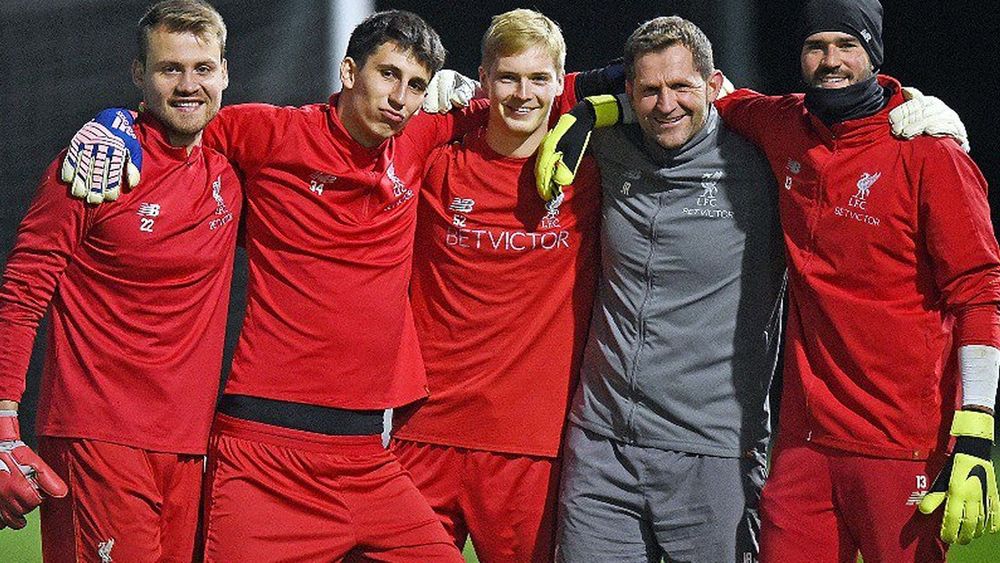
Initially working with younger players, the Dutchman progressed into the senior set-up and became first-team goalkeeper coach in 2011. He remained through four managerial regimes, witnessing the club’s difficult early years, its gradual rebuilding and the extraordinary success that followed under Jürgen Klopp.
For Achterberg, however, the achievement was about more than the silverware. His greatest satisfaction came from the daily work of developing goalkeepers and helping them establish careers at the highest level.
“I think being 15 years at a club like Liverpool is kind of a dream for a lot of people," he tells Football Presse. "As a goalkeeper coach, you want to achieve the highest level, and obviously I got that chance.
“You have to be good at your job as well to stay that long at the club. I enjoyed every day working with goalkeepers. I want to create good goalkeepers, help all the goalkeepers to make a career, and I always try to be on the front foot as a coach, helping them develop and looking at what is needed for the games.
“I also did a lot of recruitment with goalkeepers, watching games and looking at who was around in all the major competitions, whether there was new talent coming through and things like that, so I could stay up to date.
“It was a great experience to be there. You have a lot of highs and lows.”
From financial uncertainty to a new beginning
Achterberg's Liverpool story began during a turbulent period. He arrived before Fenway Sports Group completed its takeover in October 2010, and remembers the contrast between the club's early difficulties and the improvements that followed.
“In the start you had more lows because the club was not financially in a good place. Then they got taken over by Fenway, and everything improved. The team improved as well.”
The change in ownership provided the beginning of a new chapter, although the journey towards competing consistently for the biggest honours would take time. Achterberg remained through the managerial changes involving Roy Hodgson, Kenny Dalglish and Brendan Rodgers, eventually becoming an established member of the first-team coaching staff.
One of the most memorable periods before Klopp's arrival came under Rodgers, when Liverpool came close to winning the Premier League title in 2013-14.
“We had one really good year with Brendan Rodgers, when we had Luis Suárez, Coutinho and Sterling up front. We had a really good front four and we were close to winning the league.”
That campaign gave Liverpool supporters a glimpse of what the club could achieve, but the title ultimately eluded them. For Achterberg, it was an important high in a period that had contained plenty of uncertainty.
The next managerial change would prove even more significant.
Klopp changed the atmosphere around Liverpool
Liverpool appointed Klopp in October 2015, beginning a relationship that would eventually deliver the club's first Premier League title and a Champions League triumph, among other major honours.
Achterberg had a close-up view of the transformation, not only in the team's performances but also in the relationship between the club and its supporters.
“When the manager changed to Klopp, from that moment everything improved in the whole club. The supporters got more belief and they became more behind the team, staying with the team.
“The way Klopp made the team play football improved the whole atmosphere around the club. Then obviously we had good success, winning trophies. We probably could have won more trophies as well, but we won nearly every trophy once, so that was great.”
The scale of the change was reflected in the football. Liverpool developed into one of Europe's leading sides, reaching successive Champions League finals before winning the competition in 2019. The following season brought the Premier League title, ending the club's 30-year wait for a top-flight championship.
Achterberg remembers the quality of the squad assembled during those years and the intensity with which it played.
“We had so many good players. It was an enjoyable time to watch them play, the way they worked, the intensity they played with and the creativity they had.
“Everyone paid money to watch that team play. I think for two or three years we were one of the best teams, if not the best team in the world at that time.
“We won one Champions League, but we probably could have won two at least. Sometimes in football you don't always get what you deserve because there are a lot of other good teams. Decisions can make the difference in the end, whether you win or not. It can be referee decisions, injuries or not taking your chances. That is part of football. You have to deal with it.”
That perspective also shaped his response when asked to compare two of Liverpool's most painful moments: Steven Gerrard's slip against Chelsea in 2014 and the goalkeeping errors associated with Loris Karius in the 2018 Champions League final.
“I'm not a guy who looks back on one moment. A season goes over many, many games and you know mistakes will happen from any individual. You always have to respect each situation and deal with it.
“As a team, we win together and we lose together. That's all I want to say about it.”
The careers behind the trophies
While the success of Klopp's Liverpool side brought global recognition, Achterberg's own measure of satisfaction remained closely connected to the goalkeepers who passed through his hands.
He worked with a succession of senior professionals, including Pepe Reina, Simon Mignolet, Brad Jones, Karius, Alisson Becker, Caoimhín Kelleher and Adrian. His approach was to create an environment in which every goalkeeper understood their importance, regardless of their position in the selection order.
“They were all good guys and they all worked really hard. You always try to create a good goalkeeping group between each other, so they respect one another and understand their positions.
“You treat them all the same because you need them all. If one is having a problem, the other one has to fill in. I always found it really enjoyable to work with them and help them, but treating them the same is really important if you want to get the most out of them.”
Alisson's arrival raised the standard further, while Kelleher provided competition of a level that Achterberg felt was exceptional.
“It was great when Ali came to the club. You could see the level he brought, the quality, the power and the speed. We probably had the best goalkeeper squad over those last few years, with Kelleher and Adrian as well.
“If you see the speed, movement and reactions of Kelleher, you basically have two number-one goalkeepers. With Ali being probably the best in the world, it wasn't easy for Kelleher to always be number two, but he respected the situation because he could also see how good Ali was and still is.
“I couldn't have been happier with the situation. Adrian moved back home to Betis Sevilla after getting an offer there, and that's part of football. It was an enjoyable time to work with them and help them, but in the end the goalkeepers have to do it on the field. They need to get the credit for what they show.”
The development of younger goalkeepers and the opportunities they found elsewhere were just as important to him. Achterberg took pride in seeing Kamil Grabara, Danny Ward and Péter Gulácsi move on to bigger opportunities and establish themselves in European football.
“For me, it's about developing goalkeepers more. It's good to see keepers like Alisson and Kelleher, and then you have Jaros, Harvey Davies and Marcelo. We also sold Grabara, and had Danny Ward and Péter Gulácsi. They were all good goalkeepers who made good careers.
“We had loads of goalkeepers who went on to make a good career, and that is even more enjoyable for me. I've worked with so many goalkeepers at Liverpool, and it's great that most of them have gone on to have really good careers.
“I also enjoy it when we sell Grabara and Danny Ward for good money, and when Gulácsi goes to bigger teams and makes a good career in Europe. That is the passion and enjoyment you need to have.”
Achterberg's Liverpool chapter ended in 2024, alongside Klopp's departure, bringing his 15-year association with the club to a close. He moved to Saudi Arabia to join Steven Gerrard's coaching staff at Al-Ettifaq, embracing a new challenge after what he described as the best period of his life.
“It was probably the best time of my life, but everything is good here. I enjoy working with the goalkeepers. I could work anywhere with goalkeepers because improving them is my passion. I always try to develop the young ones and take young players with the first team to improve them.”
Fifteen years at Liverpool had taken Achterberg from a club struggling financially to one that had conquered England and Europe. The trophies were a defining part of that journey, but his own lasting satisfaction came from the people he helped along the way.