
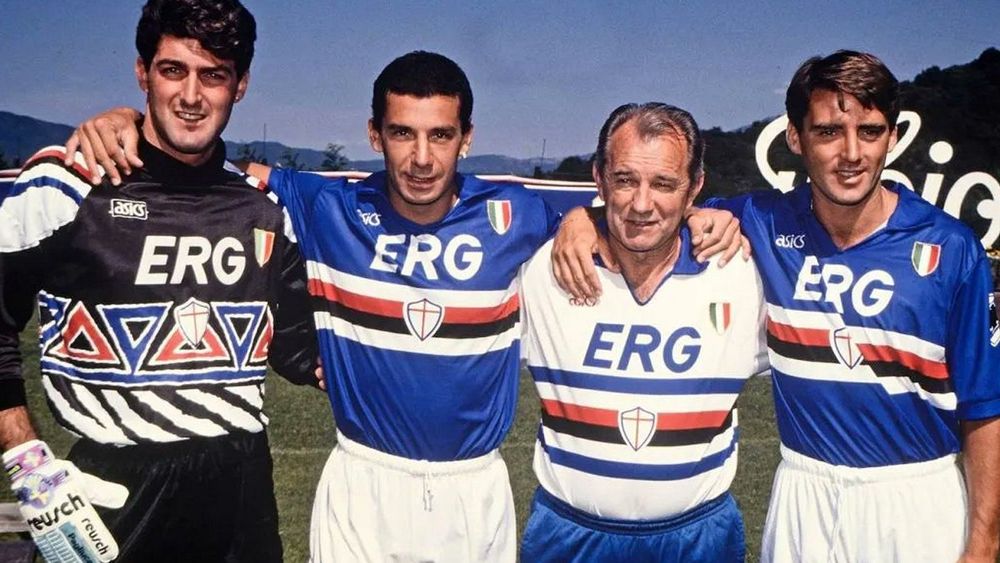
But for Marco Lanna, the greatest achievement of that extraordinary generation was the bond they shared, a friendship so powerful that he dreaded the end of the summer holidays.
There are football teams remembered for the trophies they won, the goals they scored and the great players who wore their shirts. Then there are teams remembered for something much harder to measure: the feeling they created.
For Marco Lanna, Sampdoria's remarkable generation of the late 1980s and early 1990s belonged to the latter category. They won the Italian championship, conquered Europe and established themselves among the continent's elite. Yet, when Lanna reflects on what made that team so special, his thoughts return not to the celebrations or the silverware, but to the people with whom he shared the dressing room.
A dressing room built on friendship
“I think what was special about that group was that we were genuinely a group of friends and real men,” he tells Football Presse. “I believe the president did a tremendous job because, before signing players, he looked at the men. He created a group that really couldn't go wrong.
“We were very united as a team. We were few in number. In the end, the first-team squad consisted of 18 players, plus two from the youth team. It was a team built over time, but during that time we developed relationships that became incredibly strong.
“That bond meant everybody played for everybody else. We never gave up. If somebody needed help, we helped each other. In difficult moments, we would talk things through as if we were a family.”
It is an extraordinary description of a dressing room that contained some of the most recognisable names in Italian football. Gianluca Vialli, Roberto Mancini, Gianluca Pagliuca and Pietro Vierchowod were among the personalities who helped define an era, while Lanna, a Genoa-born defender who had grown up supporting the club, was living a dream few footballers experience.
His journey was not one of immediate stardom. Coming through Sampdoria's youth system, he entered a first team populated by established internationals and players whose reputations had already been made. Even finding a place in the defence was a considerable challenge.
Learning alongside giants
“I came from the youth team, so I was the young lad trying to break into the first team, and I had some real giants in front of me,” he recalls. “As defenders, Pellegrini, Mannini and Vierchowod were a trio who were very difficult to dislodge. The competition was extremely high.
“But it helped me enormously to grow and improve. I watched how they moved and what they did. I used their experience to build my own.
“The expectations and responsibilities were enormous, so I had to grow up quickly. But it wasn't difficult in the sense that I was left alone. It was a group that helped you. They understood the difficulties a young player could have when coming into the first team and playing important matches. They helped me in every possible way.”
That generosity towards a younger teammate says much about the culture Lanna describes. There was no need for an enormous squad or a constant turnover of players. The group developed together, learned to trust one another and shared an ambition that had been placed before them by a president with a dream.
Paolo Mantovani wanted to take Sampdoria to the summit of Italian football. Under Vujadin Boškov, they achieved it, winning the 1990-91 Serie A title, the club's first and still its only Scudetto. They had already won the European Cup Winners' Cup in 1990, defeating Anderlecht in the final, and would reach the European Cup final at Wembley in 1992.
For Lanna, winning the championship carried an additional significance. He was not simply a footballer collecting a medal. He was a local boy celebrating with the club he had supported since childhood.
A boyhood dream fulfilled
“I'm from Genoa, so winning at home is not easy. It isn't something many people manage to do,” he says. “Winning with Sampdoria, a team that wasn't considered one of the big clubs at that time, and then becoming one of the big clubs, was fantastic.
“Being a prophet in your own country is never easy. To have achieved that was a dream come true for me.”
Yet the trophies only tell part of the story. Ask Lanna what it was actually like to live inside that dressing room and his answer becomes even more revealing.
“I used to go to bed at night and couldn't wait to get up the following morning to go training. When summer came, I couldn't wait for the holidays to finish so I could go back into pre-season training.
“That is something that never happened again during the rest of my career. That tells you what that group was like.
“We were so happy together that the training camps, the hard work and the difficult matches were a pleasure to face because we were facing them together. We had that unity of purpose. We were genuinely a magical group.”
It is difficult to imagine a more powerful description of collective belonging. Footballers routinely talk about togetherness, but Lanna describes something much deeper: a workplace he genuinely missed when he was away from it. The friendships were not confined to matchdays, victories or the celebrations that followed a trophy. They were part of everyday life.
What today's football is missing
And it is precisely this quality that makes his comparison with modern football so interesting. Lanna believes that the game has lost some of the commanding personalities who once shaped teams from within. When discussing Vialli and Mancini, he identifies a combination of technical quality, strength, ambition and leadership that he rarely sees replicated today.
“Luca and Roberto were probably the best partnership of those years, and even beyond that period. They combined technique with strength and an enormous desire to win. They were charismatic players, people who pulled others along with them. They were genuine leaders on the pitch.
“I believe they would do exactly the same things today. The technique and quality they possessed are qualities that many forwards are missing at the moment. And that ability to lead on the pitch is something I don't see in today's football. I honestly don't see players like them.”
It is not simply nostalgia for an era when Italian football was producing exceptional talent. Lanna's argument reaches back to the very philosophy that created the Sampdoria dressing room: outstanding footballers mattered, but the people behind those performances mattered just as much.
The club's golden generation was built on the belief that talented individuals could become something greater when they trusted one another. Lanna experienced that transformation as a young defender learning from his heroes, then as a champion celebrating with friends who had become family.
He would later return to Sampdoria as president, facing a very different challenge, with the club approaching the brink of bankruptcy. That experience, he admits, was considerably harder than playing. His connection to the club, however, has never diminished. He still hopes to contribute to its future and wants to see it return to the position it once occupied.
Perhaps that is why his memories of those extraordinary years remain so personal. The trophies belong to Sampdoria's history, but the friendships belong to the men who lived them.
And for Lanna, there is one memory that says more about that team than any medal ever could: the feeling of looking forward to Monday morning, even after a weekend of football, and wishing the summer away simply to be back alongside his teammates.