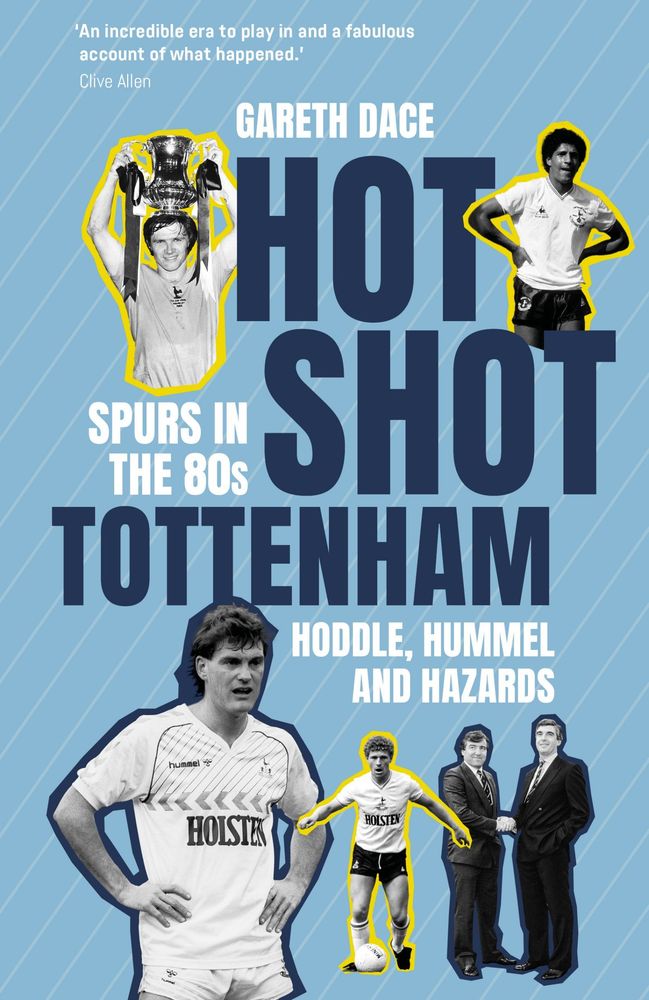
Scholar is remembered by many Tottenham Hotspur supporters for the financial problems that engulfed the club at the end of the 1980s.
Gareth Dace believes that is only half the story.
The author of "Hot Shot Tottenham", the history of Spurs during the transformative 1980s, argues Scholar was one of the great visionaries of English football – a chairman who understood the commercial potential of the sport long before many of his contemporaries.
"He was this visionary, not just for Tottenham but for English football," Dace told Football Presse.
"He really dragged English football through its darkest period in the mid-'80s and had this vision for how it could promote itself, how it could be better at enticing more people to football, how it could be better at enticing an international audience to English football."
It is an intriguing reassessment of a man whose tenure at White Hart Lane remains fiercely debated.
Scholar took control of Tottenham alongside businessman Paul Bobroff in 1982, arriving at a club that had already re-established itself among England's leading sides under Keith Burkinshaw.
His ambition went considerably further.
"He wanted Spurs to be English and European champions," Dace said.
"He wanted them to play with swagger and to be signing the best players."
The commercial transformation of football that Scholar envisaged now looks familiar.
Television rights, sponsorship, corporate hospitality and international audiences are fundamental to the modern game. In the early 1980s, however, English football was still operating in a very different commercial environment.
Dace believes Scholar recognised where the sport was heading.
"Scholar wanted people to understand the value that football had commercially," he said.
"Certainly with television, with sponsorship, with outside and potential fan bases across the world."
That international vision is particularly striking when viewed from outside England.
Dace, who was born in Enfield in 1981 and grew up as a Spurs supporter from 1988, researched the decade through interviews with former players and supporters. His conversations also gave him a wider understanding of just how isolated English football had become internationally.
"Scandinavia was really a bit of an outlier," Dace explained. "For the rest of the world that was interested in European football, it was France, Germany, and more particularly Italy, which were the leagues that people wanted to watch."
Scholar wanted English football to compete for that attention.
"He didn't necessarily just drag Tottenham into the modern day when he took over the club," Dace said.
"He dragged Tottenham into the future."
That is perhaps the strongest argument for reassessing Scholar's legacy.
Dace believes many of the ideas now considered normal within the football business can be traced back to the thinking of chairmen such as Scholar.
"All the things that we recognize as being the norm in terms of the business of football these days, it comes back in some way to Irving Scholar," he said.
"And whether that's for a good thing or a bad thing, that is almost entirely down to him and the vision that he had."
The problem was not necessarily the ambition.
It was the execution.
Scholar became increasingly involved in footballing decisions and developed difficult relationships with key figures inside the club, most notably Burkinshaw.
"He was the proverbial kid in the sweet shop who had the keys to the shop," Dace said.
"And whereas chairman and directors prior to Scholar had been almost invisible, Scholar wanted to be in the dressing room, he wanted to be mates with the players, he wanted to have a say in team selection and who the manager was buying."
That inevitably created tension with a manager who had already delivered two FA Cups and was building one of the most admired teams in Europe.
"Him and Keith Burkinshaw were always going to clash," Dace said.
Scholar eventually turned his attention towards Terry Venables, believing a new managerial direction could take Tottenham to the league title.
"He really went on a beeline to get Terry Venables to come in, and he thought that would be it," Dace explained.
"He thought, 'I'll get Venables in, he's going to win the league championship with us.'"
But the relationship between chairman and manager proved complicated.
"Scholar and Venables clashed," Dace said. "They had disagreements over the type of players that they needed to buy."
At the same time, the financial foundations of Scholar's Tottenham were beginning to weaken.
The club's status as a public limited company added another layer of responsibility, while wider economic forces made the situation increasingly difficult.
Dace points specifically to the 1987 stock market crash, which damaged the value of shares, as one factor among several that affected Tottenham.
"Different market forces had an impact and a negative effect on the club," he said.
But there were also decisions that alienated supporters.
The redevelopment of the East Stand, including corporate boxes, became particularly controversial among the traditional fan base.
"He alienated the fan base with the rebuild of the East Stand or the Shelf, which is the famous side of White Hart Lane," Dace said.
"When corporate boxes were put in there, I think that really lost the majority of the fans."
Eventually, the financial crisis caught up with Scholar's ambitions and Tottenham entered the 1990s in a dramatically weakened position.
Dace does not absolve Scholar of responsibility.
"Ultimately he's the number one at the club, so he ultimately has responsibility for it," he said.
But he believes history should recognise the external pressures and the scale of Scholar's ambition rather than reducing his tenure to the club's financial problems.
"He was badly let down, I think, by business partners that he had at Spurs," Dace said.
"He wasn't able to form the key relationships that he needed to."
That complexity is what makes Scholar such an important figure in Tottenham's history.
His vision was not necessarily wrong. In many respects, it was remarkably prescient.
The commercial revolution he anticipated would eventually transform English football, while Tottenham's modern identity as a global football brand is built around many of the principles he recognised in the 1980s.
But the man trying to drag Tottenham into that future could not successfully manage the footballing, financial and human relationships required to get there.
That leaves Scholar with a particularly unusual legacy: a chairman whose ideas may have been ahead of his time, but whose execution helped leave Tottenham behind at precisely the moment English football was about to enter its most lucrative era.
Gareth Dace is author of "Hot Shot Tottenham: Spurs in the 80s – Hoddle, Hummel and Hazards" from Pitch Publishing - which is available here.