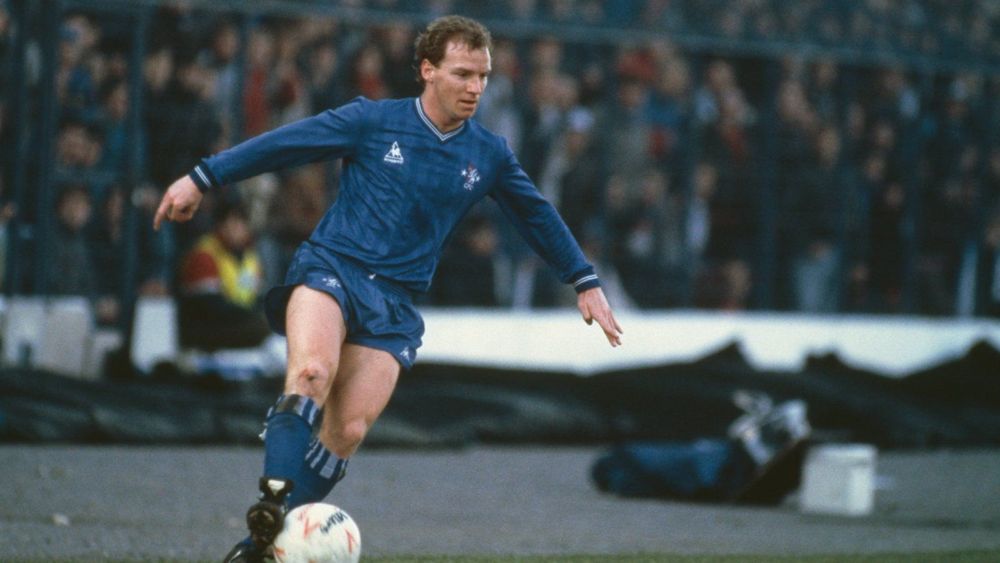
His five years at Stamford Bridge began with a decision influenced by something as simple as the colour of the shirt. What followed was a memorable partnership with Kerry Dixon, a friendship forged after an early confrontation, and a place in a Chelsea side that transformed its fortunes under John Neal.
But Speedie's memories extend beyond the football. He remembers the characters around him, the different atmosphere of the old Stamford Bridge and even the unusual Friday routine that took the players onto the pitch before every home game.
Why Chelsea? A move to remember
"I had the opportunities to go elsewhere, but I chose Chelsea because they played in blue and my dad was a Rangers supporter and they play in blue," Speedie recalled to Football Presse.
"There was a couple of other clubs, but I didn't speak to anybody. It was just Chelsea. That was the main club for me."
There was also a significant adjustment waiting for the young Scot. Moving from Darlington to London meant entering a completely different environment, both professionally and personally.
"It was a massive transformation. Living in London is not the easiest thing to do. It takes you an hour longer to get to places than it would normally.
"Everything's full speed ahead. Compared to up north, it's a bit more laid back. You never adjust to that. You don't know what's coming from one day to the next, so you try not to think about it."
John Neal, the manager who understood his players
On the football side, however, Speedie found a manager and an assistant who helped make the transition easier.
He did not know Neal particularly well before arriving, but the presence of fellow Scot Ian McNeill, the assistant manager, offered a familiar connection.
"My dad liked him," Speedie recalled.
Neal would prove instrumental in building the Chelsea side that returned to the First Division in 1984. His understanding of the players and, particularly, how to get the best out of his attacking partnership became a defining part of Speedie's experience.
Kerry Dixon: From early confrontation to best friends
The relationship with Dixon, though, did not begin particularly harmoniously.
Asked why the pair had struggled to see eye to eye initially, Speedie's response was characteristically direct.
"Because he's f***ing lazy! I did all the running."
There was even a physical confrontation during their early days together.
"Oh yeah, we had a little scuffle once when he first came."
It took Neal to recognise that the two forwards were approaching their jobs differently and explain how their respective qualities could complement one another.
"And then John Neal, the genius of a man, explained to us what I do and what he does as magic.
"And that's when we became best of friends."
It was a relationship that survived their playing careers. Speedie confirmed that they remain close and still make appearances together, including a planned engagement in Bournemouth and Poole.
"We are, yeah," he said when asked whether they were still friends.
Dixon and Speedie became one of the most recognisable strike partnerships in Chelsea's history, with Pat Nevin completing an attacking combination that helped bring excitement back to Stamford Bridge.
For Speedie, the importance of Neal's intervention was that he understood the different qualities of his forwards rather than expecting them to play in the same way. What initially appeared to be a source of friction became one of the team's greatest strengths.
The old Stamford Bridge and its Friday routine
The surroundings in which that football was played were also very different from those supporters experience today.
The old Stamford Bridge still had its running track around the pitch, creating a physical distance between the players and the crowd. Yet Speedie remembers another aspect of the stadium that is less likely to be familiar to modern supporters.
"We used to train there on a Friday. Every home game we trained at the back of the pitch."
It was not simply a case of turning up for a few sprints before heading home.
"No, we had a game. Your five-a-side game behind the nets, and do all the training, a few sprints and stretching.
"It was never a hard session on a Friday. It was always laid back and just preparing for the game on Saturday."
The running track inevitably affected the relationship between the supporters and the action on the pitch, although Speedie does not necessarily regard it as the biggest problem with the old ground.
"Yeah, when it's more enclosed, it's obviously better atmosphere."
He has also been impressed by the transformation of the stadium since his playing days.
"Today's stadium is amazing."
Why Speedie eventually left Chelsea
Speedie's five-year spell at Chelsea eventually came to an end in 1987, when he moved to Coventry City. His departure was not simply about looking for another challenge or taking a step up.
He was ready for a change in management.
"I needed to get away from the management team at Chelsea at that time."
That meant John Hollins, whom Speedie was careful to distinguish from his assessment of the manager.
"Nothing against John Hollins, he was a great guy, but as a manager he wasn't that good."
It was an honest assessment from a player who had experienced the best and worst of football's personalities, but it did not diminish his affection for the club or the importance of those years.
Speedie had arrived from Darlington as a young forward who simply wanted to play for Chelsea. He left having helped establish a formidable attacking combination, experienced a remarkable dressing-room friendship with Dixon and played under a manager he remembers with considerable admiration.
His recollections are of a football club where individual personalities mattered, where different styles could be brought together and where a Friday five-a-side game behind the Stamford Bridge nets was part of the preparation for another Saturday afternoon.
The running track might have separated the players from the supporters, but the characters inside that Chelsea team helped bring the club closer to a brighter future.
The David Speedie Story by David Speedie and Paul Hodgson is available now.