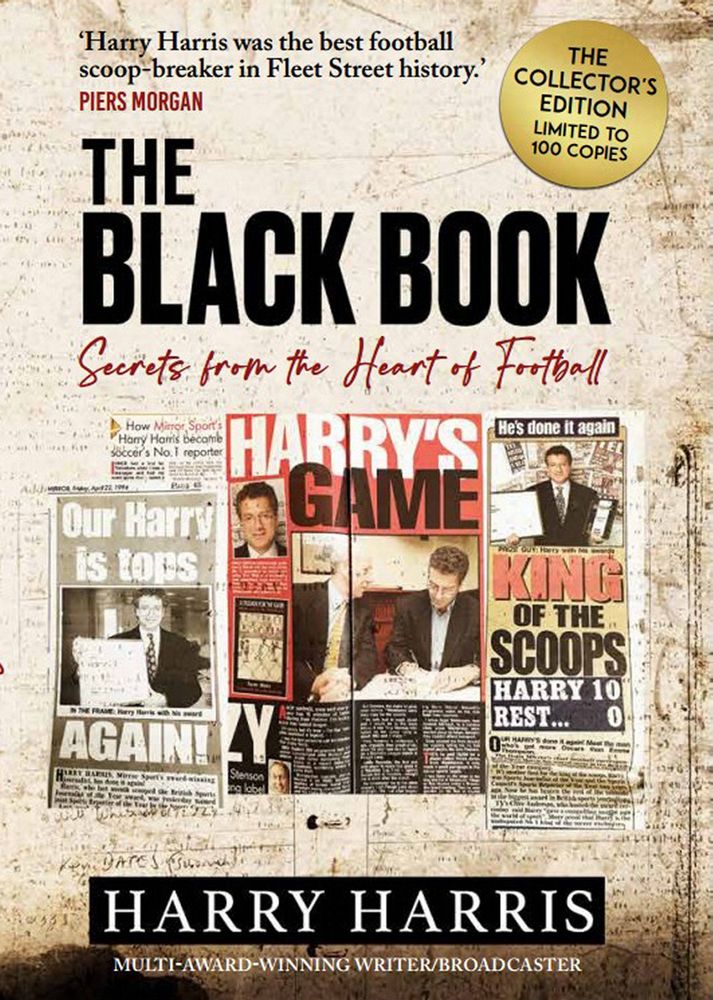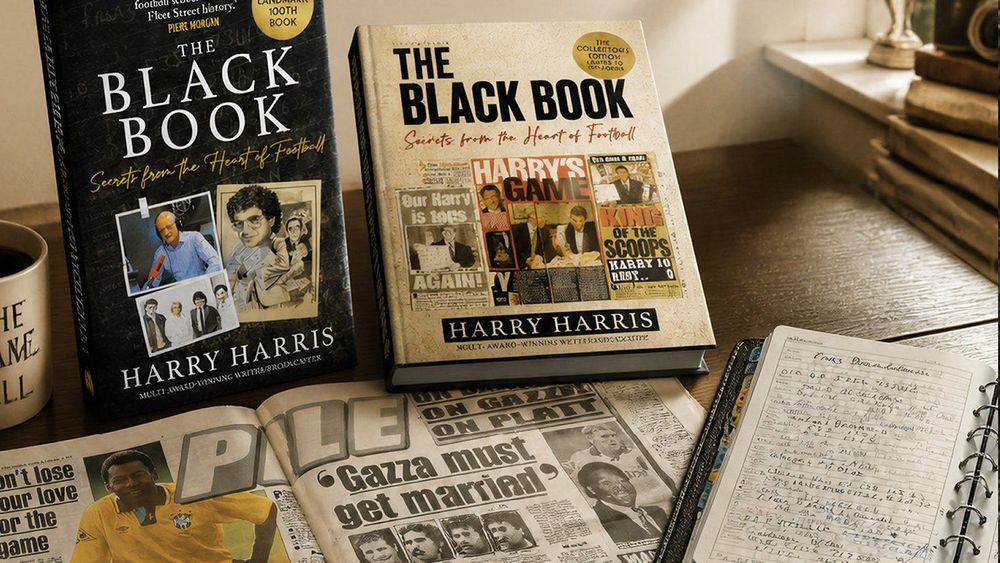
In his 100th book, "The Black Book", he finally explains how some of them happened — and why his reward was sometimes the exclusive itself.
For Harris, the payoff for helping a football transfer happen was never money. It was the headline that followed.
The veteran journalist, whose career spans more than five decades, has worked at the heart of football through an era of extraordinary change. As chief football writer of the Daily Mirror for more than 18 years and subsequently the Daily Express for eight, he broke major stories, investigated football's murkier dealings and built a network of contacts that became the foundation of his work.
Harris has won 24 industry awards, including the British Sports Writer of the Year title twice, and twice been named winner of the Sports Story of the Year award. His scoop revealing Roy Keane's departure from the Republic of Ireland squad before the 2002 World Cup was among the stories that demonstrated the value of those relationships.
Now, in "The Black Book: Secrets from the Heart of Football", his 100th book, Harris is explaining how the headlines were made.
“I think it's because I've decided now was the time because I've been keeping a lot of secrets from a lot of people over a long period of time about how a lot of major headline news came about," Harris tells Football Presse.
“A number of them are dead, so they can't sue me anymore. And it's been such a long time now, I don't think it really is something they're going to take issue with. So I thought the time was right now to reveal all. To tell the truth about what was going on behind the scenes.”
The book runs to nearly 500 pages, almost 200,000 words and 200 photographs. Harris says there is only one story in which he has withheld the names of the people involved, because both men are still alive and would not welcome their identities being revealed.
The rest draws on a lifetime of experience in which the ability to keep a confidence could be as valuable as the ability to get a story into print.
When the story was the reward
The title comes from Harris's extraordinary collection of contacts, accumulated in an age before Google, mobile phones and social media made information so readily accessible. His black book contained numbers for people who trusted him enough to share information — and that trust sometimes put him in a position where he became part of the story he was reporting.
He recalls a transfer involving a chairman who trusted him and wanted the deal kept off the record until it was completed.
“So back then, a chairman rings me up, and this is off the record. But when or if this transfer goes through, clearly my payment is not in cash or an envelope. It's the story. It's the headline.
“I don't want to be paid like a football agent, although I could make a case for that. I just want the story. And that was the deal.”
Harris was talking to the player on behalf of the club, but a major rival was offering incentives that went beyond the player's own contract. He describes arrangements involving benefits for relatives, from a new home for a father to a car for an uncle and other rewards for family members.
The chairman's complaint was that trying to operate honestly could leave his club unable to compete.
“He said, look, I want to deal honestly in football. I want to be an honest broker. I want to keep within the rules.
“But it's not sustainable because I will not sign a player. I will not get any player into my football club. And I can't compete because the other, my rival, whatever I say, if I say, right, this player, his mother can have a house, his dad can have a car, whatever it is, they're going to trump it.”
It is an insight into the business of football that extends beyond the transfer fee announced publicly. Harris's account is about the private negotiations and competing interests that can determine where a player ends up — and the journalist's role in bringing those arrangements into the open.
The dangers behind the headlines
Harris's willingness to pursue a story also brought him into conflict with people who had powerful reasons to stop him.
During the 1990s, he investigated alleged wrongdoing in football, tracing paper trails and facing repeated legal threats. Asked how often his work had brought him close to danger, his answer was blunt.
“All the time. I mean, legal action was the key to slowing me down or trying to stop me altogether. And I could paper the wall with the number of writs I've received over a period of time.
“You know, and I've also had physical threats.”
One episode in the book arose from his work with an investigative team at the Daily Telegraph. Harris spent nearly two years working alongside the journalists, examining potential criminal activity at football clubs, and eventually helped with their investigation into the death of Emiliano Sala.
He recalls the anger of an agent connected to the arrangements for Sala's tragic journey, who demanded to know who was supplying information and went to the newspaper's editor to insist Harris be removed from the investigation.
The confrontation escalated when a man connected to Cardiff City was followed to a coffee shop in north London. The Metropolitan Police investigated but did not consider the incident a realistic threat to life and did not make an arrest.
For Harris, such episodes are part of the reality of pursuing uncomfortable stories. He does not present investigative journalism as a glamorous exercise in breaking news; his account reveals the personal pressure that can accompany the work.
An East End upbringing
Asked if there ever a point when the danger persuaded him to leave a story alone, Harris was adamant.
“No, no, no, no, no, no, no. I was brought up in the East End by Chapel High Road.”
Harris recalled growing up near the Kray family, whose name became synonymous with organised crime in London's East End. It was a reference to his background as he explained why intimidation had never been enough to make him abandon an investigation.
"I came from the East End, proper East Enders. Yeah, it takes a lot to move the dial on intimidation.”
The remark provides a glimpse of the man behind the byline: someone whose approach to pressure was shaped long before he became one of the most decorated football writers of his generation.
But Harris is equally clear that persistence alone does not produce an exclusive. His advice to aspiring journalists returns to the principle that underpins the book — the importance of relationships and the confidence that sources place in a reporter.
“Honesty, integrity, and transparency is the key ingredients. You know, you've got to gain people's trust if you want to get a big story.”
That trust is the thread running through "The Black Book". It explains how Harris accumulated the contacts that opened doors, why some of football's most significant stories began with conversations that could not immediately be reported, and why he believes their origins are worth recording now.
He hopes readers will find both the humour and the historical significance in the episodes he has chosen to reveal.
“I couldn't help but amuse myself by some of these stories. And I hope that's what the reader finds, that there's a combination of very amusing stories, but also very important stories about how they occurred at that time and what we can learn from them when you apply it now.”
After 99 books about other people, Harris has finally turned the attention on himself. His 100th is an account of the relationships, risks and decisions behind a lifetime of football journalism — and of the stories that, until now, he has kept to himself.
Harry Harris is author of "The Black Book: Secrets from the Heart of Football" from Legacy 11 Books - which is available here.