
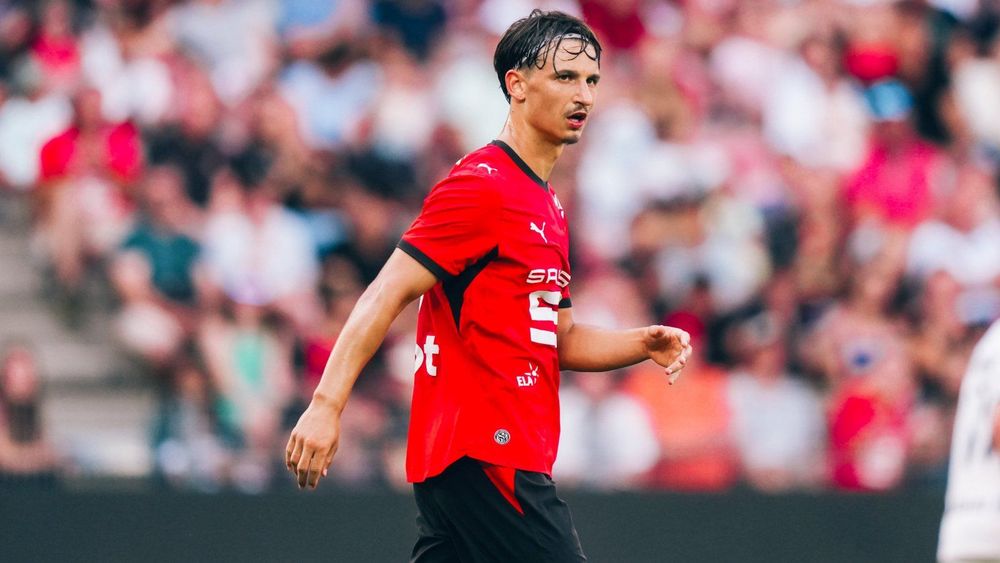
"It's a different profile from what we usually see," the new France coach said of his most eye-catching selection. "I like these profiles, in tight spaces — they're interesting against teams that sit deep, these are players who interest me and that I want to see up close. We've picked him apart, he scores goals."
It was a call-up so unexpected that Lepaul himself called it "madness" in a video shared by his club, Stade Rennais. It came inside a squad list built to look nothing like Didier Deschamps' final years in charge: five new faces in total, N'Golo Kanté and the Hernández brothers left out, Aurélien Tchouaméni absent only through injury. Kylian Mbappé retained the captaincy regardless.
Lepaul had never been picked for a single youth national team, not even once, at any age group. Team-mates from his generation at Olympique Lyonnais's academy — Amine Gouiri, Pierre Kalulu, Maxence Caqueret — were long since established in Ligue 1 or abroad. Lepaul, rejected by that same Lyon academy as a boy, spent his early twenties shuttling between Championnat National and National 3 with Épinal and Orléans, two divisions below the level his contemporaries were playing at.
Xavier Collin, who coached him across two spells at Épinal, has watched the rise from close range.
"Very happy for Esteban, who's continuing on from last season, when he started really well," Collin said following the call-up — a coach's understated way of describing a run that has taken a National-level forward to the country's senior team inside two and a half years.
The story carries extra weight because of Lepaul's father. Fabrice Lepaul was himself a promising winger who broke into Auxerre's first team before a road accident in 1997 left him with a short coma and broken ribs, ending his career early. Fabrice died in another road accident in May 2020, at a point when his son had no club at all. Informed of his call-up on Friday, Esteban's first reaction wasn't for himself.
"I thought of my dad first," he said. The promise the two of them had made — that the son would reach the top of French football his father never quite got to — has now been kept twice over.
The acceleration, once it came, was rapid. Back at Épinal for the 2023-24 season, Lepaul finished as National's top scorer in the first half of the campaign, prompting Angers to sign him for a modest €150,000 in January 2024. Angers won promotion to Ligue 1 that same season — three divisions climbed in barely seven months — with Habib Beye, who managed him there before later taking over at Rennes, an early convert.
"It's really important for the club to have this type of player, who wants to keep developing and arrives with a big hunger," Beye said at the time.
Rennes signed Lepaul from Angers in August 2025; he finished his debut season as Ligue 1's outright top scorer with 20 goals.
Current Rennes head coach Franck Haise, who inherited him mid-project, has been equally direct about what Lepaul offers up front.
"Even though it will happen to him — and it already has — that he goes a few matches without scoring, Estéban is a goalscorer," Haise said during pre-season. "I hope he stays like that for a long time, because it's going to let him keep climbing the levels."
Lepaul himself has talked about the platform that trust has given him: "I feel completely free, I feel really, really good physically. I know there's a team that believes in me."
Not everyone saw this coming, but one voice came close. Back in May, when Lepaul's name first circulated as a wildcard for Didier Deschamps' World Cup squad, former Marseille defender Eric Di Meco argued on RMC's Super Moscato Show that domestic form alone wasn't enough.
"To come into the France squad, shining in Ligue 1 isn't enough for him," Di Meco said. "There are two, three or four levels of difference between what you can do in Ligue 1 and the national team."
But he left a specific door open: "If he keeps scoring next season and Rennes play Champions League or Europa League and he shines there, maybe we'll see him with Zizou."
Five months and a change of national coach later, that is almost exactly what happened. Christophe Dugarry, the 1998 World Cup winner, was blunter still at the time — "For me, he shouldn't go to the World Cup," he said on the same station, pointing out Lepaul hadn't even made Ligue 1's team of the season — and struck a similar note of caution once the actual Zidane call-up arrived in September.
"There's so much uncertainty that even for him this wouldn't necessarily be a good thing," Dugarry said. "Everything he's doing is very good — he's on a good trajectory, but he's still a bit green."
The news of his call-up reached him in the best possible company. Lepaul was with his Rennes team-mates when Zidane's list was read out, and the club's own footage shows the dressing room erupting around him as his name came up — as much their moment as his, after a first quarter of the season built in large part on his goals. Rennes' official statement afterwards captured the mood inside the building: "Symbol of hard work, of unshakeable will, the striker continues his irresistible rise."
The profile Zidane described — a threat in tight spaces against defences that sit deep — matches a player built more on movement and finishing instinct than pace or physical dominance. Data analysis run by L'Équipe this season placed him statistically closest to West Ham's Taty Castellanos and Bayern Munich's Nicolas Jackson: a penalty-box poacher who thrives on service rather than creating chances from nothing himself.
Watching him play backs that up — Lepaul does his most dangerous work in the six-yard box rather than drifting wide to beat a man, closer in profile to a classic, old-fashioned number nine than to the mobile, false-nine forwards France have tended to field in recent squads. He has carried that instinct into this season, with three goals in his first four Ligue 1 appearances after his 20-goal debut campaign.
Lepaul will get his first taste of that level in Turkey on 25 September and away to Belgium three days later, as Zidane begins his tenure with four Nations League fixtures either side of home games against Italy and Belgium at the Stade de France. For a player who spent his early twenties wondering whether professional football would happen for him at all, four matches to force his way into a maiden squad list is unlikely to feel like pressure.
It's the France career itself, arriving a decade later than it might have, that still feels like the unlikely part.