
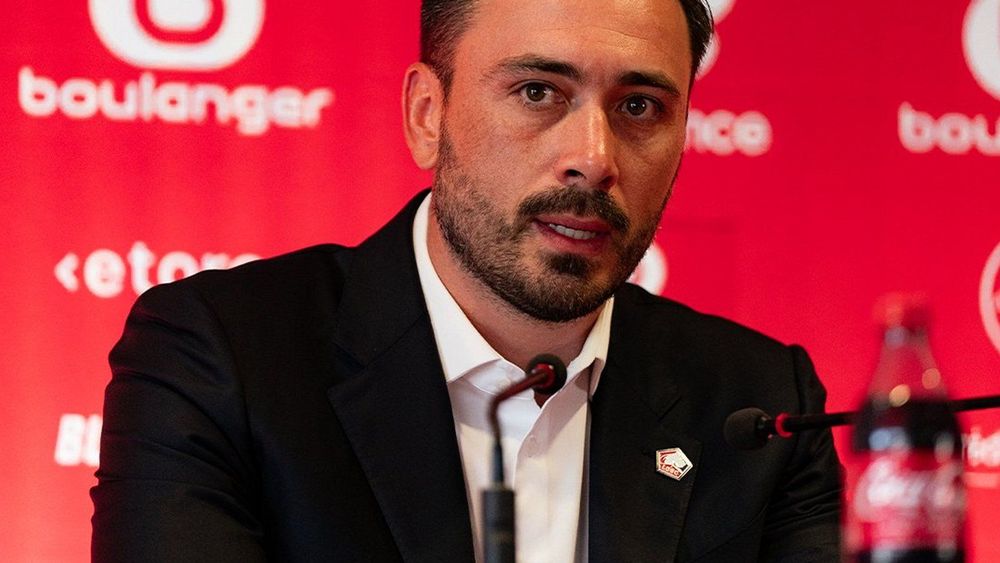
He was Carlo Ancelotti’s assistant at Bayern Munich, Napoli, Everton and Real Madrid before joining the Brazil national team. His education has been extraordinary, but so has the difficulty of establishing an identity of his own when his father is a five-time Champions League-winning manager.
Now, at 37, Davide is beginning to do exactly that.
His first experience as a head coach came at Botafogo in 2025. It lasted only five months, ending after the club finished sixth in the Brazilian championship. Davide’s record was 15 wins, 10 draws and eight defeats from 33 matches, while Botafogo’s season was complicated by financial and structural upheaval.
In June 2026, Lille gave him a second opportunity, appointing him on a two-year contract after Bruno Génésio’s departure. The French club had finished third in Ligue 1 and qualified automatically for the Champions League, making the appointment a significant challenge rather than a sentimental promotion.
This season, Lille had made an excellent start to the domestic campaign, collecting 10 points from their opening four league matches and sitting top of Ligue 1. The beginning has been encouraging, although a Champions League defeat to Real Betis and a late draw with Paris Saint-Germain have already shown the level of scrutiny awaiting him.
For Tim Vickery, however, Davide’s story began long before Lille.
“He's been alongside Carlo for a very long time,” Vickery told Football Presse. “And that's not just sitting there and watching. He's been involved in the work. He's learned how his father deals with players, how he prepares teams and how he handles difficult situations.
“But there comes a point where you have to leave the family operation. You have to discover whether what you've learned actually belongs to you.”
Davide first entered coaching through fitness work at Paris Saint-Germain in 2012, when Carlo was managing the French club. He later moved into a more tactical role and became part of his father’s staff at Bayern Munich, Napoli, Everton and Real Madrid.
The relationship has been unusually close, but Vickery believes it has also given Davide an education that few young coaches could replicate.
“Carlo is an extraordinary coach to learn from because he has worked in so many different environments,” he says. “Italy, England, France, Germany, Spain — and now Brazil. Davide has been able to see how the same manager changes according to the country, the club and the players.
“That is a huge advantage. But it can also become a trap if people only see him as Carlo's son. At some stage, he has to be judged on what he does when Carlo isn't standing next to him.”
The first attempt to make that separation came in Brazil.
Davide took over Botafogo during the 2025 season, replacing Renato Paiva. The club were defending champions of Brazil and competing in the Copa Libertadores, but the circumstances were far from stable. The team eventually finished sixth in the league and were eliminated by Liga de Quito in the Libertadores round of 16.
Vickery believes the experience should not be dismissed simply because it ended quickly.
“Botafogo was a very difficult job,” he says. “You've got the expectations of a big club, the political situation, the money and the fact that Brazilian football is not always easy for somebody coming from Europe.
“Davide didn't do badly. He had a difficult environment and he had to learn very quickly that being the son of Carlo Ancelotti doesn't give you any protection once you're the head coach. You are responsible for everything.”
That distinction mattered. As Carlo’s assistant, Davide could influence training, tactics and preparation while his father carried the final responsibility. At Botafogo, every decision belonged to him.
“It's a completely different education,” Vickery says. “As an assistant, you can have ideas and you can argue your case, but ultimately somebody else makes the decision. As a head coach, you have to decide what happens when the team is losing, when a player is unhappy, when the board is demanding something and when the supporters are angry.
“You don't learn that simply by sitting next to a great manager. You learn it by being responsible for the consequences.”
That experience may explain why Lille represents a particularly important opportunity.
The club is established in French football, financially more stable than many Brazilian sides and accustomed to developing young players. It also carries the demands of European competition, with Champions League football providing an immediate test of Davide’s tactical and managerial ability.
Vickery says the move gives him something Botafogo could not always provide: time to develop a coherent footballing identity.
“Lille is a very interesting appointment because it's not just a club looking for a famous name,” he says. “They have a structure, they have a recruitment system and they have an idea of what they want to do. That gives a young coach something to work with.
“Davide has to show that he can take those resources and create a team. Not Carlo's team, not a team that looks like Real Madrid because that's what he knows, but his team.”
That process has already begun.
Lille’s early results have been built on pragmatism and adaptability rather than a rigid attempt to imitate Carlo’s football. Their opening matches have included difficult moments, changes in personnel and the need to manage players with different expectations. Davide’s response has been measured, helping the club begin the season at the top of the French table.
For Vickery, that is significant.
“One of the things Carlo does very well is manage situations,” he says. “He understands that football is not always about imposing an idea. Sometimes you have to understand what you've got and make it work.
“Davide has learned that from him. But the question is whether he has another layer as well. Can he develop an idea of his own? Can he build something over two or three years? That's what Lille will tell us.”
The question of independence is particularly important because Davide has spent so long working within elite football’s most successful coaching family.
His time with Carlo included major trophies and dressing rooms filled with established international stars. At Lille, he must work with younger players, develop talent and establish authority without relying on the reputation of the man who gave him his first major opportunity.
Vickery believes Davide’s age may work in his favour.
“He is young enough to understand the modern game,” he says. “He has worked with data, with different training methods and with players who have grown up in a completely different football culture from Carlo's generation.
“That's one of the reasons why I think he could become interesting in his own right. He has the traditional education from his father, but he also belongs to a younger generation of coaches.”
There is another advantage: Davide speaks several languages and has already worked across different football cultures. His rapid adaptation to Portuguese was one of the reasons he became such a useful member of Carlo’s Brazil staff.
“His languages are incredible,” Vickery says. “He picked up Portuguese very quickly. That matters because the younger generation is often the bridge between different football cultures.
“He understands how Carlo thinks, but he can also communicate with players and staff who have grown up somewhere completely different. That is a very valuable quality for a coach.”
Davide’s appointment at Lille also means that he is no longer simply part of Carlo’s story.
His father remains Brazil’s head coach, while Davide has taken responsibility for a club competing in France and Europe. Their careers may continue to overlap, but they are now moving in different directions.
Vickery sees that as healthy for both.
“It's important for Davide to have his own problems,” he says. “Carlo has had an extraordinary career, but Davide cannot spend his whole life being compared with it. He has to make mistakes that are his mistakes and have successes that are his successes.
“And Carlo has to let him do that. At some point, the best thing a father can do for a son is to stop protecting him.”
The early signs at Lille suggest Davide has been given the right environment to begin that process. A strong domestic start has created goodwill, while the Champions League will offer a more demanding examination of his tactical maturity.
But the real test will not be whether he can produce a successful first month.
It will be whether he can build a career that survives independently of his surname.
“There's no question that Davide has had an exceptional education,” Vickery says. “But education is not achievement. Now he has to turn what he's learned into something of his own.
“That's the fascinating part of the story. We've seen Carlo Ancelotti the great manager. Now we're beginning to find out who Davide Ancelotti is.”
Tim Vickery's book "Mundials: A South American History of the World Cup" is from Pitch Publishing - which is available here.
