
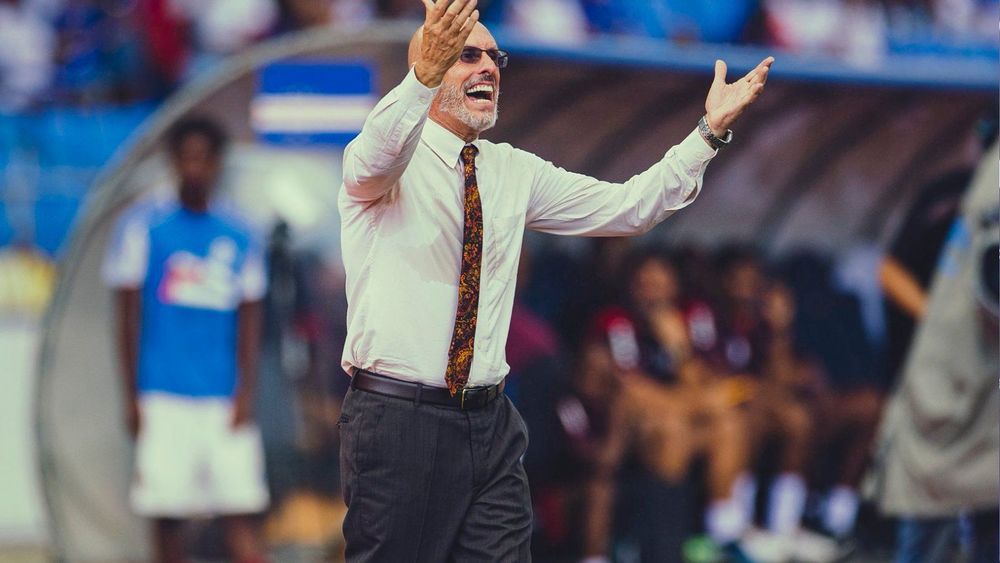
Having coached India twice, the Englishman argues that the development of domestic players must begin with better coaching, rather than relying on investment in the professional game to deliver progress.
“I think the biggest problem in India is the lack of vision," Constantine tells Football Presse. "There isn't a short, medium, or long-term plan for Indian football, and that's the problem.
“I think they felt with the Indian Super League that would solve the problem, but it didn't, because in the beginning of this ISL, you were having seven foreign players. So basically you were only seeing four Indian players on the team, and that's not going to help anybody.”
For Constantine, the priorities are clear. He believes India needs to invest more heavily in developing its own coaches, creating a stronger foundation for the next generation of players.
“I think the main issue is that we are not developing the coaches. So for me, if I had all the money in the world, it would be about developing Indian coaches to develop Indian players, better players, better coaches, better players. That's not happening.
“There is the AFC licence that we have in India, but it's not very difficult to pass. I don't think there is enough development in that area. It's not something that makes headlines anywhere around the world. So for me, I think that would be it.”
Constantine sees coach education as central to India's ability to turn potential into performance. Without that investment, he believes the country will continue to struggle to translate its large pool of talent into progress at international level.
“There is a huge amount of talent in India, but when the Indian national team is not doing very well, when the Indian Super League teams are not winning, you know, the AFC Champions League, no one's really going to be taking too much notice of the Indian national team or any of the players in that country.
“So yeah, a massive amount of talent there, but it's not being utilised for me due to a lack of coach education, I would say.”
His criticism is not simply about results. Constantine is questioning the structure beneath them: whether young players are being developed effectively, whether coaches are receiving the education they need and whether the country has a sufficiently clear plan to improve over time.
His experience in Pakistan provided another perspective on the difficulties facing national football programmes. Appointed Pakistan head coach in September 2023, he led the team to a historic 1-0 victory over Cambodia in a FIFA World Cup qualifier the following month. It was Pakistan's first win in World Cup qualifying and secured progress to the second round for the first time.
Pakistan's challenges included limited domestic competition and the difficulties of preparing an international team without the consistent foundations enjoyed by more established football nations. Constantine's spell there ended in 2024, although he returned for a further period in 2025.
The experience added to a coaching career spanning several continents, including India, Pakistan, Nepal and Africa. Constantine believes that international experience has given him valuable knowledge, even if he feels it is not always fully appreciated by employers in Europe.
“The experiences I have had, you cannot buy. And, you know, I wouldn't change anything.
“If you gave me a choice, yeah, I would love to be in the Premier League or with a good club in Europe. I'm not opposed to going to the national teams. For example, if Albania asked me to come to be the national team coach, I would be more than happy.”
He also believes his background can make it harder for potential employers to look beyond conventional career paths.
“The problem is that they will look at my CV and say, well, yes, you've done this and that in Asia with India and Pakistan and Nepal and in Africa, but what have you done in Europe?
“So I think my CV doesn't allow people to think outside of the box. Why would we bring somebody who has had this background to Europe? I am English, I was born in England, I played football in England, and I'm currently based in Cyprus, so I think I have lots to offer.”
Constantine has also developed an interest in football administration, having completed a master's degree in sports directorship with distinction. He sees that qualification as another route through which he could contribute to the game.
“Whether it's a sporting director, because I recently passed my master's degree in sports directorship in November, on the 17th of November, I will be graduating from my university at Manchester United Stadium, Old Trafford, to get my degree. Got a distinction.
“So either as a coach or as a sporting director, I would be very interested in any potential offers. So hopefully this article is read by lots of people and we get lots of offers.”
Constantine has since taken up the challenge of leading Rwanda for a second time, having been appointed head coach of the senior national team and under-23 side in March 2026.
His message about India, however, remains relevant to the wider question facing football nations trying to close the gap on established powers. Investment in a league can raise its profile, but developing players requires sustained work at every level.
For Constantine, the starting point is not complicated: develop better coaches, give them the tools to improve players and build a long-term plan that outlasts individual competitions or appointments.