
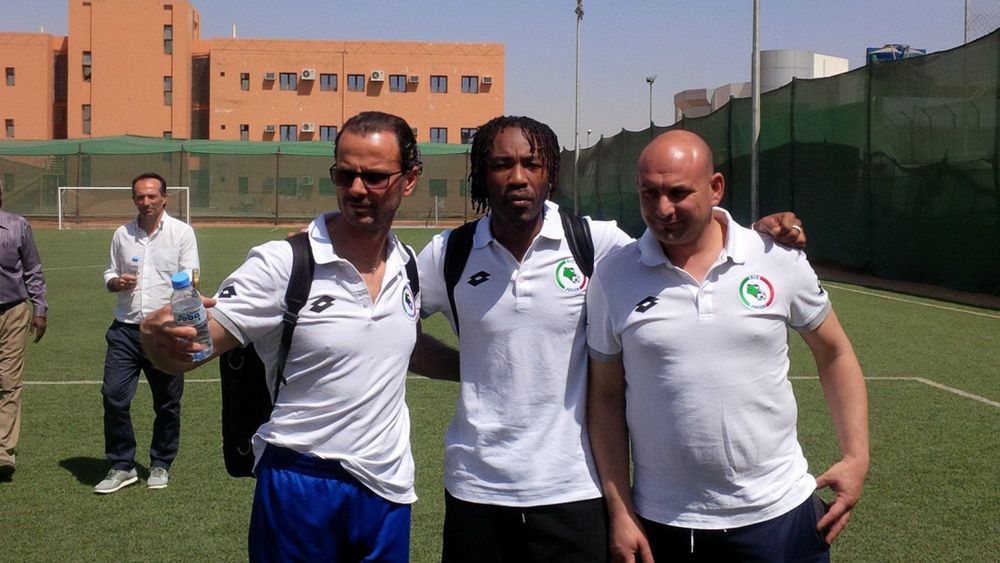
Today, the former winger is combining television commentary with helping the next generation of footballers find their way into the professional game.
But his relationship with football began almost by accident.
“I was adopted when I was very young, at the age of five," Manfredini recalled to Football Presse.
"When I arrived in Italy and joined my new family, they wanted to help me socialise and settle into this new environment, this new country. They took me to a football pitch near our home.
“I started playing football so I could spend time with the other boys, feel better and become involved in this new environment. That is how my passion for football began. As I kept playing, people gradually noticed that I had talent. I realised it myself, too, and little by little I developed that talent."
A place among Juventus’s brightest prospects
Manfredini’s ability eventually attracted the attention of Juventus, where he spent five years in the youth system. Among his teammates during that period was Alessandro Del Piero, who was already beginning to make his mark at senior level.
“Someone living in Battipaglia was a good friend of an important Juventus executive. He told him there was a young black boy in Battipaglia who might be suitable for Juventus. I went to Turin for a trial and they took me.
“I spent five years in the Juventus youth system. In the final two, Del Piero joined us. He had arrived from Padova and, because he wasn’t playing very much in Juventus’s first team, where there were players such as Roberto Baggio and Gianluca Vialli, he came to play the final stages of the Primavera championship with us.
“You could already see that he was a different player. We were promising youngsters with good prospects, but he had something extra. I remember his performances with great affection. He was an extraordinary player, and I remember with pleasure having played alongside a phenomenon.”
The path to senior football was less straightforward for Manfredini himself. Juventus sent him out on loan to several clubs as he worked to establish his career, before he eventually found an environment in which he could flourish at Chievo Verona.
Finding his home at Chievo
After spells with clubs including Pistoiese, Viterbese, Avezzano, Fermana, Cosenza and Genoa, Manfredini found the right conditions to develop at Chievo. The club would become one of the great underdog stories of Italian football in the early 2000s.
“I finally found an environment in Verona, at Chievo, that helped me express myself at the highest level. I remember a healthy, peaceful environment and a wonderful city. I remember so many good things, including a fantastic coach who helped us grow enormously, technically, tactically and in terms of personality.
“The president was also a wonderful person who made us feel very welcome. My time at Chievo was an experience that I still carry in my heart.”
Under Luigi Delneri, Chievo developed an attacking system that enabled the club to compete with Italy’s established powers. Manfredini remembers the demands placed on the wide players, who had to contribute in attack while also tracking back to help the defence.
“Delneri had an attacking idea of football, with two wingers playing alongside two forwards. We had to help the strikers score goals, but at the same time, when the team was defending, we had to get back into the defensive line.
“We trained enormously hard to develop the athletic strength needed to play that way. Gradually, we understood his ideas. Match by match, he convinced us, and we also convinced ourselves that we could make it work. In the end, we enjoyed ourselves and ran a lot.
“We managed to compete with the strongest teams in Italy. In my opinion, they were much stronger than us, but we did our job and finished fifth in the Italian championship. For Chievo, that was a wonderful achievement.”
The challenge of Lazio and the European stage
Chievo’s success brought Manfredini opportunities elsewhere, including a move to Lazio. The prospect of playing for a major club in front of enormous crowds was difficult to resist, even though he had considered staying in Verona.
“When a big club calls you, it is difficult to say no. I had thought many times about staying at Chievo, but the chance to join a club of Lazio’s stature, to compete with players who were better than me or had a bigger reputation, and to play at the Olimpico in front of 70,000 people was very attractive. It made me feel genuinely proud.
“It was a very important moment in my career. I had to change the way I played because I found myself alongside teammates who were much better than me. But that helped me grow, helped shape me as a player and helped me understand what top-level football was really about.”
His Lazio years brought domestic silverware and Champions League football, including the experience of facing some of Europe’s biggest sides. His career also took him to Spain with Osasuna and to Fiorentina, Perugia and other Italian clubs.
Each move brought a different challenge, but the Chievo experience remained particularly close to his heart. Asked whether the club could eventually return to the heights it reached in the early 2000s, Manfredini acknowledged the scale of the task while refusing to rule it out.
“Returning to those levels will be very complicated, but nothing is impossible. The important thing is to work and keep bringing better players into the team. Chievo started in the lower divisions and gradually reached Serie A, so why couldn’t that happen again? I believe several years would have to pass before it could happen.
“My time at Chievo, like the experience of all those players from that era, can be summed up in one word: fantastic. There is nothing more to add.”
A new role in football
Manfredini retired from professional football in 2013, but he has remained involved in the game. He now works as a commentator for Italian public broadcaster RAI, covering Serie C, while also helping young players develop and identifying talent outside the top divisions.
“I would like to continue commentating on matches because it is something I really enjoy. I would also like to help young players emerge, develop and reach the highest level. I am already doing some of that work.
“I really like following youth football and identifying important players in the lower divisions who might eventually move up to the higher levels. That is more or less what I want to do in the future.”
After a career that took him from a neighbourhood football pitch to Juventus, Chievo, Lazio and European competition, Manfredini has found a new way to contribute to the game that first helped him settle into life in Italy.
“And then, apart from that, I’ll just keep running after my children as they grow up.”