
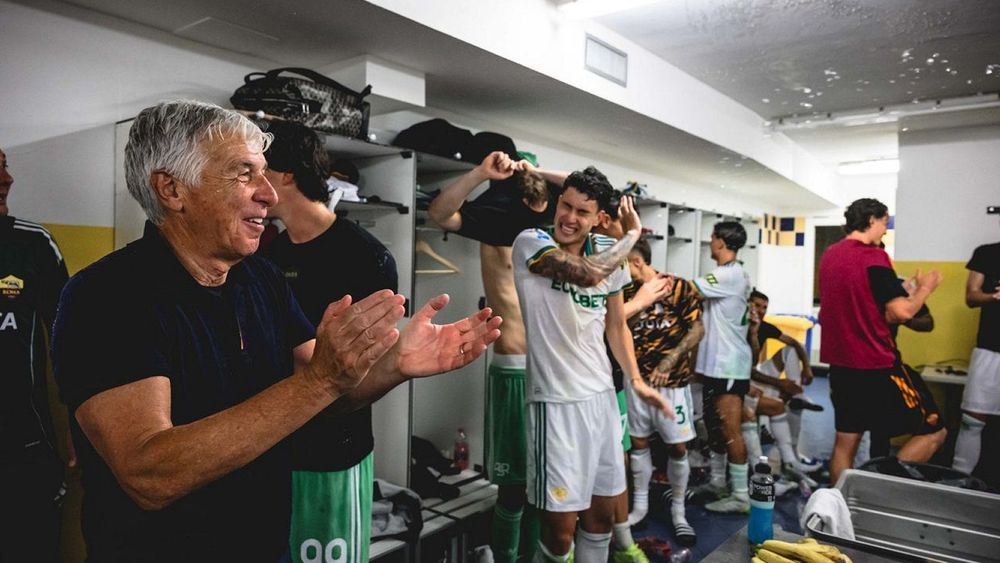
He came through the club's youth system, broke into the first team and made his Serie A debut there. But it was years later, at Palermo, that Gasperini helped shape the football ideas Donati would eventually carry into management.
“Gasperini and (Giampiero) Ventura, especially from a tactical point of view, were the ones who made me understand why and how things were done,” Donati tells Football Presse.
“Every coach has their own characteristics, their own way of doing things, both on the pitch and off the pitch.”
Donati had already worked under a succession of respected coaches, including Carlo Ancelotti, but says each offered something different.
“They all have something, otherwise they wouldn't even be there.”
For Gasperini, the tactical education went beyond simply learning a system. At Palermo, Donati was asked to play in a three-man defence, a role that initially represented a significant change for a midfielder. But he found himself enjoying it.
“It wasn't difficult for me to change from midfielder to defender because I touched the ball a lot,” Donati later recalled of the experience.
“Gasperini thought there were more advantages than disadvantages to putting me there.”
That willingness to move players into unfamiliar roles was characteristic of Gasperini's approach, and Donati found himself increasingly fascinated by the thinking behind it. His time at Palermo was not a successful one in terms of results. Yet that is precisely why Donati's memories of Gasperini are so interesting.
“With Gasperini at Palermo, things didn't go well from the point of view of results, but we played incredible football, beautiful football, football that, according to my own ideas as well, was right.
“We sometimes lost games that we should have won.”
For Donati, the Palermo experience demonstrated one of the uncomfortable truths of coaching.
“Unfortunately in football, sometimes that doesn't mean it has to lead to results as well. In today's world, results are too important and there is very little time to achieve things.
“You have to try to get to them immediately, because otherwise they sack you.”
Yet the football itself stayed with him.
Donati has previously described Gasperini's Atalanta as the style of football he feels closest to as a coach, particularly because of its collective movement and intensity. He says the principles he absorbed from Gasperini helped him begin imagining what his own teams might eventually look like.
That evolution also needs to be understood alongside Donati's relationship with Atalanta itself.
“The growth of the club started a long time ago, when I was young and even before that. I was there too, I went through the whole youth system.”
For Donati, the modern Atalanta story is therefore not simply the story of Gasperini.
“Atalanta also supported itself by developing young players, then selling some, developing others, and it's something that never stopped. In fact, it increased over time.
“It's a question of organisation.
“A club has to be well organised, with real professionals working right from the youth levels.
“When you do things like that, results are very likely to come.”
That is one reason Donati believes Gasperini found such a suitable environment in Bergamo.
The coach arrived at Atalanta in 2016 and spent nine seasons turning the club into a regular European competitor, winning the Europa League in 2024 and taking Atalanta to the Champions League quarter-finals in 2025. He left for AS Roma in 2025 and is now in his second season at the capital club.
Atalanta, meanwhile, have entered a new era under Maurizio Sarri. But Donati's admiration for what Gasperini achieved has never depended solely on trophies.
Indeed, he sees the coach's greatest contribution as creating an identity and convincing players to believe in it. Donati's own philosophy has developed from that experience, although he is careful not to suggest that he simply wants to reproduce Gasperini's football.
“Every coach has something a little more, something a little less, but they all have something.”
And the biggest lesson was perhaps that football management extends far beyond tactics.
“Nowadays football isn't just tactics or just training.
“Football is managing the whole situation 360 degrees, everything on the pitch, off the pitch, psychologically.”
“There are a thousand aspects.”
It is an approach that makes sense when looking at Donati's own coaching journey. He has worked in Scotland, Italy and Greece, winning promotion with Legnago Salus before taking charge of Athens Kallithea and then Sampdoria.
The results have not always followed the football, just as they did not at Palermo. But that is precisely the lesson Donati took from Gasperini.
Good football can be real even when the table says otherwise. The challenge for a coach is finding a club prepared to give those ideas enough time to become results.
“In the world of today, results are too important,” Donati says.
And perhaps that is why his admiration for Atalanta's development remains so strong.
It was not built around one manager, one transfer window or one successful generation. It was an organisation capable of giving a distinctive coach the conditions to make his ideas work.
Donati saw the beginnings of that culture as an academy player. He experienced Gasperini's football from inside the dressing room.
Now, as a coach himself, he is trying to work out what parts of those lessons belong in his own game.
“Whatever happens, you have to think about facing the next day and trying to do better.”
That may be the most appropriate lesson for Donati's own career: take what the great coaches give you, understand why it worked, and then build something of your own.