
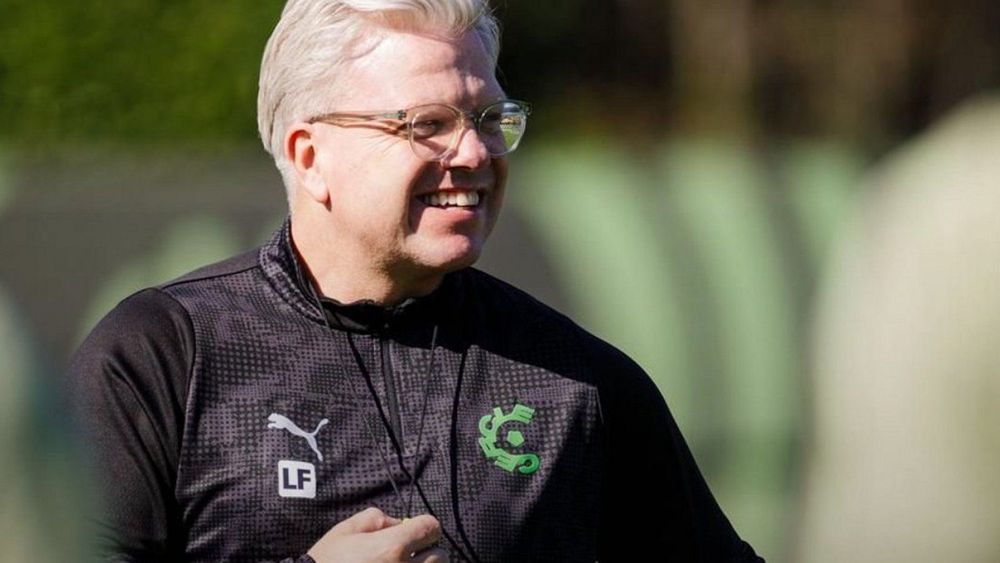
He started in youth coaching in Denmark, helped build the academy at FC Midtjylland, worked with Danish youth internationals, learned inside the Brentford system and eventually moved into senior management.
Today, at 50, he is in Belgium with Cercle Brugge, having arrived in March 2026 to rescue a club facing relegation.
The latest chapter is already giving him another experience to add to a coaching career built around development, people and the demand for results.
“You can do both, of course you can, but you need wins to do it,” Friis told Football Presse.
That sentence probably sums up his philosophy better than anything else.
Friis believes in developing players and building for the long term, but he has never confused patience with an excuse for losing. His coaching education began in Denmark in the 1990s, initially working with young players before joining the project that would become one of the country's most influential football academies.
At FC Midtjylland, Friis was among the coaches who helped establish the academy in 1999.
“We were five or six guys who were in charge of that, and it was a great experience,” he recalled.
“We could start over again because there was not an old way. There was no, ‘We normally do it like this.’ We started with everything.”
That freedom shaped him.
“We could say, ‘These are our values, this is the way we’re going to go,’ and build from there.”
Midtjylland's academy was a radical idea in Danish football at the time, bringing together young players in a structured development environment at a club that itself was still establishing its identity.
“There were a lot of people who were against it in Denmark because you cannot do it like this in Denmark. It’s not the culture,” Friis said. “But you had seen it for decades in England, for example.”
He believes what Midtjylland started helped change Danish football.
“It was a game-changer in Danish football that Midtjylland started this, and a lot of clubs followed the way they did afterwards.”
Friis subsequently worked with Denmark's youth national teams before returning to Midtjylland, eventually moving closer to the first team. His experience covered virtually every level of the game. It also established one of the ideas that still runs through his coaching.
“I think it’s basically the base and the foundation of how I am as a coach today.”
That foundation travelled with him to England.
Brentford appointed Friis in January 2018 as an Individual Development Coach, specifically to accelerate the progress of their most promising young players. He later became head coach of Brentford B. It was an ideal environment for a coach obsessed with development.
And it brought him into close contact with Thomas Frank, whose influence Friis still talks about with obvious affection.
“Thomas is not only a good coach, he’s also a good friend of mine,” Friis said. “He’s really, really good in man-management. The way he looks at people. He’s a very positive guy who sees opportunities instead of all the mistakes and failures.”
Friis also learned to appreciate the detail Frank put into training.
“He’s not a typical manager who is living for Saturdays,” he said. “Thomas is living for every day, working on the training pitch, working on small things, creating drills, doing stuff like this.”
That period at Brentford helped Friis develop another important part of his philosophy: young players need the right environment around them.
“You need to create situations where it’s possible to get to the first team,” he explained.
His approach was not simply about telling young footballers to work harder.
“One of the most important things is to get close to them, to get under their skin, to understand how they think, to understand their background.
“If you understand the human being, you have a really, really good chance to develop the player.”
It is an approach that remains visible in his work today.
Friis is careful, though, not to confuse being close to players with being their friend.
“I’m not talking about being best friends,” he said. “I’m talking about being totally honest outside football as well.”
At Brentford, he also became increasingly interested in using data to measure whether development was actually happening.
He and colleagues created a traffic-light system for individual performance: green for good, yellow for something that could go either way and red for an area that needed improvement.
“You need to find ways to measure what they need to become better at,” he said.
For Friis, data was never intended to replace coaching intuition.
“Football is feelings,” he explained. “But if you make a lot of decisions based on feelings, it’s not many times you’re right.”
His answer was to combine the two.
“You need the data, the facts into football also, together with the eyes, and then you will see what real football is.”
After England came the opportunity to become a head coach.
Friis returned to Denmark and took charge of Viborg in January 2021, leading them to promotion to the Danish top flight. He then moved to Aalborg before another international opportunity emerged.
Sparta Prague was the next major step. Initially joining Brian Priske's coaching staff, Friis spent 18 months as an assistant before being handed the head-coach role in the summer of 2024.
The biggest moment came almost immediately. Sparta reached the Champions League proper after beating Malmö FF in the qualifying play-offs.
“To see people in the stands crying for having Champions League back at Sparta after 19 years — achieving that with the club, with the fans — this is for me the most outstanding moment in my time in Prague,” Friis said.
But Sparta also taught him something less comfortable. The Champions League qualification brought enormous excitement, yet maintaining hunger in domestic football proved difficult.
“For many of them, there was no more to achieve,” he said. “That was hard.”
His conclusion was simple.
“The hunger is the most important when you have players, new players, young players, old players, when you have staff, when you have sporting directors, directors in general. The hunger is the most important.”
Sparta ultimately parted company with Friis in May 2025 after a season in which the club failed to win silverware, despite the Champions League qualification. He left with a significant European experience behind him but also with lessons he knew he would carry forward.
“I have learned a lot from the experience,” he said. “And I look forward to using them again.”
That opportunity eventually came at Cercle Brugge. When Friis arrived in March 2026, Cercle were fighting for their Belgian top-flight survival. There was little time for theory.
They needed results. Friis delivered three wins, a draw and two defeats across the six relegation play-off matches, earning 10 points and keeping Cercle in the Belgian Pro League.
The experience was almost a real-life demonstration of something he had explained in the interview. Long-term development matters. But immediate results matter too.
“It can be difficult to influence sometimes because if you’re not in the right place at the right moment, then you will be beaten by missing results if you are focused a lot on developing players and teams.
“Can you do both? Yes, of course you can, but you need wins to do it.”
Now Friis has the opportunity to build rather than merely rescue.
Cercle's 2026-27 campaign began with a 2-2 draw at Standard Liège, before another 2-2 draw against Sint-Truiden.
It is still early, but the difference is significant: Friis is no longer arriving simply to put out a fire. He is building his own environment.
And that brings his career almost full circle.
From the young coach helping establish Midtjylland's academy, to Brentford and the science of player development, to Viborg and his first senior success, Sparta and the Champions League, and now Cercle Brugge, the central idea has remained remarkably consistent.
“Being part of that and learning — the limit was the sky because it was a brand-new club, a brand-new academy,” he said of his beginnings at Midtjylland.
That spirit still defines him.
Friis has never stopped moving between development and competition, between the human side of coaching and the demands of performance.
He knows the theory. He has lived the pressure. And at Cercle Brugge, he now has another chance to put everything he has learned into practice.