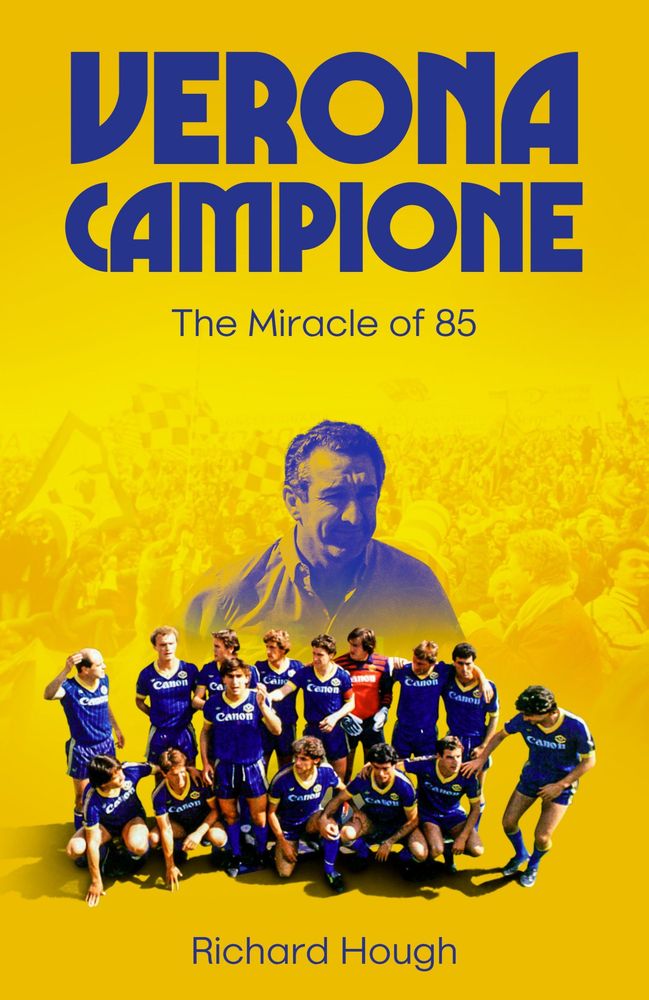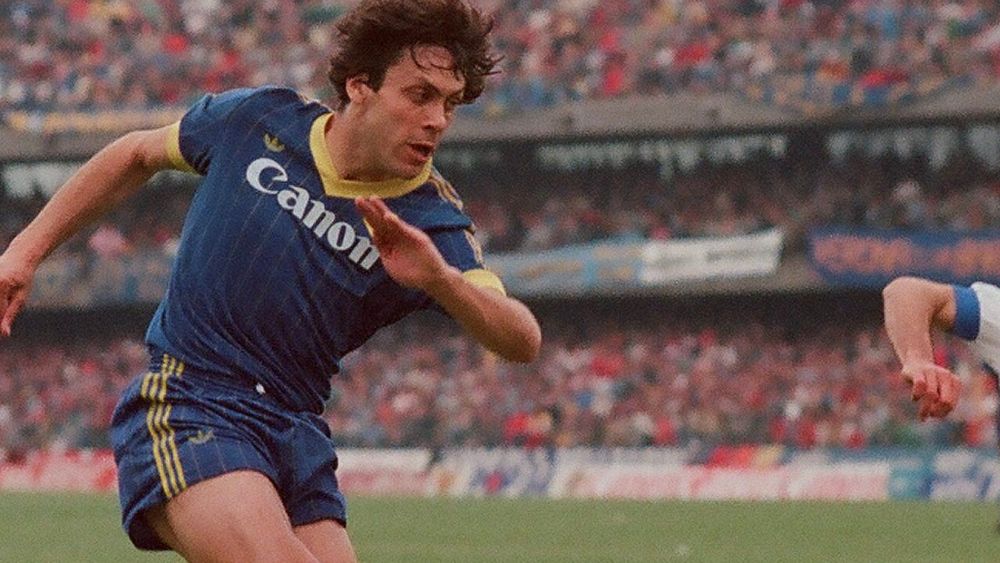
Hellas Verona's 1985 Scudetto is one of football's great underdog stories.
But the club's subsequent collapse — culminating in bankruptcy just six years later — is almost as remarkable.
For Richard Hough, whose research into Verona's championship season included interviews with members of the title-winning squad and extensive newspaper archives, the explanation lies partly in how quickly Italian football was changing around them.
"It was almost inevitable, I guess, knowing Italy and knowing Italian football, that having reached such an incredible peak, things would somehow deteriorate," Hough told Football Presse.
"And I guess it's basically, I would say football during that period was changing in a major, major way."
That transformation began almost immediately after Verona's triumph.
"Big money was arriving in the game, and Berlusconi would take over Milan the following year," Hough said.
"You would have the emergence of Sky Sports and the television rights. Subsequently, you'd have the Bosman ruling."
Each development would alter the balance of power in European football.
For Verona, the problem was that success itself became increasingly expensive to maintain.
"And in the case of Verona as well, that forced up wages," Hough explained.
"Verona had to pay more and more money to keep the players and to bring new players into the club."
That was a very different environment from the one in which Osvaldo Bagnoli had built his championship-winning side.
The transfer market was changing, too, with agents becoming increasingly influential.
"Most of the players from that era didn't have an agent, or agents were just beginning to get involved in transfer dealings," Hough said.
"They would become increasingly involved."
The consequences were significant.
"Verona had to pay more and more money to keep the players and to bring new players into the club."
The club consequently began taking financial risks in an attempt to remain competitive.
"They kind of just overextended themselves really, by over-investing in players who maybe didn't work out for them, paying over the odds."
But Hough's research also uncovered a darker part of the story.
"To then also get involved with some murky individuals and some murky accounting mechanisms, using Swiss bank accounts and players coming in."
It was a period in which financial manoeuvring around transfers was not unique to Verona.
"It still happened until quite recently," Hough said.
"It's still happening in Italian football, not just Italian football, probably elsewhere, where they try and balance the books."
For Verona, however, the consequences were severe.
The club had to reduce its wage bill, and the most obvious way of doing that was to sell the players who had helped make the club successful.
"And as they had to offload their best players to try and reduce the costs in the wage bill, it all went spectacularly badly for them."
The collapse was therefore not simply a matter of a brilliant team breaking up.
It happened as the football environment itself was being transformed.
"Football was really changing," Hough said.
"And Verona at that point, having enjoyed the glory days of the 1980s, just weren't really equipped to deal with what was coming in the 1990s."
That also helps explain why Hough is sceptical about the possibility of another club of Verona's stature winning Serie A.
The romantic possibility remains.
"The romantic in me would say yes. Could happen."
But the reality is much harder.
Hough points to clubs such as Atalanta and Bologna as examples of teams that have challenged the established hierarchy in recent years.
"Atalanta, you know, this season people were saying, maybe around about Christmas time, Atalanta were in with a chance."
"People were bigging them up and saying, well, could Atalanta do something? Could this be their season?"
But then the pressure arrives.
"And then the big teams begin to — the pressure, it's the pressure as well. The pressure begins to build."
Hough saw a similar pattern with Bologna.
"Bologna as well, you know, they were pushing in for a top-five finish right until the very end, and then gradually when it comes down to the very, very final few games or the last most important decisive moments of the season, they kind of fall away."
Even so, Hough stresses how impressive those modern challengers have been.
"Still a remarkable achievement for a club like Bologna, everything they've achieved in the last couple of seasons."
But winning the title remains another matter.
"It's not easy for a small club to win it. It's very, very difficult."
And when Hough spoke to people connected with Verona about whether the miracle could ever happen again, the response was even more pessimistic.
"Most people I spoke to said, yes, unlikely, almost impossible for Verona certainly, or for a club like Verona to ever win the Scudetto again."
That is ultimately what makes the 1985 title so significant.
Verona did not simply defeat the established giants for one extraordinary season.
They did it immediately before Italian football entered a new financial era — one in which the economic forces that eventually overwhelmed the club made another miracle increasingly difficult to imagine.
And, for Hough, that is why the collapse is inseparable from the triumph.
"It's part of the reason why the '84-'85 season is so special."
Richard Hough is the author of 'Verone Campione' from Pitch Publishing - which is available here.