
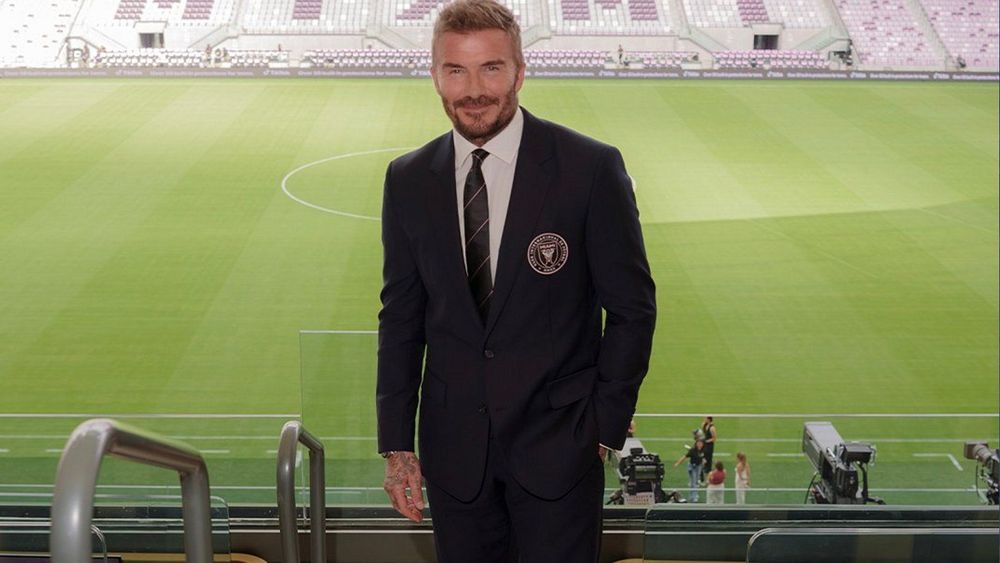
Hoffard says Beckham's arrival changed how players, coaches, and even global audiences viewed the American game.
Speaking to Football Presse, Hoffard reflected on his time at New York Red Bulls and the extraordinary period when global superstars such as Beckham and Thierry Henry were not marketing symbols, but fully embedded elite professionals reshaping standards on and off the pitch.
“I can’t say enough about Red Bull. I loved my time there,” Hoffard said. “You’re going into a club and you’ve got Thierry Henry, Rafa Márquez, Tim Cahill… big world superstars. That was exciting.”
But it wasn’t just the names that stood out — it was the shift in gravity around them. Hoffard recalls a specific moment that captured the scale of MLS’s transformation: a match against Manchester United at Red Bull Arena, where Beckham’s presence alone altered the emotional temperature of the stadium.
“Even warming up, you look around and you see all these superstars in the crowd coming to watch,” he said. “It was something you never forget.”
For Hoffard, the Beckham era represented the moment MLS stopped being a developmental league and started becoming a global product. That shift, he argues, was amplified further when Henry arrived in New York — not as a fading icon, but as a player still capable of defining matches and drawing enormous crowds.
One of the defining memories came when Henry returned to Arsenal in the Emirates Cup, in a whirlwind summer where Hoffard’s Red Bulls faced PSG and Arsenal in consecutive days.
“It was Thierry’s first time back at Arsenal,” Hoffard said. “The Emirates was going crazy when he walked out for warm-ups. That was a moment that will always live with me.”
The Red Bulls, improbably, won the tournament — a surreal achievement in Hoffard’s telling, where MLS players briefly matched Europe’s elite on their own terms.
“We tied 1-1 and won the Emirates Cup,” he added. “I think Arsenal had the ball for 89 minutes. But we won it.”
The legacy of Beckham’s influence, however, has only grown in the years since. Now part-owner of Inter Miami, Beckham has helped build a franchise that culminated in an MLS Cup triumph inspired by Lionel Messi last season — a symbolic full circle moment for the league’s most influential ambassador.
For Hoffard, that evolution feels like a continuation of the same story he witnessed firsthand in New York: star power accelerating structural growth.
“The league is in a great place,” he said. “Every year the standard is getting better. There’s more money, better players coming in. They’re doing a really good job.”
But he is also cautious about what comes next, particularly with MLS moving toward alignment with the FIFA calendar and the logistical challenges that brings in colder markets across the United States and Canada.
“There’s going to be an interesting watch,” Hoffard noted, pointing to cities like Toronto, Minnesota, and New England, where winter conditions could redefine how the league operates.
Still, the broader arc remains clear to him. Beckham opened the door, Henry widened it, and the league has since stepped through into a new global era — one now shaped by ownership, superstardom, and sustained investment at the very top.
Hoffard’s memories, anchored in dressing rooms, training grounds, and unexpected European triumphs, offer a reminder that MLS’s rise wasn’t abstract. It was lived moment by moment by coaches and players suddenly sharing space with some of football’s most recognisable names.
And for him, that remains the essence of the Beckham effect — not just bringing attention, but changing what was believed possible.