
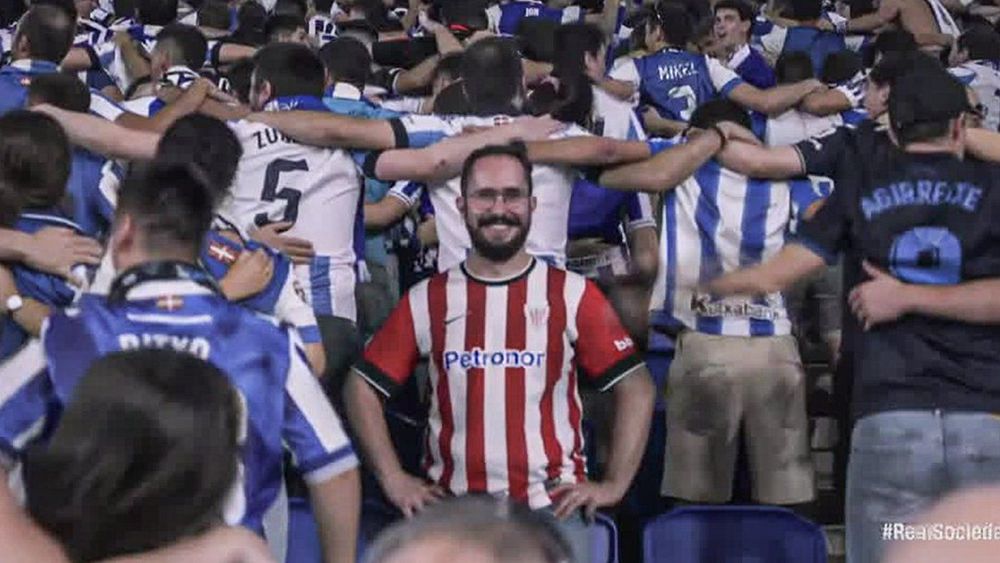
There are few football rivalries where supporters can watch their team lose 3-0 and still smile for the camera.
But that is exactly what happened to Athletic Club supporter John Azanza when Real Sociedad defeated his team — and the moment, captured on camera, became an unlikely symbol of the Basque derby.
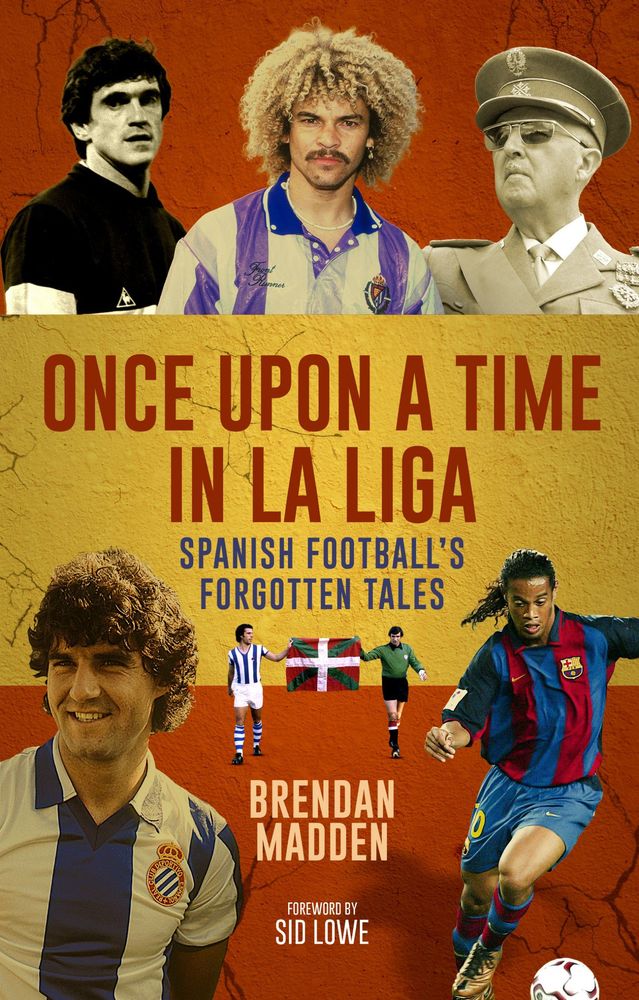
For Brendan Madden, author of "Once Upon a Time in La Liga", the fixture between Real Sociedad and Athletic Club is unlike almost anything else in football.
"I'd love to know if you, Jacob, or any of your listeners or viewers could think of another example of a derby like that in world football," Madden asked Football Presse.
"But there's just no trouble between the teams, between the fans.
"There's like no problems. There's like even like poetry competitions and just amazing. It's like a festival."
Brendan Madden is the author of "Once Upon a Time in La Liga" from Pitch Publishing - which is available here.
The rivalry between Bilbao's Athletic Club and San Sebastián's Real Sociedad is fierce. But it exists within a shared Basque identity that can make the relationship between the clubs' supporters remarkably different from the hostility associated with many major derbies.
Madden describes it as:
"Probably the one derby that's hard, really hard."
The two clubs have historically placed enormous importance on developing local players, meaning many footballers have encountered one another repeatedly through youth football before eventually meeting in the first team.
That helps create an unusual dynamic when the biggest match in the region arrives.
"The players respect each other.
"A lot of them will have grown up playing each other multiple times in youth, all the way through the youth grades, because obviously both clubs have got this incredible focus on youth development.
"So it's just the most incredible respect for Derby."
The rivalry is therefore intense once the match begins, but the relationship surrounding it can be remarkably convivial.
"For the fans, it's almost like a cultural event.
"They'll drink and eat together.
"And then that's not to say the game isn't full-blooded."
Madden points out that the absence of hostility does not mean the players treat the match as a friendly.
"I'm sure if we look at the yellow and red card stats are pretty high."
But there is a distinction between fierce competition and genuine animosity.
The Basque derby has developed its own traditions away from the pitch, including cultural events involving the two clubs. The official BertsoDerbia, for example, brings together bertsolaris — Basque improvisational poets — representing Athletic and Real Sociedad around derby fixtures. The two clubs' foundations describe it as an initiative designed to promote healthy rivalry and coexistence through sport and Basque culture.
Madden sees that cultural dimension as central to understanding the fixture.
"It's, it's like a festival."
The contrast with other famous derbies is particularly striking because the sporting stakes remain enormous.
Athletic and Real Sociedad compete for players, supporters, prestige and trophies, while Athletic's historic Basque-only philosophy makes the competition for local talent especially significant. The two clubs' academies are also central to their identities.
Yet the relationship between supporters can survive all of that.
And Madden found the perfect example in Azanza, the Athletic fan who became briefly famous after appearing in footage from a derby in which Real Sociedad were comfortably ahead.
"Real Sociedad were winning, I think they won the game 3-0, but it was after the second goal and the third goal, they do that Poznań thing.
"And you've got this single Athletic fan."
Azanza simply stood watching while the home supporters celebrated around him.
"You got the whole crowd just bouncing around and he just kind of smiles even though his team's sort of 3-0 down."
For Madden, those few seconds captured something that hundreds of pages of explanation might struggle to convey.
"That just sums up what that derby is all about."
The moment subsequently travelled around the world, giving a much wider audience a glimpse of the relationship between the two sets of supporters.
Madden became determined to find the man behind it.
"I struggled to find him and he's part of this electro txaranga."
The search eventually took him somewhere rather unexpected.
"He’s part of an electric one, which I read about, and I actually found their Instagram page, and they've got a bookings thing.
"I said, hey guys, you know, if I can get hold of John Azanza, and they're like, yeah, here he is."
Madden's conversation with Azanza confirmed that the viral moment was not simply an isolated piece of internet content.
"Lovely guy, and I think, yeah, he deserved his moment of fame."
The story also illustrates why Madden's approach to Spanish football is so different from conventional match reporting.
Rather than simply describing the score or the atmosphere, he wanted to understand the culture behind the image — and the relationship between two clubs whose supporters can be rivals without becoming enemies.
That shared identity does not erase the competition. Quite the opposite: it gives the fixture another layer.
Recent coverage of the derby has similarly highlighted how supporters from both clubs can mix in the same stands, meet socially before matches and even have divided loyalties within the same families.
For Madden, that is what makes the fixture so special.
"It's the most incredible respect for Derby."
And perhaps that is the lesson of the Basque derby.
Football does not require hatred to create a great rivalry.
In Bilbao and San Sebastián, supporters can compete fiercely for 90 minutes, argue over decisions, celebrate wildly and desperately want their neighbours to lose — then return to the same bars, the same friendships and the same shared culture.
As Madden's discovery of John Azanza shows, sometimes the most revealing image of a rivalry is not the celebration of victory.
It is the supporter who can stand in the middle of it all, watch his team lose, smile at the camera and remain proud of who he is.