
It needed the right characters, players who could help the club climb the divisions, and eventually the quality to compete at a higher level.
Phil Brown, who worked alongside Allardyce as assistant manager and first-team coach, believes Bolton’s Danish contingent played a crucial part in that evolution. Their contribution was not simply about the individuals who arrived at the club, but the stepping stones they provided as Allardyce assembled a team capable of progressing through the divisions.
“We had our own training ground," Brown told Football Presse. "We'd bought it and changed it into a space-age, state-of-the-art training ground. People were coming across from Denmark, and the reason they were coming across was that we were building something.
“I'm not saying everybody in Denmark's a farmer, by any stretch of the imagination. You go to Copenhagen and you've got a beautiful city and some great football teams. But at the end of the day, you're sourcing from a small group of Danish people and you want to get to European status. That takes ambition, that takes a lifetime's planning, and that's what we were piecing together.”
Brown sees the Danish players as integral to the club's progression from the Second Division towards the Premier League. The recruitment strategy had to evolve as Bolton climbed, with different qualities required at each stage.
“In my humble opinion, when I first joined the club in the Second Division, we went to the Championship, and then we were looking to get to the Premier League. You needed hardened, workmanlike players.
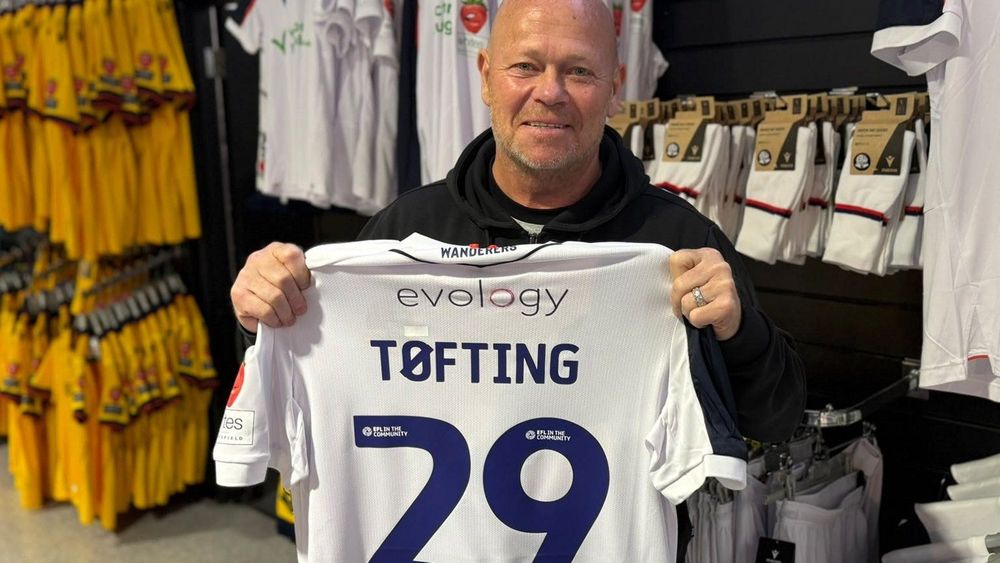
“I make reference to Stig Tøfting. He wasn't one of the greatest players, but he played for the national team, so he was good enough. He'd run through a brick wall. He was different, and that was right up our street.”
Stig Tøfting: the mentality Bolton needed
Tøfting was the sort of player who could give a team its edge. Brown's assessment is revealing: he does not pretend that every member of the Danish contingent possessed the same technical ability, but he recognises the value of a player whose determination and attitude suited the demands of the club at that stage of its development.
Bolton needed players who could withstand the physical challenges of the divisions they were trying to escape. Tøfting's international pedigree mattered, but so did his willingness to throw himself into the contest.
For Brown, that combination made him an ideal fit for the project Allardyce was constructing.
Bo Hansen, Per Frandsen and Michael Johansen
The Danish contingent was not made up of one type of player. Brown remembers their contrasting personalities and qualities, from a striker who could find the net to a midfielder whose character made him a pleasure to work with.
“Bo Hansen was the biggest moaner you'll ever come across, but he could stick the ball in the back of the net. He had pace and he'd get in behind. If he wasn't playing, he was a nightmare.”
It is a typically candid assessment, balancing the frustrations of managing a player's temperament with the reason he was valuable to the team. Hansen's ability to stretch defences and score goals made him an important part of the mix.
“Per Frandsen was an absolute pleasure to handle. Michael Johansen was a quirky little character who would make you laugh every time.”
Those personalities mattered in a squad being assembled for a demanding climb. Brown's recollections give a sense of a dressing room in which players could be very different from one another, yet each had something to offer.
But when asked to identify the player who could take Bolton to another level, Brown singled out one name.
Claus Jensen: the player who raised the level
“The key to it all, I think, was Claus Jensen. Dear me, he was taking us to the next level.”
Jensen represented the next stage in Bolton's development. The club had begun with players capable of doing the hard work required to progress through the divisions; now it was bringing in greater quality and building a team around players who could make a difference at a higher level.
Brown explains the sequence in straightforward terms.
“The stepping stones were the Danish players, and then all of a sudden we got the better Danish players. Now you're surrounding Claus Jensen with good players, and then you're selling them for £4 million, which was a lot of money.”
The point is bigger than any one transfer. Bolton were developing a recognisable identity and building a squad whose value could grow as the club advanced. Players who helped establish the foundations could be supplemented by better ones, and the club could then benefit both on the pitch and financially.
Brown credits Allardyce with having that wider picture in mind.
“All of these things were part and parcel of a growing brand. Sam had the end picture in his head, and we were going along for the ride. But I was latching onto this end picture.”
It was a project that required patience, recruitment and a clear understanding of what the club needed next. The Danish players were not a sideshow in that story. In Brown's view, they were among the foundations on which the transformation was built.
The pre-season that went disastrously wrong
Brown's affection for Denmark extends beyond the players who came to Bolton. He also recalls a pre-season trip that proved to be one of the worst preparations the club had experienced, despite the connections that had made the destination an obvious choice.
“I've got an affinity with the Danish people. Don't get me wrong, it was one of the worst pre-seasons we ever had.
“When Sam and I got together, he said my responsibility as assistant manager and first-team coach, alongside Neil McDonald, was to organise pre-season. I had Danish connections coming out of my ears, so we decided to play three games in Denmark.”
Bolton faced AB and OB, with Brown unable to recall the third opponent during the interview. The results were emphatic defeats, and the trip became a source of ridicule back in England.
“We played AB, OB, and I can't think of the third one. Anyway, we got beaten 6-1, 6-0, and 3-2 in the final game. We then went to America and got drubbed by three teams there as well. We came back to England with about 12 injuries.”
The pre-season could hardly have gone worse. Yet Brown remembers what followed as an important part of the story, rather than evidence that the preparations had been wasted.
“We went the first 12 games undefeated. I firmly believe it was because of the Danish players and the way they were. It was just fantastic.”
The connection with Denmark had brought difficult results and a brutal set of headlines, but Brown's faith in the people and football culture remained intact.
“When we got beaten 6-1 and 6-0, the headlines back in England were, ‘Are they playing tennis?’ Six-one, six-love. I'll never forget the headline. It's driven me forward ever since.
“But it's Denmark. I love Denmark. I really love Copenhagen. What a beautiful city.”
More than a recruitment route
Brown's account of Bolton's Danish contingent is ultimately a story about how a football club builds towards something bigger. Tøfting brought the uncompromising mentality required for the climb; Hansen offered pace and goals; Frandsen and Johansen brought their own qualities and personalities; and Jensen, in Brown's estimation, helped take the team to another level.
The important distinction is that these players were part of an evolving plan. Bolton did not simply assemble a group of Danes and hope for the best. Under Allardyce, the club was building towards the Premier League, adjusting the quality of its squad as its ambitions grew and recognising that progress required both the right foundations and the right additions.
Brown's admiration for the Danish people remains evident, even when he recalls the pre-season that went so badly. The defeats and the jokes became part of the story, but they did not undermine his belief in the connection.
For a club with ambitions far beyond its starting point, the Danish influence was, in Brown's words, one of the stepping stones that helped take Bolton towards the next level.