
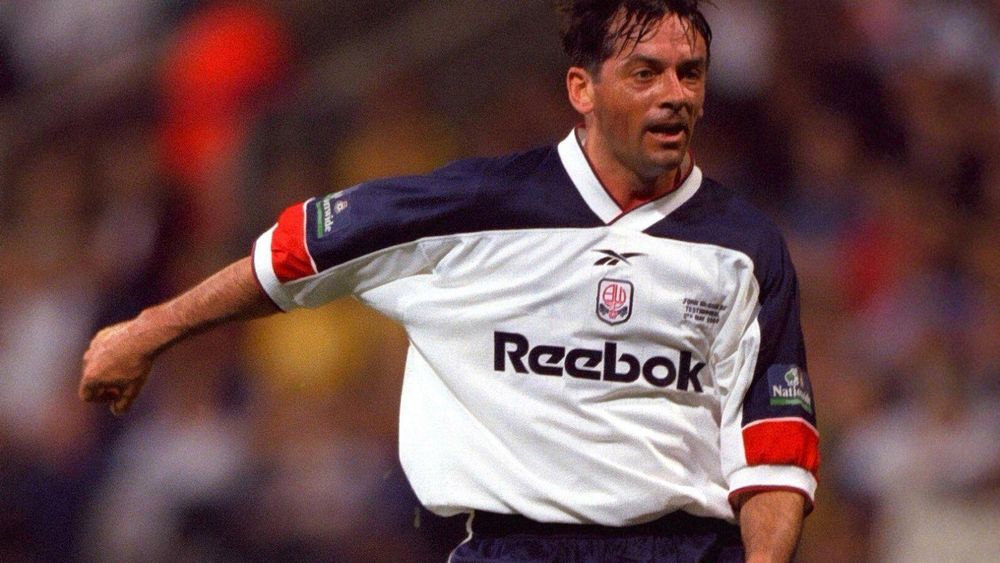
He was approaching his peak years as a footballer, had been recognised in the Professional Footballers' Association's team of the season on several occasions and had developed into an attacking right-back.
“I thought I'd served my time now," Brown told Football Presse. "I'd done my apprenticeship where football was concerned, and here was my chance. So I'm 27, 28-year-old, and everyone's telling you your best time in your career would be probably between 27 and 33.
"That's where you make the big money, or that's where you make the big moves, or that's where you're fittest, and you know the game. You've got sufficient experience then.
“I had such a good time at Halifax. I got involved in the PFA with regards to the team of the season on three, four occasions. So my game was coming, you know, a different type of game. I was being identified as an attacking full-back, and all of these things were coming into play.”
The breakthrough came through the FA Cup. Halifax faced Bolton in a tie that required two replays, giving Brown three opportunities to measure himself against Phil Neal, the experienced England and Liverpool right-back who was playing on the opposite flank.
“But then we played Bolton in an FA Cup game at Halifax Town, back in the day when you used to have replays. And sure enough, it went to two replays, so three games in total. Phil Neal was playing left-back for Bolton Wanderers. I was playing right-back for Halifax Town, and I just kept on coming up against him, and he liked what he saw, and he liked what he was witnessing.
“They beat us over the three legs, but we gave them a run for their money in two games. And that's probably the best kind of scouting you'll ever get your hands on.”
Brown had other options, with Burnley, Coventry City and Peterborough United also among the clubs he recalls showing an interest. Ultimately, Bolton offered an opportunity to learn from a player who had reached the highest level of the English game.
“My mother had said that if you're ever going to learn how to play right-back, he's played 51 times for England. So it's a no-brainer. But I don't like the use of the words 'no-brainer', you know. It sounds like you've got no brains, and I don't particularly subscribe to that. I understand what it means, of course I do.”
Learning from Phil Neal and Sammy Lee
Neal was Bolton's player-manager when Brown arrived. His reputation, built on years of success with Liverpool and England, made him a figure Brown could study closely, even if the practical coaching on the training ground came from somebody else.
“Unbelievable. He was a player-manager, so therefore in my position, I'm thinking to myself, the more I'm playing, the more he's just the manager, you know. And if you understand what I mean by that, I'm keeping an England full-back at bay.
“Don't get me wrong, his career, he was 35, 36 years old. That's the reason why he stepped to one side. But I'd signed for one reason and one reason only. Surely he was going to improve my game.
“To watch him play was the only way he improved me, because Phil wasn't a coach, he was a figurehead. He was bigger than the club, if you want to see it that way, you know. Having played 51 times, having won every trophy for Liverpool, having graced the top flight of English football for many, many years, I had to just keep on studying what he was doing, watching what he was doing. And he was such an exponent of being able to see a pass. It was just brilliant to see, and a great technique, obviously.”
Brown found his more direct coaching education under Mick Brown, Neal's assistant, who had previously worked at Manchester United under Ron Atkinson. But another teammate made an equally important contribution to his development: Sammy Lee.
Asked whether he could see the difference between Neal and Lee and the players around them, Brown was emphatic.
“100%. 100%. And sometimes their acceptance of that, it has to be seen to be believed, you know, because it was total disbelief. How could I have come down this far? Or it was one of them where it's an acceptance, and maybe the more time I spend with him, the better he'll become, and all of these things.
“Sammy Lee was a really great player to play with as a full-back because he used to do a lot of hard work in front of you that you didn't have to do as much defending. Sammy Lee was brilliant for me in front of me because he protected me.”
For Brown, Lee's contribution was about understanding the game and doing the simple things exceptionally well. The winger's defensive work allowed Brown to attack without leaving himself unnecessarily exposed.
“If somebody asked me what my passing sequences were, my first pass was number seven back in the day, the right winger. If he's working his tripe off to protect me, my job is to give him the ball because he's good at going forward. That's the reason why he's playing seven. It was ABC as far as I was concerned.
“But Sammy Lee was brilliant. He stopped me from getting roasted by the opposite winger, the number 11, just by putting a screen on him and reading any pass that was going into him. He was brilliant at that. So there's certain things about Sammy Lee's game that were quite simple, but he was very good at it.”
Meeting Nat Lofthouse at Burnden Park
There was another reason Bolton appealed to Brown: its history. Nat Lofthouse, the club's legendary former centre-forward, was president when Brown arrived. His mother made sure the young signing understood the importance of acknowledging the people who had helped define the club.
“When I signed for Bolton Wanderers, it was down to the fact that legends such as Nat Lofthouse — he was president of the club, but used to be the man, the go-to striker for England, for Bolton Wanderers. And he was just a legend in the area.
“I always remember the first day at Bolton Wanderers, my mother said to me, 'Whatever you do, never mind Phil Neal, whatever you do, make sure you go and see Nat Lofthouse.' So I had to go and shake his hand. So that just showed you the humility of the family that I had.
“And I hadn't thought for one minute I'd cracked it. I just couldn't wait to get to grips with a team that was in a higher division and then obviously with ambition to get higher.”
Brown's affection for Burnden Park came from the history embedded in the ground and the experience of playing there in front of large crowds. It was a stadium he had admired as a football supporter before he became one of the players walking out onto its pitch.
“The fond memories of Burnden are the fact that it was an elevated piece of land. It was a plateau of six foot up from the running track around it, you know. And it was widely thought of as one of the best stadiums in the country back in the day because it used to get packed houses, you know, full house.
“And it was on Manchester Road and it had history. There was all sorts about it that you thought, 'This is the kind of club I want to play at.'
“Being a football supporter, I just love having a look around stadiums when they're empty. I love it, I really do. But then getting an opportunity to play on the hallowed turf in front of 20,000, 25,000 people, well, for me, that's a lifetime's ambition fulfilled.”
Brown joined Bolton in 1988 and remained for six years, experiencing the club's progression through the divisions before eventually leaving to finish his playing career at Blackpool. His move had begun with three FA Cup meetings against Neal, but the opportunity became much more than a transfer. He learned from outstanding professionals, developed his understanding of the full-back's role and experienced the connection between a football club, its history and its supporters.
For a player who had worked his way through the lower leagues, stepping onto the pitch at Burnden Park in front of a packed crowd was the fulfilment of an ambition — and the beginning of another important chapter in his football life.
Follow our 5-part series with Phil Brown this week as we discuss his almost 50 years in the professional game.