
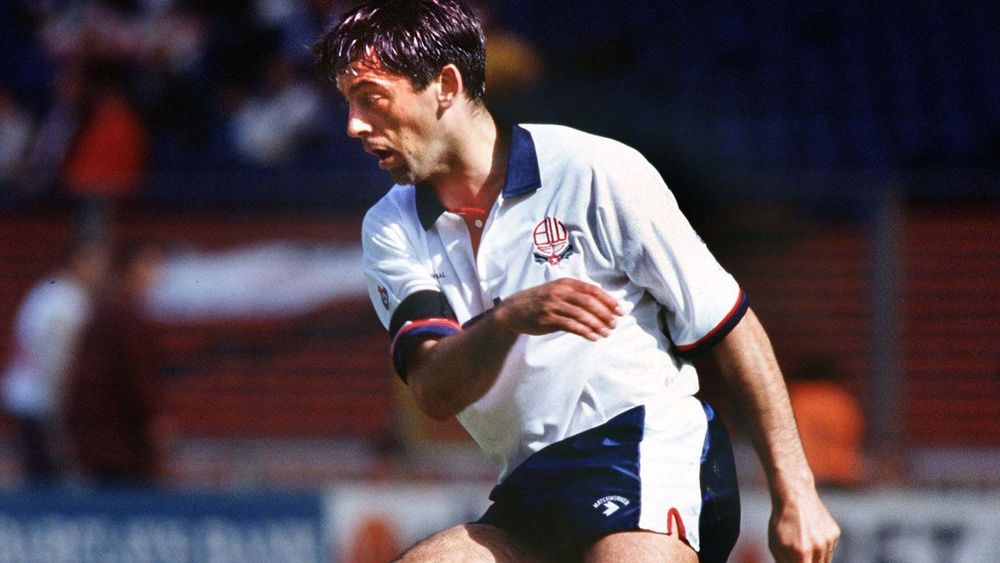
Having served his time as an electrician, he was accustomed to long days and hard graft. The prospect of training for a couple of hours and then heading home was difficult for him to comprehend.
Brown told Football Presse, “It was an easy decision for me because, you know, there was nobody else in terms of league football, nobody else around, you know, so I was probably staring at a life of — I served my time as an electrician. I had a lot of support from my fellow electricians and, you know, bosses and people like that.
“I always remember borrowing the boss's van, you know, his work van, to go to training on a Tuesday and Thursday night so I could get to training. And then, you know, one day I had to ask for the Saturday morning off because I was playing for Hartlepool United. We worked seven days a week.
“There's certain people that you think about and you forget. But without them you wouldn't have achieved, you wouldn't have got that professional contract. And when you get the professional contract, I was still going back to thank them.”
The contrast between his two working environments was considerable. Brown was used to working 12-hour days, seven days a week, and could not understand why his new teammates were satisfied with the relatively short hours involved in professional football training.
“But then you go into the world of football and it's a totally different world. It's absolutely, you know, you're working one-and-a-half, two hours a day. And I just couldn't understand that, you know, because I was working 12 hours a day, seven days a week as an electrician.
“And, you know, you finish training sessions, I was looking around the changing room saying to the lads, 'What do we do now? What do we do now?' And they're all looking at me as if I'm talking a foreign language.
“So I started my own business up. I started my own electrical business up and I was doing domestic rewires. And when we finished training at 11.30, 12 o'clock, I was jumping in the car and away, doing a rewire. They couldn't understand it.
“And then when the manager found out, he was like, 'How can you do both? You can't do them both.' I said, 'I can. I know I physically can.'”
Brown's determination to keep working was about more than earning money. He also questioned the idea that football needed to occupy every waking hour of a player's life. He enjoyed the game, but believed there was a danger in becoming so immersed in it that perspective disappeared.
“Mentally, football's an enjoyable game, in my opinion. Once you get too far into it, it becomes blurred vision.
“But for me to train for an hour, an hour and a half, two hours on a Monday morning, Tuesday morning, Wednesday off, Thursday morning, Friday morning, maybe one double session on a Tuesday afternoon, I'm like, 'This is not right.'”
The coaches who helped him improve
Brown's solution was to make the most of his time on the training ground. At Hartlepool, he found two coaches who were prepared to help him develop beyond the scheduled sessions: George Smith, a former Birmingham City midfielder, and Willie Maddren, the former Middlesbrough defender who also coached at Hartlepool.
“Then you bump into a coach. I bumped into two coaches at Hartlepool United, again going into bumping into people. George Smith, who was a former midfield player for Birmingham City, and Willie Maddren, who was recognised in the North East as one of the best centre-halves that have ever come out of the North East. And some of the greats have come out of the North East.
“And then both of them taught me dedication, come back, do extras. You know, when a coach says something, make sure it sticks. And if you can do it on your own, do it on your own, practise on your own.
“So they were the ones that I was thinking, 'They're the kind of guys that I need at my beck and call for any questions I'm going to be throwing their way.' It's just like when I'm doing an electrical job, somebody's asked me a question about it, I'll be telling them, I'm at their beck and call.
“That's exactly what these two guys were, and they were brilliant. They were absolutely priceless for me.”
The lessons were straightforward: work at your game, listen to people who know what they are talking about, and take responsibility for your own development. Brown found coaches who were willing to answer questions and help him improve, and he made the most of their availability.
The results were reflected in his consistency. Brown estimates that he played approximately 220 games across five seasons at Hartlepool, averaging more than 40 appearances per campaign.
“And they got me through five seasons at Hartlepool United. I think I played something like 220 games in five seasons. So that, on average, is like 42, 43 games a season.
“So that tells you, one, I was fit enough. Two, I was mentally capable of getting to the next game. But three, I was good enough. That was the most important. Three, I was good enough because I was first choice for the manager. I was reliable.
“I had bad games. We all have bad games. But I was first choice and kept on going back and going back and going back, and eventually you get a career from it.”
Keith Houchen, Bob Newton and the Hartlepool dressing room
Hartlepool also brought Brown into a dressing room containing players with different qualities and backgrounds. Among them was Keith Houchen, who would later become famous for scoring Coventry City's winning goal in the 1987 FA Cup final, and Bob Newton, a robust forward whose partnership with Houchen left an impression on Brown.
“When I signed for Hartlepool United, we had Keith Houchen, who was renowned for scoring the winner for Coventry City in the FA Cup Final. You know, Bob Newton. We had the Linighan brothers, Andy Linighan and David Linighan. So we had some good players that actually progressed and went further from Hartlepool United.
“So the scouting system at Hartlepool, I cannot question.”
Houchen's development as a centre-forward provides a particularly revealing example of how Brown began to understand the relationships between players. Rather than attributing everything to a specialist training routine, he described how Houchen's qualities complemented those of Newton, whose physical approach offered a different kind of challenge to defenders.
“Not with Howchie. Where Howchie was concerned, he played alongside a lad called Bob Newton. And Bob Newton was a renowned lower-league footballer, but that doesn't make him a bad person. It doesn't make him a bad player. He was a stocky-built lad. He was solid. He was quite resilient. He had a reputation that crossed the line before he did.
“And sometimes he was on the thick end of a hiding, and other times he was on — you know, it was a tough game, but he never, ever shied away from it.
“Whereas Howchie was concerned, he was a refined footballer. He was a better footballer. And he had a range of movement. He was probably six foot three, Keith. And for Keith to be feeding off somebody who's stocky-built, five-ten, five-eleven, six foot maybe, for him to play alongside, it was probably the foundations of what Houchen thought: 'This is what I like. This is what I like about the game. I'll feed off this guy and I'll show you what I can do.'
“And he could put the ball in the back of the net. There was no doubt about it.”
Brown was beginning to recognise that a manager's job involved understanding how players could complement one another. The strongest partnerships were not necessarily formed by selecting two players with identical qualities, but by recognising what each could contribute.
He also saw the importance of trust. Billy Horner, who gave Brown his opportunity at Hartlepool, was credited with establishing Houchen as a centre-forward. Asked about the specialist training involved, Brown instead drew attention to the value of continuing to select players who were performing well.
“But for Billy to improve them, I think that's probably the first lesson in management. The best way to improve our players is keep on picking them. So that, one, they've got to be good enough. Two, if you keep picking them, they're doing something right.”
Billy Horner and the beginnings of a managerial education
Brown's curiosity extended beyond his own development as a player. He wanted to know what happened after training, how a manager approached the job and what went into organising a football team. Horner gave him an early opportunity to observe those responsibilities at close quarters.
Brown also recognised that his upbringing had influenced the way he approached learning. Just as he had been willing to ask questions in his electrical work, he sought out coaches who could help him improve on the football pitch.
“I always look at that and wondered, was that my upbringing? You know, the fact that I've just mentioned George Smith and Willie Maddren, and they were my go-to coaches.
“And what I mean by coaches, you knock at the coach's door and say, 'Do you fancy going out with a bag of balls in the afternoon?' In the afternoon, maybe because I didn't have a rewire. You know, it's crazy, but that's fact.
“But Billy was the manager who picked the team and did the tactics and organised all of the things that you do. I'm looking back at that as I'm answering the question here, Jacob. I'm looking back at that and asking, is that my grounding now? Is that my apprenticeship with regards to management? Because I kept on asking questions. What does the manager do now? You know, we're finished now. What do you do?”
For Brown, the important thing was that these experiences were accumulated naturally. He was not following a formal management apprenticeship, but he was observing how the game worked, questioning the people around him and beginning to understand the responsibilities that came with leading a team.
“So Billy was probably my first manager that I looked at and went, do I want to be a manager? Then you get the next one, do you want to be a manager? And eventually when Bruce came around, I wanted to be a manager.”
Hartlepool had provided Brown with the opportunity to establish himself as a professional footballer, but the five seasons he spent there also gave him the foundations for what followed. He learned from coaches who encouraged him to work independently, played alongside footballers whose contrasting qualities offered lessons in team building, and began to look beyond the pitch to understand the manager's role.
His electrical business remained part of that journey, reinforcing the discipline and work ethic he had brought into football. For Brown, the two professions were not incompatible. Both demanded reliability, attention to detail and a willingness to keep learning.
The lessons he took from Hartlepool would stay with him as he moved into the next chapter of his playing career, and eventually towards management.
Follow our 5-part series with Phil Brown this week as we discuss his almost 50 years in the professional game.