
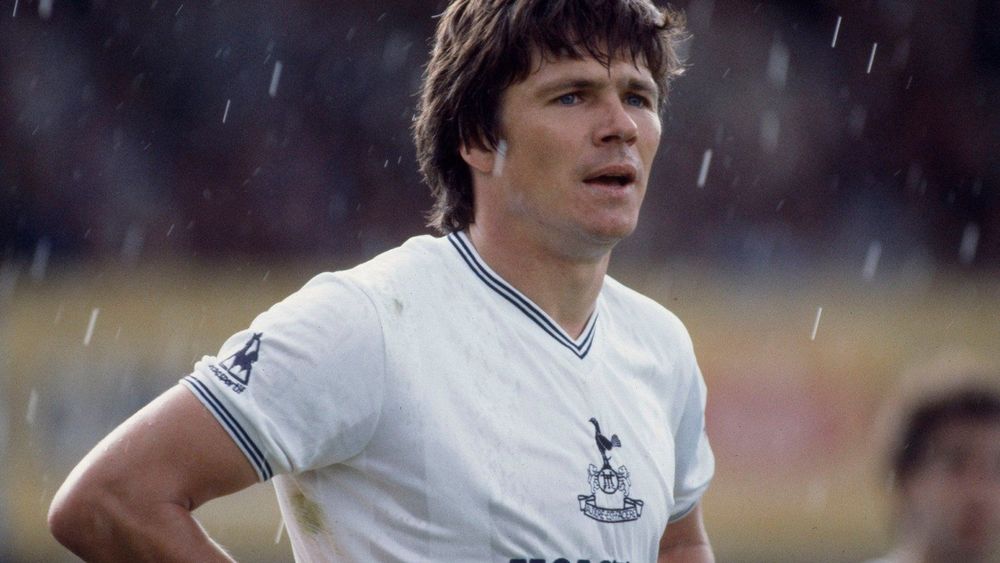
As a teenager at Spurs, Miller was desperate to play but found himself waiting for his opportunity. There were few loan arrangements in English football at the time, and when close friend Alan Brazil suggested going to America for the summer, Miller was tempted.
Brazil was heading to America to play football, where young British players could spend several months earning money while getting regular games.
“I was getting frustrated because I wasn't playing,” Miller recalled to Football Presse. “I was 17, 18 and I wanted to play.
“Alan Brazil, one of my close friends, said to me, ‘I'm going to America for the summer to play football.’ In America in those days, they had a lot of young lads running around for the senior players.
“You got there for six months, you had a nice few bob, you had a good time socially and you played. So Alan said to me, ‘Do you fancy coming?’ I said, ‘I wouldn't mind that.’”
Before committing himself, however, Miller spoke to Tottenham captain Steve Perryman.
“I said to Steve at the time, ‘I think I'll go to America for the summer and come back in September.’
“He said, ‘You'll have a great time there, but I'm not sure it'll do your football any good. Why don't you go to Norway?’”
Miller had no idea why Norway would be an alternative.
“I said, ‘I didn't know Norway played in the summer.’
“He said, ‘They can't play in the winter.’
“I said, ‘Well, I never knew that.’”
Perryman's advice would prove transformative.
Through a mutual friend, Lars Ugland, who was then head of the Norwegian FA, Miller was given the chance to spend a weekend on trial with Skeid, a club that had just won promotion to the Norwegian first division for the first time.
Their manager was Leif Eriksen, who would later manage the Norwegian national team.
“He organised me to go and have a trial, a loan, a weekend with a club called Skeid, who had just got promotion into the first division for the first time in their history. They needed some players.
“Their manager was a guy called Leif Eriksen, who eventually managed the Norwegian national team. He said, ‘Go there for the weekend, have a little practice match and we'll see what you do.’
“Of course, I went there. We played on the astroturf and it went very well for me. I organised the back and Leif wanted me to stay.”
Then came another incentive.
“They offered me three times the money I was getting at Spurs, and I thought, ‘Yes, that'll do.’
“And then I saw the ladies there in Norway and thought, ‘Yeah, it could only be good.’”
Miller returned to Tottenham and told Keith Burkinshaw he wanted to spend the summer in Norway.
Burkinshaw agreed, although his response was characteristically blunt.
“I went back to Burkinshaw and told him I was going to go away for the summer and he said, ‘Okay.’ But his first words were, ‘Don't expect anything like the wages you're going to get there when you come back here.’
“Which is typical Keith for a Yorkshireman.”
The move proved to be considerably more than an adventure.
Miller helped Skeid finish fourth in the league despite having only just been promoted, with the club qualifying for European competition. He was also voted the league's Best Foreign Player of the Year.
“We finished fourth in the league. We qualified for Europe, which is very unusual for a team who had just got promotion.
“I was voted Best Foreign Player of the Year in the league.”
Tottenham eventually brought him back, and Miller returned to England with precisely what he had been looking for: regular first-team football and the confidence that came with proving himself away from home.
“Then I came back to Spurs. Obviously they made me come back — I mean, we signed a contract and came back — and then I started playing.
“So Norway for me was a great time and a great experience. I still have many friends in Norway, particularly Lars Ugland, who's a great friend of ours.”
It is impossible to tell the story without returning to Perryman.
For Miller, the Tottenham captain was not simply an important senior player. He was somebody the younger players respected and someone who understood when to intervene.
Asked about Perryman's leadership, Miller is unequivocal.
“One of the best. Great leader. I see Steve quite often, speak to him all the time. He had time for everybody.”
Perryman had himself grown into a remarkable Tottenham era, having played alongside an earlier generation of club greats before becoming a leader of Miller's team.
“He grew up in a great era. Remember, he played in a terrific side when he got in the team. He had international players either side of him, Alan Mullery and Martin Peters.
“He'd done all the running around for us. Alan Mullery and Martin Peters. And obviously Gilzean, Chivers and Mike England.”
For Miller, Perryman's longevity and ability to bridge two great Tottenham sides made him particularly unusual.
“To play in two top sides is very rare in a career.”
And his personality never changed.
“Steve was a very strong character, great leader, big personality, good talker, and no change now, the same as he's always been.
“So for us young players, he was someone to look up to and respect, and he reminded us constantly if our standards dropped.”
That makes Perryman's assessment of Tottenham's failure to win the league during his playing career particularly interesting to Miller.
Perryman has suggested that Spurs lacked the cynicism of some of their great rivals, particularly Liverpool and Everton, and that this may have cost them when they came close to winning the title.
Miller does not dismiss the idea.
“Yeah, we just lost our way a little bit, maybe. We came close a couple of times, especially, but we just didn't have something that took us over the line.
“I don't know what that was. It could have been cynical, maybe. I'm not sure.”
There is an important qualification from Miller, though, particularly given his own position as a defender.
“Certainly defenders were maybe some of the other players. In other positions they weren't cynical. But we gave it a good go.”
And Miller does not want Tottenham's failure to win the league reduced simply to a question of mentality.
The competition they faced was extraordinary.
“Everton and Liverpool had two of their best teams ever, so it wasn't like it was an easy league to lose.
“This wasn't when Leicester won the league and Spurs finished runners-up. We're talking about two of the best teams in the history of Liverpool and Everton, that period.
“You see how many trophies they won and what they did.”
There is a hint of acceptance in Miller's final assessment.
“It was just unfortunate. But you take what it was. It was where it was then anyway.”
That may be the fairest way to view Tottenham's near misses.
They had the flair, the personalities and the trophies to prove their quality. They had Hoddle and Ardiles supplying the artistry, Perryman providing leadership and Miller and his fellow defenders doing the work that allowed the more gifted players to flourish.
But they were competing against Liverpool and Everton sides that were operating at an extraordinary level.
And perhaps that explains why Perryman's old observation still resonates with Miller.
Maybe Tottenham did need a little more cynicism.
Maybe they simply needed a little more luck.
Or perhaps, as Miller ultimately suggests, they were unfortunate to have been competing against two of the greatest teams either club has ever produced.
What is certain is that without Perryman's intervention, Miller's own story might have taken a very different course.
America could have been the adventure.
Instead, Perryman sent him to Norway.
Miller came back as a player ready for Tottenham's first team — and eventually became part of the side that would win two FA Cups and the UEFA Cup.