
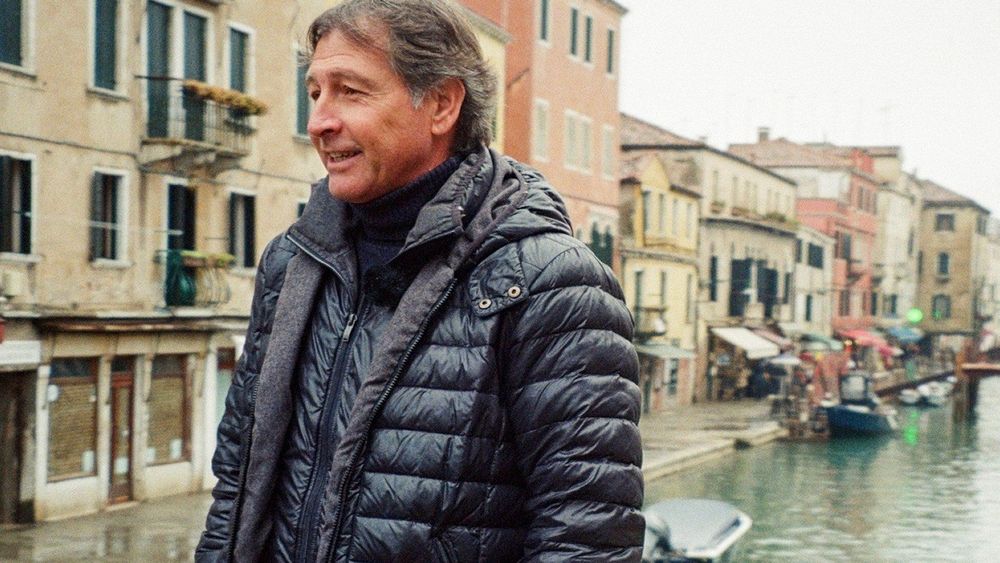
Looking back, Poggi has no regrets.
“For me, my career was the realisation of a dream, definitely,” he told Football Presse. “It gave me a lot of satisfaction and I have no regrets.”
His happiest years came at Udinese, where he spent six seasons after joining from Torino in 1994.
“Definitely my best experience was Udine, also because it lasted six years, during which I achieved my best personal results.”
The hardest was Roma, despite the extraordinary professional experience.
“Roma was an extraordinary experience from a professional point of view, because it is an enormous club with an incredible fanbase,” Poggi said.
“But it was also very difficult because moving from provincial football to metropolitan football, personally, was a very difficult transition.”
Before Udinese and Roma came Torino, where Poggi made his Serie A debut against Juventus in 1992.
It was more than a football match for a young player who had grown up watching the derby on television.
“It was the first derby I had seen, Torino-Juventus, with great champions,” he recalled. “When I was called to go onto the pitch I was so, so emotional because it almost didn't seem real to me that I was entering a match that, until shortly before, I had only watched on television.”
A year later he was part of the Torino team that won the Coppa Italia under Emiliano Mondonico, a coach Poggi still remembers for his extraordinary ability to read matches.
“We were a very strong team, there were many champions and we were coached by a very intuitive manager,” he said.
“Among all the coaches I had, Mondonico was certainly one of those who read the game best. He knew what to do at every moment depending on the result.”
But Udinese became the defining chapter.
“I arrived when I was 23 and left when I was 29,” Poggi said. “The Udinese I still consider, in a certain sense, my second home.”
“It represented the most important part of my career.”
It was also where Poggi formed his famous attacking partnership with Oliver Bierhoff and Márcio Amoroso.
“I had an excellent understanding with them on the pitch and a good relationship outside as well, so much so that we still speak to each other today,” he said.
The reason the trio worked, Poggi believes, was precisely because they were different.
“We all had completely different characteristics from one another,” he explained. “And we had a coach who gave us the possibility to emerge, to make ourselves known and to bring out all our characteristics.”
That coach was Alberto Zaccheroni, whom Poggi regards as the most important manager of his career.
“Zaccheroni was undoubtedly the most important coach of my career,” he said.
“I had him for two years at Venezia when I was still a boy, and then three years in Udine. He taught me the game of football in the true sense of the word.”
“Zaccheroni wasn't just a coach, but a master of football.”
Poggi believes Zaccheroni's work at Udinese was even more impressive than the Scudetto he later won with Milan.
“Even though he then won the Scudetto with Milan, I believe the achievement he made with Udinese was undoubtedly the most difficult and important of his career.”
His own place in Serie A history came at Piacenza in December 2001, when Poggi scored after just eight seconds against Fiorentina.
What he remembers most is not the speed.
“The thing that still seems strange to me about that goal is that the ball belonged to Fiorentina,” he said.
“So I managed to score having touched the ball only twice.”
The record survived until Rafael Leão broke it in 2020. Poggi's reaction was characteristically generous.
“My first reaction was to say, finally someone has beaten it.”
“I have always thought that with the evolution of football, records have to be broken.”
“I am happy that it lasted so long, for 19 years, but I am equally happy and convinced that soon they will break Leão's record too, because it means football is evolving.”
Poggi eventually returned to Venezia, where he finished his playing career in 2009. If given 90 minutes to relive one match, however, he would go back even further.
“I would choose the Venezia-Como play-off in Cesena in 1991,” he said.
“It is the match we won which allowed us to go to Serie B after so many years.”
His connection with Venezia has continued long after his playing days. Poggi moved into football management, working with clubs including Mantova, Udinese and Venezia, where he held senior technical and international-project roles and was part of the club's return to Serie A in 2021.
Today, his work remains centred on young players and the development of football away from the professional spotlight.
That makes his view of the Italian game particularly interesting.
Poggi believes today's young Italian players are not short of ability.
“What the Italian player lacks is only the opportunity,” he said. “The opportunity that can be given to him by a coach who has courage and lets him play.”
“There are many, many good young Italian players.”
For Poggi, the wider problem is that Italian football has lost something fundamental.
“It has changed. It is almost another sport,” he said of Serie A.
“That was the league where every player in the world wanted to come. It was an extremely difficult league, and for this reason I am very happy and proud to have played in those years.”
His journey took him through some of the biggest clubs and dressing rooms in Italian football, but the thread running through Poggi's career is remarkably simple.
It began with a boy watching Torino-Juventus on television.
It ended with a man who had actually played in that derby, won the Coppa Italia, shared an attack with Bierhoff and Amoroso, learned from Zaccheroni, played for Roma and scored the fastest goal Serie A had ever seen.
And when asked to choose the one match he would play again, he did not choose the record or one of the great nights at a major club.
He chose Venezia.
That probably tells us everything about Paolo Poggi.