
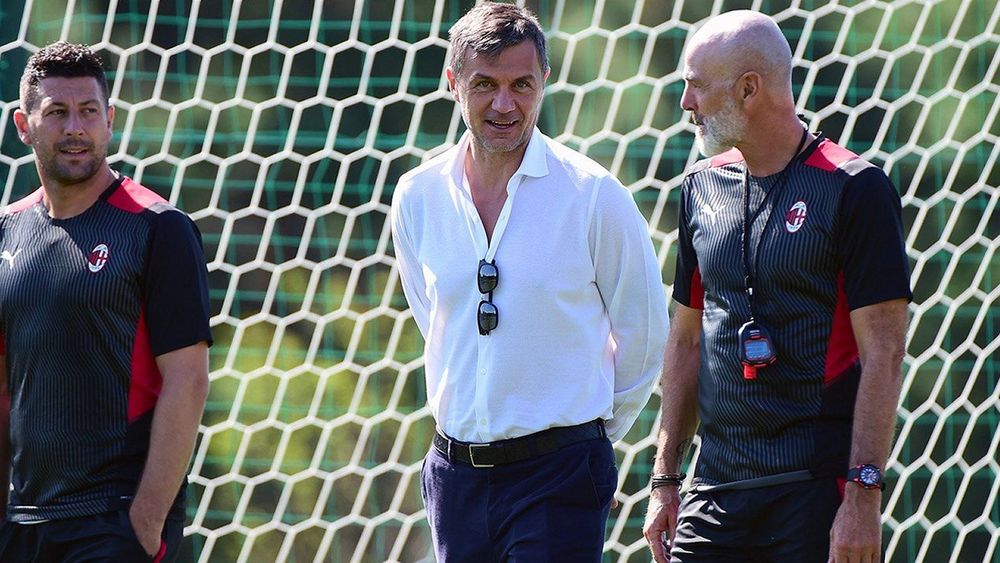
Speaking to Corriere della Sera, Maldini insisted he had no attachment to the role itself.
"I'm not attached to the position. I feel very free in my choices. Thank God I have no financial needs. What leads me to accept roles is the possibility of actually carrying them out, of making my contribution," he said.
"I'm sorry this is seen as arrogance or intransigence. But if I'm identified as responsible for something, I feel duty-bound to actually be responsible for it."
Maldini revealed that his first move, alongside advisor Leonardo, had been to approach Guardiola about the vacant head coach position, travelling to Barcelona to meet the former Manchester City manager in person.
"He's the coach who most embodies technical, offensive football. Through some friends he had shown he liked the idea of coaching a national team. We went to see him in Barcelona, had lunch together, talked for an entire day. He was very tempted. He came very close to accepting. He even started writing out line-ups on paper," Maldini said, adding that Guardiola's eventual decision to pass was driven not by financial demands but by fatigue after ten years in the Premier League and recent back surgery.
With Guardiola unavailable, Maldini and Leonardo turned to Andrea Pirlo as their preferred candidate, having initially also considered Daniele De Rossi and Fabio Grosso - both, like Pirlo, members of Italy's 2006 World Cup-winning squad.
"Our idea was tied to technique, to offensive football, to change. In Italy we've fallen behind in a lot of areas. We wanted young players' development to be based not on tactical over-coaching but on technique, one-on-one ability, an offensive mentality. And we wanted a young coach with a history in the national team," Maldini explained.
De Rossi and Grosso were ultimately ruled out, he said, because Giovanni Malago's presidency had been secured with an agreement not to approach coaches currently employed by Serie A clubs.
The arrangement collapsed, according to Maldini, when Malago moved to change the terms under which the pair had agreed to work.
"Then the agreement was revisited; as a result, the only thing to do was resign - or rather, decline to sign the four-year contract that was due to start on 1 August," he said.
Pirlo's candidacy had also drawn scrutiny over his sponsorship ties to Russian betting company Fonbet, controversy that further complicated the appointment before Malago moved to take direct control of the coaching decision himself.
Maldini offered a measured assessment of his successor, Claudio Ranieri, who has been appointed to the technical director role, with Roberto Mancini taking the head coach's job.
"His history speaks for him. I can't judge. Having a figure like Ranieri is a plus, something exceptional. I just say the work to be done is enormous. I don't know what he's been asked to do. I fear a lot of importance will be placed on the national team, and much less on rebuilding Italian football from the ground up," he said.
Asked how he personally felt about the outcome, Maldini pointed to a conversation with Guardiola about Johan Cruyff's transformation of Spanish football as an illustration of the project he had hoped to build.
"I have a regret I'll carry with me. I had taken on a demanding commitment that in those days had become almost a dream: to do something for future generations, to build a competitive Italy," he said. "It's a shame. A real shame."