
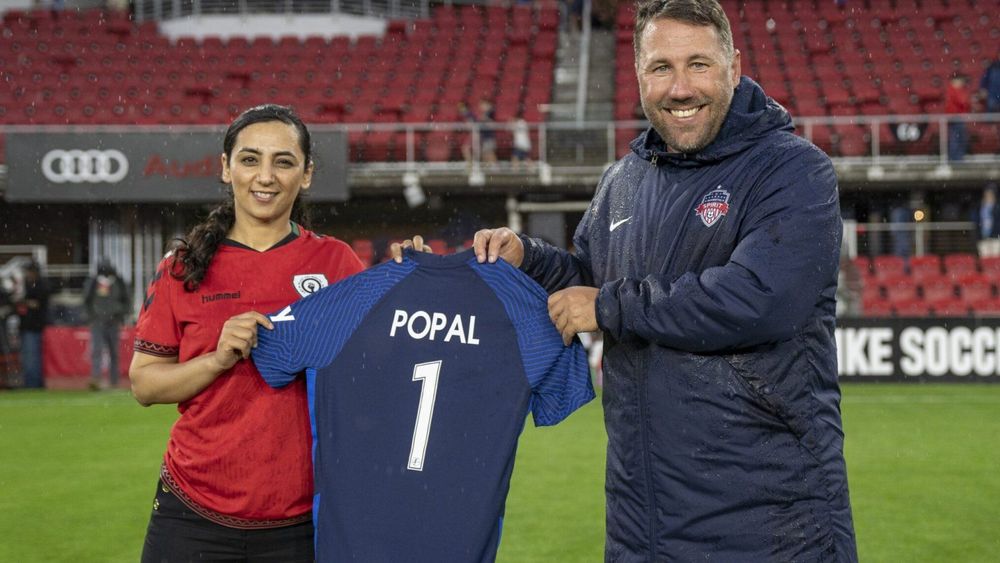
It is a deeply personal account of the fight to establish women’s football in her country and the subsequent struggle to protect players after the Taliban returned to power.
We also examine FIFA’s plans for the inaugural Women’s Club World Cup in 2028 and the 2027 Women’s Champions Cup, the return of Indonesia’s domestic league after a lengthy absence, Canada’s October internationals against Denmark and the second-season progress of the Northern Super League.
Khalida Popal’s autobiography: a remarkable story of courage and survival
Khalida Popal’s autobiography, *My Beautiful Sisters: A Memoir of Courage, Hope, and the Afghan Women's Soccer Team*, published by Citadel Press in 2025, is one of the most compelling accounts of the struggle to establish women’s football in Afghanistan.
I strongly recommend this book. Popal describes growing up in a country where women were expected to remain in the shadows, returning from exile in Pakistan with her family after the Taliban fell from power in 2001, and then helping to build Afghanistan’s women’s national team.
Her work with the Afghanistan Football Federation brought her into an increasingly prominent position, but that visibility also put her at risk. In 2011, she was forced into exile again. A decade later, from her home in Denmark, she would help coordinate the escape of members of the national team as the United States and other countries withdrew their military and infrastructure support from Afghanistan in August 2021.
The book is much more than a football autobiography. It offers a vivid account of the restrictions placed on women and girls, the personal risks involved in challenging those restrictions and the lasting consequences of the Taliban's return. It is an important work from both a women's rights and sociological perspective.
Popal recalls how, after her family returned to Kabul, she and her school friends would play football during the break between morning and afternoon classes. The opportunity to play gave them a rare space in which they could express themselves freely.
“With the school quiet, we could be ourselves, we could talk and we could also celebrate, shout and express ourselves playing soccer. These were new experiences and new emotions. Girls, shrieking with glee at having wrongfooted the goalkeeper, before lashing the ball between the rock-goalposts against the wall, which we imagined would ripple like a net—this was not normal or accepted.
“Shouting for my teammate to pass me the ball or gasping loudly as my leg entwined with another’s, seeking to grapple the ball free of their possession, was utterly exhilarating. These girls had spent their lives being taught that women were to exist in the shadows, on the periphery. Quiet and unassuming. Since returning to the city [Kabul], I had felt the weight of this expectation crushing down on me, but every day during this time I feel able to be myself.”
Popal was instrumental in working with the Afghan federation to establish a national team. In a country without a developed grassroots structure, the organisers had to approach the process differently from most established football nations.
“In most countries, there is a healthy grassroots league system representing teams across the nation; players complete locally and the best teams play each other, as do school teams. Some countries even have semiprofessional and professional teams to draw their players from. But we didn’t have any of that infrastructure in place.
“We need to work backward and use the profile of a recognized national team to empower women at the grassroots level. Our plan was to start with the senior side and then expand the national team setup to include youth teams, holding regular festivals and tournaments to recruit for different age groups.”
Reaching the final of an early tournament in Islamabad in 2007 was therefore about much more than winning a trophy. The players understood that their performances would be judged by people who wanted the experiment to fail.
“We weren’t scared of the soccer anymore, or the field, or the ninety minutes, but we feared the pressure we were under, to keep proving ourselves and our worth. We knew that the overwhelming majority of those watching wanted us to fail, because it would give them an excuse to rip up and dispose of the seedling of women’s soccer that we had planted in the hard, stony and unwelcoming ground.
“They wanted us to embarrass ourselves and embarrass them so they would feel vindicated in their prejudicial views that we were not good enough. That was what fueled us to fight on through any pain, to prove them wrong. We could have had broken bones or kept running until we passed out—we would have played on regardless.”
In 2010, Afghanistan's women's national team played its first friendly on home soil, against a team made up of NATO soldiers. Popal saw the match as an opportunity to show the soldiers that Afghanistan was more than the conflict and the men they encountered in their daily work.
“My motivation had been to show these soldiers what they were fighting for, or rather, who they were fighting for. I desperately wanted to show them that there were many people in the country who wanted peace. I had seen the way they behaved around us when we went to our training field at the airbase, how suspicious they were. Their primary interaction with Afghans was with men, with fighters and fundamentalists. I thought it was important to show them that there was more to the population, that there was a human face to the country now.”
Popal also recognised the significance of the women soldiers taking part. It was an unusual encounter for both groups, with the players and soldiers able to see beyond the assumptions each had formed about the other.
Her commitment to women's rights continued through her own experiences as a refugee in Europe. She described football as a universal language, but one that many women were still prevented from speaking.
“Soccer is a universal language but it is also one that so many are not allowed to speak. In those dark days [as a refugee in Norway, which would not provide sanctuary but sent her back to Denmark, where she had first entered Europe after fleeing Kabul via Delhi, India], I was determined to never stop shouting.”
The most painful passages concern the aftermath of the Taliban's return in 2021. At the 2023 Women's World Cup final in Sydney, Popal was reunited with members of the Afghan team, many of whom had settled in Australia and were playing in a local league with support from Melbourne Victory.
She described the conflicting emotions of seeing the players safe, while reflecting on the collapse of everything they had worked to build.
“I feel a great responsibility to every woman and girl in Afghanistan who ever kicked a ball as a result of my work. I feel like I was played and used, and that is the most horrible, tumultuous feeling. I fought for women’s soccer to exist. I fought for spaces for them to play. I fought for them to embrace something new, to find their strength.
“I labored under the impression that we did so with a degree of relative safety. Logically, I know that this is not my fault, but logic doesn’t always dominate. Instead, the knowledge that if I hadn’t driven and pushed for the sport so hard, these women wouldn’t be at risk as they are, is all consuming.”
She also described the anguish of learning that some former players wished they had never become involved in football because of the consequences they had faced.
“I once asked some players whether they wished they had never got involved in soccer. They said yes. That was a hard thing for me to hear. These women had fought for the right to play, as I had. They had used soccer as a tool to fight back against their oppression as women.
“They had put their lives at risk—crossing borders into the unknown and leaving everything, including many of their family members, behind—but they cannot formally be recognized as a national team. A women’s team would have to be sanctioned by the Afghanistan Football Federation, something which, under Taliban rule and influence, they will never do. So, no team can exist.”
Popal calls on FIFA to help secure the future of Afghanistan's women's national team. In 2025, the organisation established an Afghan refugee side, Afghanistan Women United, with an experienced Scottish coach. It is an important development, although the question of formal recognition and the future of players who remain displaced is far from resolved.
The book also brought back memories of an interview I conducted in 2008 with former German international Monika Staab, who was then working as a FIFA women's football specialist in Asia and coaching in Pakistan, where Popal had lived as a refugee.
Staab explained the difficulties of recruiting girls in a society where parents feared that playing football would damage their daughters' prospects of marriage.
“I have to convince parents, afraid that when she plays rough and tumble football, she will not find a husband, to allow the girls to play.”
She found that marriage itself often became another barrier, with women in their early twenties expected to give up football.
“The role of women is to stay at home, do the cooking, washing and getting babies.”
My own research at the time found that, during 2009-10, an estimated 526,000 men played football regularly in Afghanistan compared with only 340 women.
Popal's book gives those figures a human dimension. In its acknowledgements, she dedicates the work to the players of the Afghanistan women's national team, which formally existed from 2007 to 2022 and continues to fight for its future.
Many of her former teammates may never be able to tell their own stories. Popal wanted to ensure that their experiences were not lost, and that the wider struggle of Afghan women was recognised.
*My Beautiful Sisters* is a stirring and revealing account of a movement that briefly created opportunities for women in a deeply restrictive society. It is also a reminder that the disappearance of a national team does not erase the courage of the players who built it.
FIFA's inaugural Women's Club World Cup heads to the United States
FIFA's plans for the first Women's Club World Cup are becoming clearer, with the inaugural 22-team tournament scheduled to take place in the United States from January 5-30, 2028.
California, most likely the San Diego and Los Angeles area, is expected to host the competition, according to reporting by *The Guardian*. The tournament was originally expected to be held in Qatar, but the United States now appears to be the preferred destination.
The timing could create significant problems for English clubs Arsenal and Chelsea, who may have to spend almost a month away from domestic competition during the 2027-28 season. Both clubs could face additional demands from the Women's Champions League or Europa Cup, as well as domestic cup competitions. Enlarging their squads may become necessary to manage the workload.
NWSL commissioner Jessica Berman has also identified a potential problem for American participants. Although the tournament falls before the start of the 2028 NWSL season, qualifying clubs such as Gotham FC would be returning from their off-season, potentially putting them at a disadvantage against teams already in competitive action.
Berman described the situation as a “fundamental challenge”, explaining that the timing would not interrupt the NWSL campaign but would mean that its representatives arrived after a period without regular matches.
The tournament will begin with a six-team play-in stage, involving one representative from each of FIFA's six confederations. The three winners will join 13 clubs that qualify directly for the group stage.
The 16 teams will be divided into four groups of four, with the top two from each group advancing to the quarter-finals. The competition will then move into a straight knockout format.
UEFA will have five automatic places, while Asia, Africa, North America and the Caribbean, and South America will each receive two. Oceania's only route into the tournament will be through the play-in stage.
Seven clubs have already qualified:
- Gotham FC — 2025 CONCACAF Champions Cup winners.
- Arsenal — 2025 UEFA Women's Champions League winners.
- Barcelona — 2026 UEFA Women's Champions League winners.
- Corinthians — 2025 CONMEBOL Copa Libertadores Femenina winners.
- Wuhan Jiangda — 2025 AFC Women's Champions League winners.
- Naegohyang — 2026 AFC Women's Champions League winners.
- Club América — 2026 CONCACAF Champions Cup winners.
The UEFA allocation is particularly interesting. Arsenal qualified by winning the 2024-25 Champions League, while Barcelona secured their place through their 2025-26 triumph. Chelsea are also expected to qualify unless Manchester City win this season's Champions League.
Barcelona will have another route through the 2026-27 Champions League winners, while the remaining places will be influenced by the clubs' UEFA coefficient rankings over the four-year period from 2024 to 2027. Barcelona, Lyon, Chelsea and Bayern Munich were the leading teams in the table at the time of Tim's report. Wolfsburg were fifth, but their absence from this season's 18-team Champions League league phase could affect their position, with Real Madrid and Paris Saint-Germain also in contention.
UEFA will allow no more than two clubs from any one country.
The United States offers FIFA a useful opportunity to test stadiums, ticket pricing and public interest in a major women's club competition. The country hosted the first men's Club World Cup in its expanded format in 2025 and is also hosting the 2026 men's World Cup alongside Mexico and Canada. It will stage the 2028 Olympic football tournaments and is being discussed as a likely host for the 2031 Women's World Cup.
The Club World Cup will therefore give FIFA an opportunity to assess the commercial potential of women's club football in the United States ahead of another major international tournament.
Women's Champions Cup: Naegohyang advance in Miami-bound competition
The second edition of the FIFA Women's Champions Cup is also taking shape, with Asian champions Naegohyang Women's FC of North Korea defeating Oceania representatives Auckland United 2-0 on October 25 in China.
North Korea international Kim Kyong-yong, 24, scored both goals, finding the net in the 17th and 88th minutes. She has been in outstanding form, recording 33 goals in 27 matches by late September 2026 and winning the Most Valuable Player award at the 2025-26 AFC Women's Champions League.
Kim has already won two domestic league titles with Naegohyang, in 2021-22 and 2023-24, and was the league's leading scorer during the first of those campaigns. She also featured for North Korea at the 2026 Women's Asian Cup in Australia, where the team secured qualification for the 2027 World Cup.
She will be one to watch at the finals in Brazil next summer, where she is expected to lead North Korea's attack.
Naegohyang will meet the yet-to-be-determined African representative in December. The winner will advance to the semi-finals in Miami on January 26, 2027, to face Club América. Barcelona will meet the winner of the South American qualifying competition the following day.
The Final Four will be held at the recently opened Nu Stadium, home of Inter Miami CF. The venue's selection gives FIFA another opportunity to use the competition as a test event in a major American football market.
Barcelona and Club América are already confirmed, alongside the eventual CONMEBOL representative. Arsenal won the inaugural edition in London, defeating Brazilian side Corinthians 3-2 after extra time in the final.
Indonesia's women's league returns after seven years
Indonesia's women's football league has restarted after a seven-year absence, with the Indonesia Women's League (IWL) beginning a new season on October 18, 2026.
The competition last operated in 2019 and will initially feature six teams, all based in Greater Jakarta. The league is being introduced on a five-year trial basis, with the Football Association of Indonesia (PSSI) allocating 24 billion rupiah, approximately US$1.3 million, to support the restart and provide modest salaries for players.
PSSI chairman Erick Thohir, the former owner of Inter Milan, has overseen the return of the competition.
One of the players returning is Zahra Naqiyyah, 22, who helped Garudayaksa Women win the only previous edition of the league in 2019 when she was just 15. She has since graduated in sports science and qualified as a football coach, as well as continuing her playing career.
Naqiyyah believes Indonesia can become a major force in Asian women's football if the domestic game is properly managed.
“If Indonesia’s women’s football is properly managed, we can become a powerhouse in Asia.”
The original competition lasted only one season before the combined effects of the COVID-19 pandemic and financial difficulties brought it to a halt.
Other players have spent time abroad during the intervening years. Nastasia Suci Ramadhani, 20, has played in the Maldives and has returned to Indonesia, where she will also represent Garudayaksa Women.
She pointed to the difference between the opportunities available to male and female footballers in the country.
“For men there’s a league every year, but for women there isn’t.”
Some members of the national team have been based overseas, including in Australia, Belgium, Germany, the Netherlands and the United States.
Coaches have warned that restarting the league is only the first step. Yopie Riwoe, 57, head coach of Garudayaksa and a former assistant with the women's national team, believes the country needs consistent, high-intensity training if it is to compete with Asia's leading sides, including Japan, China, South Korea and North Korea.
Indonesia has a population of around 290 million, giving the country a substantial potential player base. But the league needs sustained investment, better coaching and a stronger development structure if that potential is to be realised.
IWL director Teddy Tjahjono told Agence France-Presse that the long-term objective was to build a sustainable industry around the women's game.
“If the industry is strong, then financially it will be good for the clubs, for the players and for the entire support system around women’s football, which will also continue to improve.”
Indonesia have never qualified for a Women's World Cup and missed out on the most recent Asian Cup. Their only appearance at the tournament since 2003 came in 2022, when they lost all three group matches in India.
Their historical record in the Asian competition is limited. Indonesia finished fourth in 1997, the second edition of the tournament, and reached the group stage in 1981 and 1989. They did not enter several other editions and were absent from the competition between 2008 and 2018.
There have, however, been encouraging developments at regional level. Indonesia finished fourth at the 2025 Southeast Asian Games after losing 2-0 to hosts Thailand in the third-place match. The Philippines won the tournament, defeating Vietnam on penalties after a goalless final.
Indonesia then enjoyed a successful 2026, winning the second AFF Women's Cup in Malaysia. They defeated Laos 5-0 in the final, having also won the inaugural edition in 2024 with a 3-1 victory over Cambodia.
The team also took part in the FIFA Series in Thailand, losing 7-1 to the Democratic Republic of Congo before beating New Caledonia 4-2.
Indonesia are currently ranked 105th in the world. The return of a domestic league, alongside two consecutive regional titles, offers a foundation on which the national programme can build.
Canada: the Northern Super League makes its mark on the national team
Canada's October home series against Denmark provided another important milestone for the Northern Super League, with six players from the country's new professional competition selected for the national team.
AFC Toronto contributed Sabrina D'Angelo, Kaylee Hunter and Shelina Zadorsky, while Ottawa Rapid supplied Delaney Baie Pridham and Melissa Dagenais. Marie-Yasmine Alidou of Montréal Roses completed the group.
The league described the selections as another major step for Canada's first professional women's competition. President Christina Litz said the six players demonstrated the quality of talent available domestically and the importance of providing a professional pathway at home.
The number of NSL players in the squad is particularly significant given the doubts that existed about the league's potential when it was first proposed. Former Canada head coach Bev Priestman had previously described the planned competition as a developmental league, suggesting that the NWSL and leading European leagues would remain the primary sources of senior national-team players for the foreseeable future.
The six selections in the league's second season represent a strong response to those assumptions. The NSL has demonstrated its ability to develop international players, attract supporters and provide a competitive environment. It should be regarded as a first-division competition within Canada and a significant part of the wider North American women's football landscape, alongside the NWSL and USL Super League.
The league still needs to expand, with Winnipeg set to join as an expansion franchise in 2027.
Canada head coach Casey Stoney selected 24 players for the two matches against Denmark, which formed part of the preparations for the CONCACAF W Championship in Texas. The tournament will also serve as qualification for the 2027 Women's World Cup and the Olympic Games.
Stoney said the October camp was an important opportunity to bring the squad together after not having the full group available since June. She also welcomed the chance to play in front of supporters in Montreal and Toronto against a strong European opponent.
Ten players in the squad were based in the NWSL, while eight were playing in England, France and Germany. The six NSL selections included 18-year-old Kaylee Hunter, who joined the senior squad after an impressive Under-20 World Cup in Poland, where she scored four goals, including a hat-trick in Canada's round-of-16 victory over France.
The squad also included four goalkeepers: Melissa Dagenais, Sabrina D'Angelo, Lysianne Proulx and Kailen Sheridan.
Defenders included Kadeisha Buchanan, Gabrielle Carle, Sydney Collins, Vanessa Gilles, Ashley Lawrence, Jade Rose, Janine Sonis and Shelina Zadorsky.
The midfield group featured Marie-Yasmine Alidou, Jessie Fleming, Simi Awujo, Julia Grosso, Emma Regan and Carly Wickenheiser. The forwards were Hunter, Cloé Lacasse, Delaney Baie Pridham, Nichelle Prince, Olivia Smith and Evelyne Viens.
San Diego Wave defender Brooklyn Courtnall, 23, was subsequently added to the squad. She is the daughter of former NHL player Russ Courtnall. Bayern Munich defender Vanessa Gilles withdrew with a muscle injury and was replaced by Washington Spirit's Élisabeth Tsé. Jordyn Huitema and Jayde Riviere were also unavailable through injury, while Notre Dame forward Annabelle Chukwu had academic commitments.
The first match against Denmark ended 1-1 in Montreal on October 9, with Canada winning the subsequent penalty shootout 4-2.
Bayern Munich forward Pernille Harder gave Denmark the lead midway through the first half. Arsenal's Olivia Smith came off the bench to equalise six minutes from time, before scoring again in the shootout. Hunter converted the decisive penalty, while Denmark missed twice, including one attempt that struck the post.
The match also featured impressive goalkeeping performances. Denmark's Alberte Vingum, 21, made an excellent save to push a late Julia Grosso effort onto the crossbar. Canada's substitute goalkeeper D'Angelo then produced two important stops in the closing seconds to preserve the draw.
The second match in Toronto on October 12 was a much more open contest, with Denmark winning 4-3. Olivia Holdt, who is in her second season with Tottenham Hotspur, scored twice in the first half. Harder and Janni Thomsen also found the net for the visitors.
Canada's goals came from Pridham, Viens and Smith.
The Toronto match was also the final international appearance for defender Allysha Chapman, 37, who came on in the 89th minute for her 100th and last cap. Chapman made her senior debut in October 2014 and won Olympic bronze at Rio 2016 before helping Canada claim gold at Tokyo 2020, held in 2021 because of the pandemic. She also represented her country at three Women's World Cups.
The two matches were Canada's first home fixtures in well over a year. Before the October series, the nations had met six times at senior level, with Canada holding three wins, three defeats and no draws.
Northern Super League: Montréal Roses win the Supporters' Shield
The second Northern Super League regular season ended with an exciting final weekend, as Montréal Roses secured the Supporters' Shield after a direct contest with Ottawa Rapid.
Montreal entered the October 23 match on 42 points, two ahead of Ottawa. The Roses won 1-0, with substitute Tonya Boychuk scoring ten minutes from time, just two minutes after entering the match. Marie-Yasmine Alidou had earlier thought she had scored before half-time, but her effort was ruled out for a foul.
The final play-off place was also decided on the last weekend. Vancouver Rise and Halifax Tides were level on 28 points, with Halifax holding the advantage on goal difference. Vancouver defeated Calgary 3-2 on October 25 to finish on 31 points, while Halifax drew 1-1 away to AFC Toronto the following day and missed out.
The four play-off teams are Montréal Roses, Ottawa Rapid, AFC Toronto and Vancouver Rise. The semi-finals are being played over two legs, with the championship final scheduled for November 14 at Ottawa's TD Place.
The opening semi-final fixtures saw AFC Toronto host Ottawa Rapid on October 31, followed by Vancouver Rise against Montréal Roses on November 1. The return matches are scheduled for November 7 and 8, with the winners advancing to the final.
One positive feature of the second season was the strong contribution from Canadian players. Four of the league's top five scorers were Canadian, alongside one American, while seven of the top eight players for assists were Canadian, with one Norwegian.
Montréal Roses — first place, 45 points
Montréal finished the regular season with a record of 12 wins, nine draws and four defeats, claiming their first Supporters' Shield. They had led the league over the final eight rounds, overtaking Ottawa, who had been top for 11 rounds before dropping behind the Roses.
American forward Elyse Bennett, 26, finished second in the league's scoring table with 11 goals, behind Vancouver's Canadian youth international Jessica De Filippo, who scored 13.
Bennett played college football at Washington State before moving into the NWSL with Kansas City, Seattle Reign and San Diego Wave. She scored five goals in 56 regular-season appearances between 2022 and 2024, then played for Deportivo de La Coruña in Spain before returning to the United States. She joined Montréal in February 2026.
Canadian-born Tanya Boychuk, 26, finished second in the team's scoring with six goals. Although she represented Canada at youth level, she now plays internationally for Ukraine. Her most important contribution came in the final regular-season match, when she scored the only goal against Ottawa to secure the Supporters' Shield.
Ghana international Evelyn Badu and Canadian forward Lisa Pechersky each scored five goals. Badu joined from Norwegian club Molde and has represented Ghana since 2019, including at the 2024 Women's Africa Cup of Nations, where the team finished third. She scored the league's only hat-trick of the season in a 5-1 victory over Vancouver on July 4.
Pechersky has played in Sweden, the Netherlands and Norway, as well as for Memphis University in the United States. She joined Montréal after scoring four goals in 24 appearances for Vancouver during the previous season.
Canadian international midfielder Marie-Yasmine Alidou finished with four goals. She arrived from Portland Thorns and has previously played in Austria, France, Norway, Portugal, Spain and Sweden after attending the University of Quebec in Montreal.
Goalkeeper Anna Karpenko, 24, led the league with eight clean sheets. She is in her second season with the Roses after playing college football at Harvard and Georgetown. A Canadian youth international, she was part of the team that finished fourth at the 2018 Under-17 Women's World Cup in Uruguay. She is also eligible to represent Belarus.
Ottawa Rapid — second place, 40 points
Ottawa finished five points behind Montréal and qualified for the play-offs for a second consecutive season. The Rapid led the league with 49 goals, although their defensive record was less impressive, conceding 44 times.
American-born Canadian international Delaney Baie Pridham finished fourth in the scoring table with ten goals. She had led the league with 18 goals in its inaugural season and finally made her senior Canada debut in March 2026, scoring one goal in nine appearances by the time of Tim's report.
Midfielder Keera Melenhorst, 23, led the league's assist rankings with seven and also scored six goals. She played college football at Oklahoma and Pittsburgh before spending part of 2025 with Swedish club Linköping. She returned to Canada ahead of the current season.
Melenhorst has represented Canada at under-20 level and also played for the national futsal team in 2025, helping the side win the CONCACAF Women's Futsal Championship and qualify for the FIFA Futsal Women's World Cup in the Philippines. Club commitments prevented her from playing at the finals.
Ottawa midfielder Florence Belzile finished among the league's leading assist providers with five. She is in her second season with the Rapid after playing four years at the University of Nebraska and previously representing Canada at under-17 level.
Norwegian forward Johanne Fridlund also contributed four assists. She has represented Norway at several youth levels and spent much of her career with clubs in her home country, including Vålerenga, Grei and Kolbotn. She also played ten matches for Lazio during the second half of the 2021-22 season.
AFC Toronto — third place, 39 points
The previous season's Supporters' Shield winners and championship finalists finished third after another close contest with Montréal and Ottawa.
Forward Kaylee Hunter, 18, led the team with 11 goals, tying Bennett for second in the league's Golden Boot standings. Her performances also carried over to the international stage, where she scored four times for Canada at the Under-20 World Cup in Poland.
Canadian midfielder Lauren Rowe, 22, finished second in the team's scoring with eight goals. She played at Cape Breton University and for Ontario Premier League sides London FC and North Toronto Nitros before joining AFC in June 2025.
Goalkeeper Sabrina D'Angelo, 33, finished with six clean sheets, the second-highest total in the league. She has 25 senior caps for Canada and has played in the NWSL, Women's Super League and Sweden.
AFC also strengthened its attack during the season with the arrival of Lena Silano. The American forward has played professionally in the United States and Spain, including spells with Washington Spirit, UD Tenerife and Spokane Zephyr.
Silano was selected 34th overall in the 2023 NWSL Draft after playing at Long Beach State University. She spent two seasons with Washington before moving to Spain's Liga F, then returned to the United States with Spokane for the 2025-26 campaign.
She made an immediate impact in Toronto, scoring three goals in two home victories in late September: a 3-0 win over Ottawa on September 26 and a 2-1 victory against Vancouver on October 4. She finished the season with three goals and one assist in 13 appearances.
Vancouver Rise — fourth place, 31 points
The reigning league champions had a more difficult regular season, finishing well behind the leading trio. They spent 12 weeks outside the play-off places before recovering to secure fourth, winning their final match against Calgary while Halifax dropped points in Toronto.
Canadian youth international Jessica De Filippo, 25, finished as the league's leading scorer with 13 goals. She also recorded four assists.
De Filippo played college football at Louisville and Arkansas before moving to Germany with Turbine Potsdam and Spain with Sporting de Huelva. She returned to Canada in 2024, joining the Whitecaps FC Girls Elite programme in the League1 British Columbia competition.
She helped the team win the 2024 League1 Canada Women's Inter-Provincial Championship, scoring twice in a semi-final victory over Calgary Blizzard. The Whitecaps then defeated CS Mont-Royal Outremont on penalties in the final, securing a place in the 2025-26 CONCACAF Women's Champions Cup.
Vancouver's leading assist providers were Canadian midfielder Anna Bout and Colombian international María Camila Reyes, both with five.
Bout, 25, played at the University of Pittsburgh and for Danish club Odense before joining Vancouver in August 2025. Reyes, 24, arrived from Colombian club Independiente Santa Fe and brought considerable international experience, having represented her country at the 2023 World Cup and the 2024 Olympic Games.
Reyes has won two domestic league titles in Colombia, with Deportivo Cali in 2021 and Santa Fe in 2023.
Halifax Tides — fifth place, 29 points
Halifax made significant progress in their second season, improving from a difficult inaugural campaign in which they finished bottom with just three wins and 16 points.
Experienced coach Stephen Hart took over midway through the first season in 2025 and was appointed permanently last December. The former Trinidad and Tobago and Canadian men's national team coach helped consolidate the side, which narrowly missed out on the play-offs.
Slovakian international goalkeeper Anikka Toth, 24, recorded four clean sheets in her second season with the club. Born in Toronto, she has represented Slovakia at youth and senior levels and previously played college football at the University of Alabama at Birmingham.
Canadian goalkeeper Rylee Foster-Inman recorded three clean sheets before moving to Everton.
American forward Jordyn Rhodes, 26, led the team with six goals. She previously scored 45 times in 85 appearances for the University of Kentucky and has played professionally in Iceland before joining Halifax for the 2026 season.
Canadian players Julianne Vellerand and Saoria Miller each scored five goals. Vellerand, a Montreal native, played at West Virginia University and previously represented Spokane Zephyr in the USL Super League. Miller is from Halifax and played college football at Memphis before spending time with Icelandic club Keflavík.
The trio combined for 16 goals, but Halifax scored only 24 across the season, the lowest total in the league. Their defence was considerably stronger, conceding just 24 goals, a figure matched only by AFC Toronto.
Adding more attacking options should be a priority for Hart ahead of 2027. Nevertheless, the club can take considerable encouragement from its improvement and its average attendance of around 4,000, which placed it among the league's leading teams for support.
Calgary Wild — sixth place, 21 points
Calgary endured a difficult campaign, taking only two points from their first 14 matches through two draws and 12 defeats. They remained in sixth place throughout the season, finishing with five wins, six draws and 14 losses.
Leah Blayney was appointed permanent head coach on July 6, 2026, replacing interim coach Sinead McSharry. The former Australian international had been an assistant coach with Japan's national team during 2025 and 2026, helping the side win the 2026 Women's Asian Cup in Australia. She had previously coached Australia's under-20 team after five years as an assistant with the programme.
American forward Jorian Baucom, 30, led Calgary with seven goals, the sixth-highest total in the league. She has extensive professional experience across several countries, including the Czech Republic, Germany, Portugal and Scotland, as well as spells in the NWSL with Racing Louisville and North Carolina Courage and the USL Super League with DC Power and Fort Lauderdale United. This was her second season with the Wild.
Three players finished with four goals: American youth international Meggie Dougherty Howard, Australian senior international Kahli Johnson and Calgary-born midfielder Taegan Stewart.
Dougherty Howard played in the NWSL from 2017 to 2024, representing Washington, Orlando, San Diego and Angel City before joining Calgary for the 2025 season. Johnson is also in her second season with the Wild, having previously played in the A-League Women for Sydney FC and Western United.
Stewart, 19, has represented both Canada and Wales at youth level and is also in her second season with Calgary.
American midfielder Josie Aulicino led the team for assists with three, despite making only ten appearances. She added one goal after playing five seasons at Northwestern University, where she scored 25 goals and supplied 31 assists in 87 matches. She subsequently moved to Australia, playing for Box Hill United in Victoria's state league and Canberra United in the A-League Women.
Canadian youth international Mya Jones also recorded three assists, alongside two goals in 18 appearances. A Calgary native, she played at the University of Memphis and for San Diego Wave before joining the Northern Super League on loan with Toronto in its inaugural season. She also won the United Women's Soccer league's Most Valuable Player award while playing for Calgary Foothills.
Calgary's poor start proved too difficult to overcome, but the appointment of Blayney and the contributions of several experienced players give the club a platform from which to rebuild for 2027.
- Read the full version at Tim Grainey's Substack. His latest book is Beyond Bend it Like Beckham on the global game of women’s football. Get your copy today. Follow Tim on Twitter: @TimGrainey