
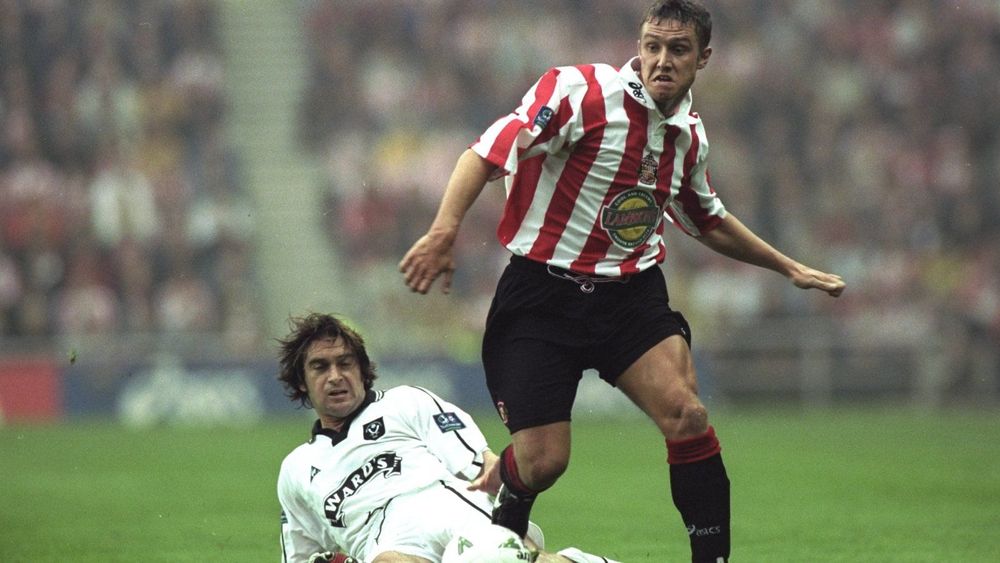
He was a Geordie, a lifelong Newcastle United supporter and a midfielder who had grown up dreaming of wearing the black and white shirt. Yet when Peter Reid and Sunderland came calling, Clark accepted the opportunity and went on to enjoy two successful seasons on Wearside.
The difficulty was that his professional decision never changed where his heart belonged. When Sunderland won promotion to the Premier League, the prospect of facing Newcastle as an opponent became something he could not contemplate. Then came an infamous T-shirt photograph at the 1999 FA Cup final, the publicity that followed and the end of his Sunderland career. For Clark, the story was about much more than a controversial photograph. It was about a rivalry he could never put to one side.
The move had come about through a familiar face. Paul Bracewell had been an important influence on Clark during his time at Newcastle, taking the young midfielder under his wing and helping him understand the demands of senior football. When Bracewell joined Peter Reid's Sunderland staff, he knew Clark was considering his options.
“That came about because of my old mentor Paul Bracewell, who I played a lot with," Clark recalled to Football Presse. "I played a lot of games with him in central midfield. Paul was the old head. He'd been very successful in a great Everton team, came to us. Well, he'd been at Sunderland a couple of times and came to us. So I played alongside Paul, and, as I said, a bit of a mentor and looked after me as a 19-year-old.
“And then a couple of years down the line, he had the opportunity to go alongside his big pal Peter Reid, who he played in midfield 4 at Everton and then, you know, when the opportunity came and he knew a few things that I was looking to potentially move on from Newcastle.
“Him and Peter got in touch with us and asked if they could potentially have a chat with us. So once they agreed a fee, like 6 or 7 other clubs did, I went to that meeting.”
Clark did not arrive at that meeting expecting to sign. He had been a Newcastle player and supporter, and the idea of joining Sunderland's fiercest rivals was almost unthinkable. But Reid and Bracewell had made their case, and the attraction of a new professional opportunity eventually won out.
“And, you know, my words were, I've come out of respect that you've got no chance of signing this, but I eventually did.”
The decision was not simply a footballing calculation. Clark had just become a father and had a young family to consider. He was able to remain in the area rather than uproot his family, and he had to weigh the professional and financial benefits of the move against the emotional pull of Newcastle.
“Peter was a brilliant manager for me. As you said, it was a weird situation because not only was I an ex-Newcastle player, I was a massive Newcastle fan. But actually, when you leave Newcastle, it's about getting the best move for yourself, both from a professional point of view, from a financial point of view, for your family.
“I didn't have to move. And I just had my first child at the time, and he, you know, settled. So yeah, and I had 2 brilliant years playing for Peter, a superb manager, great group of players.”
Winning over Wearside
Those two years were not an unhappy episode or a period in which Clark struggled to win over the Sunderland supporters. He knew his background would make the transition difficult, and he understood that performances would have to speak for him. His response was immediate: he scored on his debut at the Stadium of Light in a victory over Manchester City.
“It was always tough. I had to hit the ground running because of my background. Thankfully I did. The crowd took to me.”
There were initial questions from some of the players, too. Clark was aware that his Newcastle history would inevitably make people watch how he behaved, but he was determined to be judged on his commitment to Sunderland rather than his previous allegiance.
“I think some of the players at Sunderland were a bit, you know wanted to see what was going to be happening, you know wanted to see how I was were going to react. I think the fans had high demands and they wanted it to happen straight away, and rightly so. And thankfully it did. You know, I scored on my debut at the Stadium of Light when we beat Manchester City, and it went from there.
“And, you know, I had 2 successful seasons. I think the players seen that I was professional and I bought into what I was doing. The Sunderland lads that were there, and I became good friends with, you know, some, some, you know, real big, big players in Sunderland's history. And because they knew that I was there to do a job, I wasn't going to shirk my responsibilities, and I was there for the team.”
The team that made Sunderland successful
It was a formidable team. Clark played in a midfield that gave him the freedom to get forward, while Kevin Phillips and Niall Quinn provided an outstanding partnership at the top of the pitch. He also appreciated the qualities of the players who did the less celebrated work that allowed the team to flourish.
“Well, it helps when you have Kevin Phillips and Niall Quinn up front. That's for sure. That's for sure. That's the definitely best little and big man strike partnership I've ever been involved with.
“Niall was very, very underrated when I got to the football club. Everyone just assumed he was very good in the air, which he was at 6'4, but what a wonderful touch and what, what a wonderful football brain he had. Awareness. So he was the perfect foil for Kevin. He was also a great player for me, for a midfield player in those days that wanted to try and break lines and play one-twos with.”
Clark remembers the balance of the side, with Alan Johnson and Nicky Summerbee offering different qualities out wide, while Alex Rae and Kevin Ball gave the midfield its platform.
“So myself and Alex Rae and Kevin Ball, where, you know, Kevin and Alex for me were brilliant, you know, doing the other side of the game, allowed me to break forward and flourish.
“And just a great group of lads. And it's—I don't know, I don't know. The teams I've been successful in have had great camaraderie, have been great together both on and off the pitch. And that's the way it was.”
Reid was demanding, but Clark appreciated him as a manager and valued the relationship he developed with the coaching staff. Bobby Saxon, who had worked with him at Newcastle when he made his first-team debut, was another familiar figure who helped him settle.
“Yeah, he was tough. He was good. I enjoyed it. But he was, yeah, he let you know if he was unhappy with you without a shadow of a doubt. Yeah, but a great guy, you know, with his assistant Bobby Saxon as well.”
The promotion that changed everything
The team delivered promotion, winning the First Division title and earning its return to the Premier League. For Sunderland, it was a major achievement. For Clark, however, success brought a dilemma that had been waiting in the background since the day he crossed the divide.
He could play for Sunderland in the division below Newcastle. He could give everything for Reid, his teammates and the supporters. But the thought of being asked to turn out at St James' Park in red and white, against the club he had supported all his life, was different.
“And, yeah, but once the club got promoted back to the Premier League, there was no way I could have represented Sunderland against Newcastle. It just wasn't something I was capable or prepared to do, so I had to move on.”
That is the emotional centre of Clark's story. He was not dismissing the two years he had spent at Sunderland, nor the people who had welcomed him. He had enjoyed playing for Reid, respected his teammates and felt he had earned the crowd's acceptance. But he could not promise the supporters that he would be able to give them everything required in the biggest fixture of the season.
The T-shirt that ended it
The T-shirt incident at the 1999 FA Cup final would make that conflict public. Clark had travelled to London to watch Newcastle take on Manchester United. He was photographed wearing a T-shirt carrying the words “Sad Mackem Bastards”, a deliberately insulting phrase aimed at Sunderland supporters. The photographs circulated, the controversy escalated and Sunderland put him on the transfer list.
Clark is keen to correct the version of events that suggested he had spent hours parading around London in the shirt. His recollection is that it was put on him, photographs were taken and he removed it almost immediately. But he accepts that the images, once published, had consequences he could not undo.
“And obviously now experienced and being a manager and stuff like that myself, it was the wrong thing to do. You know, I think there's been different ways it's been portrayed, like I'd walked around the whole of London for a few hours or the full day with a T-shirt on, where in fact the T-shirt got put on us and pictures were taken and was taken off within 30 seconds.
“Not fully realizing the impact of it, but once it was published in the public domain, I knew that my career at Sunderland was over. You never bite the hand that feeds you, and that's what I've done.”
The regret in that assessment is clear. Clark knows that the people who had supported him, paid his wages and accepted a former Newcastle player into their club had every reason to feel disrespected. He had worked hard to earn their trust, only for one photograph to undo much of that goodwill.
“When you look back now, when you're a lot older and wiser, probably not my finest moment. But yeah, you know, what was done was done and we had to go on.”
Back to Newcastle, in a different shirt
His next destination was Fulham, where he was reunited with Bracewell, the mentor who had helped bring him to Sunderland. It was a fitting connection: the same relationship that had opened the door to Wearside provided a route into the next stage of his career. The move also meant that Clark could return to Newcastle as a Fulham player without facing the same conflict of loyalties.
His relationship with Newcastle supporters had, in fact, remained remarkably relaxed while he was at Sunderland. He continued to attend matches at St James' Park, sometimes going into the city centre for a few drinks before kick-off. There was banter, but he says it never became something more serious.
“I used to go and watch Newcastle when I was playing for Sunderland. So I used to go back to St James' and I'd go into the city centre and have a few pre-match beers with them before a game on a Tuesday night or whatever, you know.
“No, there was light-hearted banter, but it never got anything more than that. It never—it was never more serious than that.”
Clark's experience of Sunderland was therefore not one of simple regret. He had two successful seasons, enjoyed a powerful team spirit and worked for a manager he admired. He also knew that the club deserved a player who could face Newcastle without reservation. Once promotion made that prospect unavoidable, he could not offer that guarantee.
The T-shirt became the most visible image of his departure, and one he still regrets. But the deeper truth is more personal: Clark could cross the Tyne-Wear divide as a professional, yet he could never leave his Newcastle identity behind.