
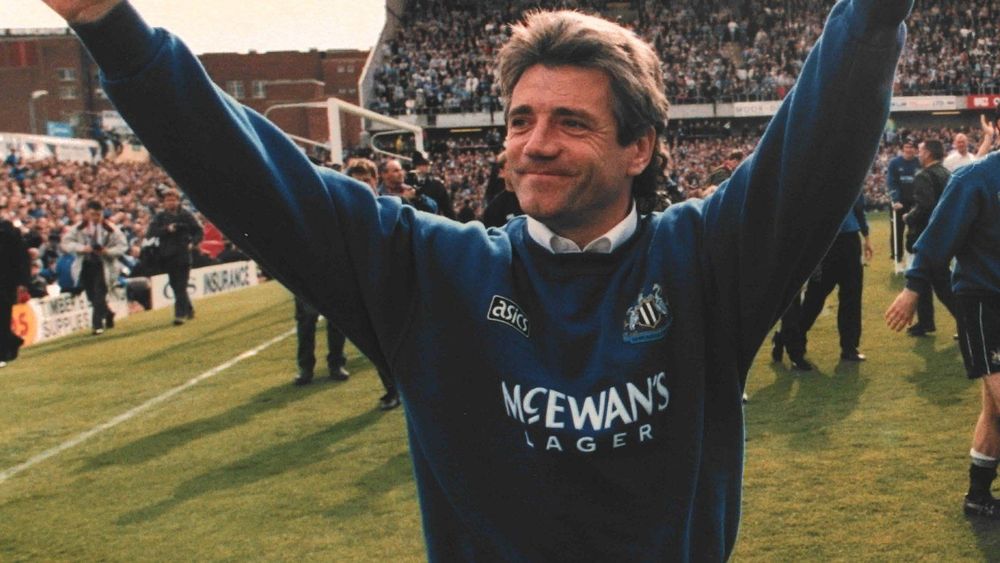
The man who had helped transform Newcastle as a player in the 1980s was back, this time tasked with rescuing the club and building a team that would eventually challenge for the Premier League title.
Clark had developed under Ardiles, whose faith in young players and encouragement to play with freedom had made a lasting impression. The Argentine had brought excitement to Newcastle, but the team's youthful exuberance could also become a weakness, with promising performances too often undermined by an inability to manage games.
“He was a great guy as well. Unfortunately, we all got on the team together, and even though we were a talented group of players, we were young, a little bit naive," Clark told Football Presse.
"We used to lose games from unbelievable winning positions. For 60 minutes, we'd be outstanding, and then the experienced opposition would come into it. So that was a little bit of an issue."
The departure of Ardiles was particularly difficult because of the relationship Clark had developed with his manager. He had admired and respected him, and the change was not something he initially welcomed with uncomplicated excitement. Yet Newcastle needed experience, and the club's next appointment was a figure whose connection with the city and its supporters was already deeply established.
“I felt I was torn because I was really close with Ozzy, and I really liked him, and there was a strong relationship. But Kevin was the man who, in the '80s, came back and revitalised our city, revitalised our football club.”
Clark had witnessed Keegan's impact as a player firsthand. He was there when Keegan made his debut, and he remembers the heartbreak when the former England captain eventually left Newcastle. Seeing him return as manager was therefore a profoundly personal experience, even if Clark could not have anticipated the scale of what would follow.
“I was there the day he scored on his debut. I was there the day he left in the helicopter when he retired, heartbroken, crying. So I knew if anyone was going to be able to rescue the club — and by the way, I didn't think for one minute he would do what he'd done in the '80s as a manager, but he probably went on even better again in the '90s as a manager — to have him come back, this was like another dream come true for me.
“This was the best thing that happened at Newcastle United Football Club when he signed for us as a player that I could imagine. I was heartbroken when he left, and when he came back as a manager, it was just surreal, really.”
Keegan's initial challenge was not to build a title contender overnight. Newcastle needed results, and the new manager had to steady a team before he could begin reshaping it. Clark recognised the immediate priority and the longer-term ambitions that came with Keegan's appointment.
“He just had to do a quick job in terms of getting this group of players to get some results to stay in the Championship so then he could start his rebuilding job, which he obviously did.”
Keegan's management was put to the test early, and Clark himself was caught up in a training-ground confrontation during the manager's first week. The midfielder threw a punch at a teammate, an incident that left Keegan concerned about his temperament ahead of an important game. Clark had initially been expected to start, but the manager reconsidered.
“That's right. And his first game, initially he was going to be in the team, but he was a bit concerned by my temperament, so he didn't put me in the starting 11 because obviously it'd been a big game and a game that was of huge importance.”
Rather than simply allowing the incident to define Clark, Keegan took him aside and explained his decision. The midfielder was disappointed to lose his place, but he understood that the new manager was looking beyond the immediate confrontation and considering what he needed from the player going forward.
“He took me to one side before that game and acknowledged that he liked me as a player, but was a bit concerned that my head was a little bit elsewhere at the time and wanted me just to have a bit of time and work with him to then make the impact he wanted.
“Obviously disappointed at the time, but yeah, great management from him straight away, to be honest.”
It was an early indication of the relationship Keegan wanted to establish. Newcastle's young players would not simply be protected because they were local or had come through the club's system. They were expected to improve, compete and earn their place as the squad developed.
Clark had grown up alongside several of the players who would become part of Newcastle's emerging generation. Steve Watson, Robbie Elliott and Alan Thompson had known him since childhood, while Steve Howey had become part of the group later. Their friendships extended well beyond football, but the arrival of Keegan meant the standards around the first team continued to rise.
“When Kevin came in, it wasn't just that you got in the team because you were a local lad. You had to have the ability. That's why we had to keep improving with each window, because there was no transfer windows then, you know. We could continue the same.”
Keegan's recruitment was central to that evolution. Clark remembers the quality of the players brought into the club, but he also believes their personalities were crucial in establishing the atmosphere that would underpin Newcastle's rise.
“He'd recruited an unbelievable group of footballers that bought into what he wanted. Unbelievable characters. We had a brilliant relationship off the pitch together. We socialised every time together, whether that was just the lads individually, whether that was with our families, with our partners, our wives, whatever. Everybody knew everybody. Each player knew everyone's mums, dads, kids, partners, whatever. The relationship was superb, and he'd created that with the characters.”
That camaraderie was important at a club where football was never confined to the training ground or stadium. Newcastle's players were constantly confronted by supporters, and the pressure of representing the club was something the local footballers understood instinctively. They helped the newcomers appreciate the intensity of the city and its expectations.
The training itself was another part of Keegan's culture. Clark describes the standards as exceptional, with the manager creating a competitive environment while ensuring the players enjoyed being part of the group.
“The standard of training was phenomenal.”
Keegan's Newcastle would eventually become one of the most memorable teams of the Premier League era, pushing Manchester United in the title race of 1995-96. Clark was part of that side, but he remembers the foundations being established through the manager's recruitment, the relationships within the dressing room and the standards demanded from every player.
For Clark, Keegan's return had initially felt almost unreal. It would become a defining chapter of his career, with the manager who had once captured his imagination as a young Newcastle supporter now leading him through the club's transformation.