
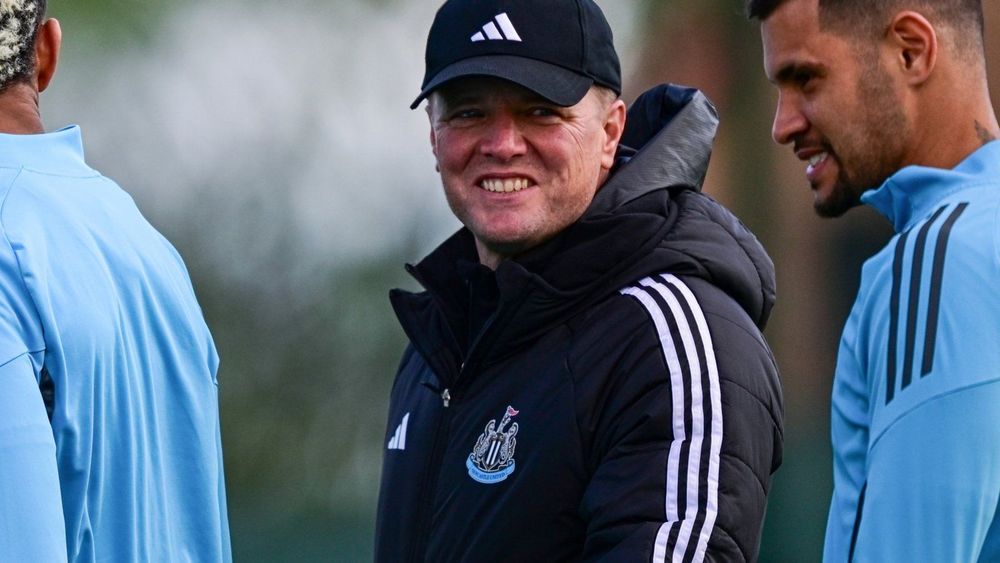
Howe recently left Newcastle United after almost five years in charge, having taken the club from a team outside the Champions League places to regular European contenders and delivered the Carabao Cup in 2025.
But long before the trophies and the Premier League touchline, Day saw something different in Howe.
The pair were team-mates at Bournemouth, and Day remembers a player whose quiet nature could disguise how much he understood about football.
"Eddie was a very good player, very calm and calculated as a player as well," Day told Football Presse.
"And I think you could see that if he was to go into management. I didn't probably see it as a player. I thought he was quite quiet, but he was very knowledgeable and he did talk and explain things as a captain and as a player."
That combination of calmness, knowledge and communication has subsequently become central to Howe's managerial career.
It is also something Day has come to appreciate more as his own coaching career has developed, having worked at various levels of the English game and spent time managing Bangladesh.
Day describes his own approach as increasingly relaxed, but says that does not mean lowering standards.
"I think my coaching is relaxed. I'd like to think there's detail in it. I'd like to want to help players and give as much information as I can," he said.
"I'd like to hear back from players and get their feedback as well."
"I think there's a lot of pressure on players to perform and do well."
"So I think my coaching as I've got older has been more relaxed now. It's not the fact, or it's not gone that I'm not caring or not as strict or disciplined, that's all still there. But I think the manner in which it's delivered has changed now."
Day believes experience teaches coaches that there is no single way to manage a dressing room.
"I think you mellow out a little bit as you get older and you realise, you know, getting the best out of players, there's different ways of doing it," he said.
"And sometimes it's being really relaxed and open and having conversations. Other times you might have to be a bit more strict in your approach."
That emphasis on communication is something Day believes separates effective coaches from those who simply possess tactical knowledge.
"I think to get the best out of people now, you need to have a good manner about you and be able to deliver, and what you're delivering makes sense, and the information that you're giving is correct," he said.
"Then I think players buy into what you're doing."
For Day, that is part of what made Howe stand out.
He remembers someone who was not necessarily the loudest personality in the dressing room, but who had a detailed understanding of the game and was prepared to share it.
"I know he's really dedicated, he's really hardworking, he's really detailed in all his work," Day said.
"He expects everyone to be the same."
That attention to detail also helped convince Day that Howe was someone he could learn from when he began moving into coaching himself.
Day's own coaching path was shaped in part by recommendations from both Howe and Wenger. The Bangladesh Football Federation has previously confirmed that the pair recommended Day for his UEFA A Licence as he moved from youth coaching into senior football.
It was not simply a professional relationship, either.
"He's a fantastic person," Day said.
"He's always tried to help me if I've ever given him a call or needed players on loan, you know, when I first started out coaching."
That willingness to help is something Day remembers just as strongly as Howe's football knowledge.
"I was delighted when he obviously took over at Bournemouth because it was a club that he was very close to," Day said.
Day had already experienced the importance of understanding an environment during his own time working abroad.
When he took charge of Bangladesh, he learned that a coach could not simply arrive with a set of ideas and expect everyone to accept them. He had to understand the people, culture and football environment first.
"I think what I learned from Asia is you have to adapt straight away to the culture of the country that you're in," he said.
"You have to make sure you involve the local coaches. You have to make sure you're polite. You have to learn how they live, how they train, first of all."
The principle was to find a balance between introducing new ideas and respecting those who were already there.
"And then you have to bring your ideas to it and find the balance of making sure that you're getting the correct work and detail into what you're doing, but also not overstepping the mark on how things have done before."
Day believes that approach is applicable wherever a coach works.
"I think if you go in with that mindset, then the local coaches and players are open to listening because they want to improve," he said.
"But I think you have to respect everyone that's around that environment, and you have to spend time speaking to people in the country that you're working in."
"You have to make sure that you're open to ideas from what they've had previously."
"And I think that then is a good ingredient for you to be able to work in that country and get respect from the local coaches and the local players."
"And I think if you do that, players respond, and then they will react and do how you want things being done to try and make the team better."
It is perhaps why Day's assessment of Howe has remained so positive despite the Newcastle chapter now being closed.
The former team-mate saw a player who was calm, knowledgeable and increasingly willing to communicate. He then watched those same characteristics develop into the foundations of a coaching career that took Howe from Bournemouth's lower leagues to the Premier League, Europe and a major trophy.
Day does not believe the transformation was as dramatic as it might appear from the outside.
The coach was there in the player all along.
"Eddie was a very good player, very calm and calculated as a player as well," Day said.
The former Bournemouth team-mate described Howe's Newcastle United departure as the end of one chapter for a coach he always regarded as exceptionally intelligent.
"And I think you could see that if he was to go into management."
For someone who has subsequently spent years trying to understand how to get the best out of footballers himself, that judgement carries added weight.
Day has learned to value detail without losing the human side of coaching, to be demanding without making every interaction confrontational and, above all, to communicate in a way that allows players to understand and believe in what they are being asked to do.
Those qualities were apparent in Howe long before he became a Premier League manager.
And with Howe now considering what comes next, Day's old team-mate can look back on a coaching career that appears to have fulfilled the promise his former colleague detected all those years ago.