
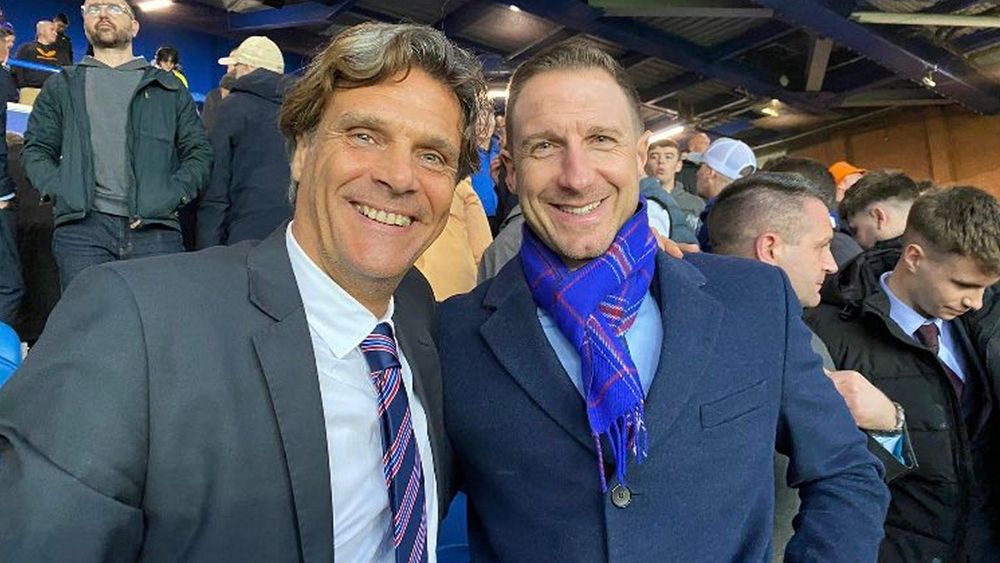
Marco Negri knows better than most what Italian football has lost.
The former Bologna, Udinese and Rangers striker came through during an era when Italy produced some of the greatest attacking players in world football. Serie A was the strongest league on the planet, the best players wanted to move to Italy, and the national team had a seemingly endless supply of elite forwards.
From Roberto Baggio and Alessandro Del Piero to Christian Vieri, Gianfranco Zola, Francesco Totti, Roberto Mancini and Vincenzo Montella, Italy’s attacking talent was the envy of world football.
Today, Negri believes that production line has slowed dramatically — and he sees the lack of top-class Italian forwards as a symptom of a much bigger problem. The former Rangers hero is the final voice in Football Presse’s “Italy’s crisis” series, following the analysis of Mario Meluso, Alberico Evani, Marco Sanna and Giuseppe Incocciati, who have all examined the issues affecting Italian football from different perspectives.
For Negri, the biggest concern is clear: Italy is no longer developing enough players capable of deciding games at the highest level.
“When I was playing, there were 10 or 11 players of a very high level in attack — from Vieri to Totti, Vialli, Mancini, Baggio, Del Piero and Montella,” Negri told Football Presse. “There were so many. Today, instead, we struggle to even call up four or five.”
For the former striker, this is not a coincidence. He believes the problem begins much earlier, with the way young players are developed.
“The fact that there are no great Italian strikers anymore is a problem that comes from the youth sectors and the methodology that is used.”
Negri believes Italian football must rediscover the importance of individual ability and creativity rather than producing players who simply follow tactical instructions.
“You have to look at the growth of players, the structures and everything connected to that, and try to change something.”
His comments echo a recurring theme throughout Football Presse’s “Italy’s crisis” series. Former Napoli sporting director Mario Meluso argued that Italian clubs needed to invest more heavily in homegrown talent, while Alberico Evani warned that the country must improve the pathway from youth football to the senior national team.
Marco Sanna also highlighted the importance of protecting Italian football’s identity, while Giuseppe Incocciati stressed the need to bring back technical quality and imagination.
For Negri, the decline of Italian football cannot be separated from the financial gap that has opened up between Serie A and Europe’s richest leagues.
“The Italian league is no longer the best in the world because there are leagues that are superior, like the Premier League and Spain.
“Unfortunately, everything is connected to television revenues. If English clubs have more money to spend, then when there is a talent available, they can take him before an Italian club.”
The former striker remembers when the situation was completely different.
“Once, every player wanted to come to Italy because there were great salaries and Italian football was the place where you could grow and show yourself. Now unfortunately it is no longer like that.”
Negri believes Serie A has been forced into a different position in the transfer market, often attracting players after their peak years rather than during their prime.
“Now Italian football is forced to bring in great players, but often at the end of their careers, like De Bruyne or Modric.”
That financial reality, he argues, has also affected the national team because Italian clubs have less ability to secure the best young talent emerging around Europe. The crisis reached another painful moment when Italy failed to qualify for the World Cup, continuing a worrying trend after also missing the 2018 and 2022 tournaments. For Negri, seeing the Azzurri fall so far from their historic standards has been difficult.
“The Italian national team has won so many World Cups and European Championships. Seeing it in this situation is really sad.”
Before Italy’s qualification failure, Negri had been encouraged by the appointment of Gennaro Gattuso, believing the former midfielder could restore passion and a stronger connection with the national shirt.
“Bringing Rino in had brought a breath of optimism and passion, a connection with the shirt.”
However, Italy’s failure to reach the World Cup ended Gattuso’s tenure and opened a new chapter for the FIGC, with Paolo Maldini now appointed as technical director as the federation attempts to rebuild its sporting structure. For Negri, the solution cannot simply be changing coaches.
The former striker believes Italy must address the deeper footballing culture that produces players. The decline is not just about tactics or results. It is about whether Italian football can once again create footballers with the imagination and quality to decide matches. Negri also pointed towards the evolution of the modern game, where countries willing to embrace technical ability and attacking courage are being rewarded.
“We are seeing that in other countries the evolution of football has produced great results. The teams that have more courage because they have quality in possession are the ones that are progressing.”
For a nation that produced generations of iconic attackers, the question remains why that talent pipeline has slowed.
Negri’s answer is simple: Italy has to return to developing players, not just managing them. The country does not need to look back at Baggio, Totti, Del Piero and Vieri with nostalgia.
It needs to understand how those players were created — and find a way to produce the next generation.