
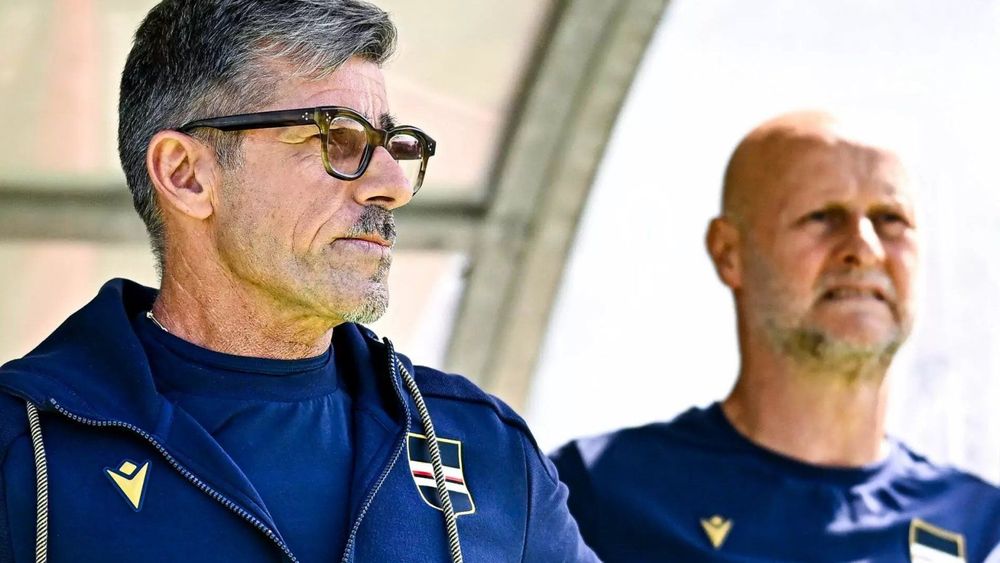
Evani argues Italian football has become obsessed with tactics while neglecting the technical education that once made it the envy of Europe.
Evani has lived through Italian football's greatest modern triumphs.
As a player he was part of Arrigo Sacchi's revolutionary AC Milan side that conquered Europe alongside Franco Baresi, Paolo Maldini, Ruud Gullit, Marco van Basten and Frank Rijkaard. Decades later he stood beside Roberto Mancini as Italy lifted the European Championship at Wembley in 2021.
Those experiences leave him uniquely qualified to judge why the Azzurri now face another painful rebuilding process.
Speaking to Football Presse, Evani believes the decline has not happened overnight. Instead, he says it begins with how young players are taught long before they reach Serie A.
"People say there are no longer talented young players in Italy," Evani said. "That discussion is everywhere. But part of the reason is that children no longer have what we had."
For Evani, modern football has replaced freedom with structure.
He recalls growing up in an era where endless hours spent playing in the street developed technique, imagination and personality naturally before organised coaching ever became part of a player's life.
"Years ago we learned everything in the street," he explained. "That is where imagination came from.
"Now children go straight into football schools and, in some cases, that creativity gets blocked."
It is a criticism that echoes throughout Italian football. While academies have become more sophisticated, Evani fears many have become too focused on producing organised teams rather than exceptional footballers.
His biggest concern is that tactical instruction now arrives far too early.
"There are many coaches who, even with very young children, pay much more attention to tactics than technique," he said. "That is the biggest difference compared to our generation."
The contrast with his own upbringing could hardly be greater.
Evani estimates youngsters of his era would spend virtually every spare hour with a ball at their feet before formal training even began.
"When we were young, we played seven or eight hours a day," he said.
"Today many children only play for an hour and a half during training, if everything goes well. That is simply too little."
More importantly, he believes those precious training sessions often focus on the wrong priorities.
"If during that hour and a half you are not working on technique either," he added, "then when players arrive at the highest level the foundations are missing."
Evani has spent much of his coaching career working precisely at that stage of development. After retiring, he coached within AC Milan's academy before progressing through Italy's youth national teams, taking charge of the Under-18s, Under-19s and Under-20s before joining Roberto Mancini's senior staff.
Helping young players fulfil their potential became one of the most rewarding parts of his career.
"I always tried to give young players back what football had given me," he said. "I wanted to help them reach their dreams.
"I always tried to teach technique and tactics, but also behaviour, education and how to live inside a team."
Some of those players reached Serie A and beyond, something Evani still regards as one of coaching's greatest rewards.
"For me, when one of those boys reaches the highest level, it is almost like returning to Serie A myself," he said.
His philosophy was reinforced during Italy's unexpected triumph at Euro 2020. Evani rejects the idea that the Azzurri possessed Europe's strongest squad. Instead, he believes the team's collective spirit compensated for technical shortcomings.
"We were not the best team individually," he admitted. "There were national teams with greater technical quality.
"But we made up for that with our unity, our sacrifice and the atmosphere between the players and the staff."
Even so, Evani knows unity alone cannot solve Italy's longer-term problems. Without a stronger production line of technically gifted footballers, future national team coaches will continue fighting with a smaller pool of elite talent.
Italy's failure to reach three consecutive World Cups has inevitably prompted discussion over who should coach the national side next.
For Evani, however, changing the man on the bench addresses only the symptom. The deeper challenge lies in rediscovering how Italian football develops players in the first place.
If Monday's warning from former Napoli sporting director Mario Meluso focused on federation policy and structural reform, Evani's diagnosis goes right back to the training ground.
For him, Italy's football crisis begins with children touching the ball less, expressing themselves less and learning systems before they have mastered the game itself.
Unless that balance changes, he fears the country risks producing fewer footballers capable of restoring the Azzurri to where they believe they belong.