
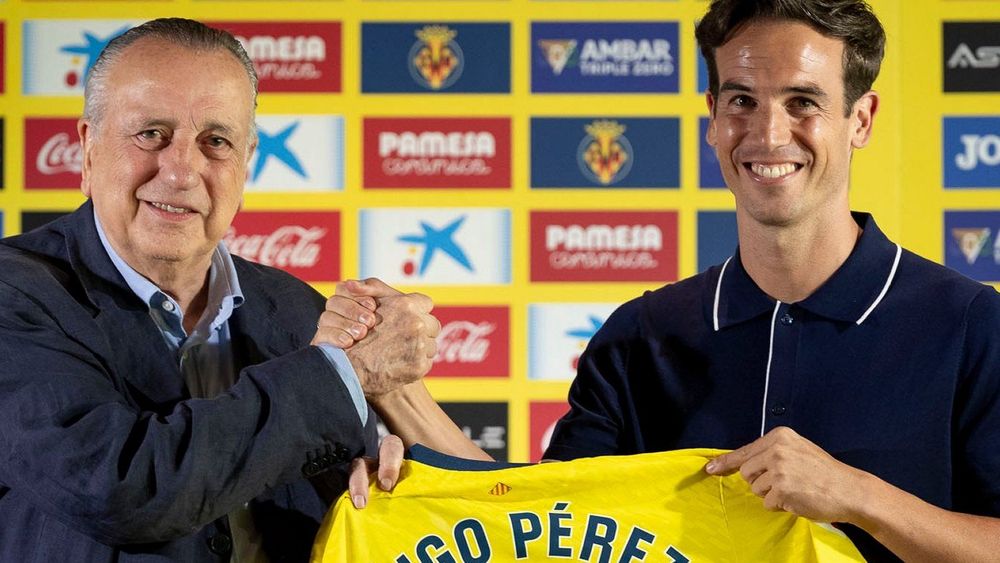
The 39-year-old Navarrese coach arrives from Rayo Vallecano, where he spent two and a half years as head coach following a period as assistant to Andoni Iraola. He guided Rayo to consecutive top-flight finishes and navigated a Europa League campaign — experience he believes has directly prepared him for the demands of Thursday-Sunday football at a higher level.
Pérez was emotional and candid throughout his opening press conference, pledging hard work and commitment where he could not promise results.
"I am very excited and enthusiastic about this new step. You always ask a manager how his teams will play and what he can promise.
"Results we know cannot be promised, but I feel identified with the importance of family, of sacrifice and of work and illusion.
"That I can promise, I guarantee it, and hopefully my ability as a coach can then deliver results and we will live some very beautiful years."
He cited Marcelo Bielsa as the reference point for his methodological approach — specifically the Argentine's philosophy of understanding the environment before imposing ideas.
"I learned from Marcelo Bielsa that the most important thing before starting to work is to know the environment, the culture and how the people who live in that region are. Villarreal has had the same ownership for thirty years and that has allowed all of us who love football to see the journey the club has made, from more modest positions to becoming a consolidated team in Europe, with great results and enormous success at academy level.
"I need some time to fully adhere to that idea, but I believe my formation at Athletic Club and my experiences at Osasuna, Numancia and Rayo Vallecano share very similar characteristics. The adaptation will not be difficult for me."
He also made clear the decision required no persuasion.
"One does not need much convincing to say yes to a club like Villarreal, especially at this early stage of my career. When this possibility arose, I had eyes for no one else. It is an important step with a great deal of responsibility, but honestly it was not a difficult decision to take."
On succeeding Marcelino, he drew parallels with his arrival at Rayo after Iraola's departure.
"The main difference is that the classification situation then was much more delicate and there was important pressure to achieve Rayo's objective. Now we have some margin during pre-season. I know that any change in behaviours requires mutual adaptation — on my part toward the players and on theirs toward me. The important thing is to coexist and build together."
He spoke at length about Champions League football, something he has long studied as a supporter and studied closely as a coach navigating Europa League demands with limited resources.
"From a personal point of view, being able to manage in the Champions League is something very important. I have been watching this competition since I was a child and it has always captivated me. There is also the importance for the club of staying in Europe — and if possible, in the Champions League season after season. That demand exists and we must sustain it."
He added: "Having directed a team competing on Thursdays and Sundays has helped me improve as a coach simply because I have experienced it. That does not make me an expert — I have only been coaching for two and a half years — but it gives me valuable experience to face this new challenge."
On his philosophy with young players from Villarreal's celebrated academy, he made the commitment explicit.
"What players need most is for the head coach to put them on the pitch, evaluate them, allow them to make mistakes, get things right and grow."
Villarreal finished third in La Liga under Marcelino, securing Champions League football for next season.