
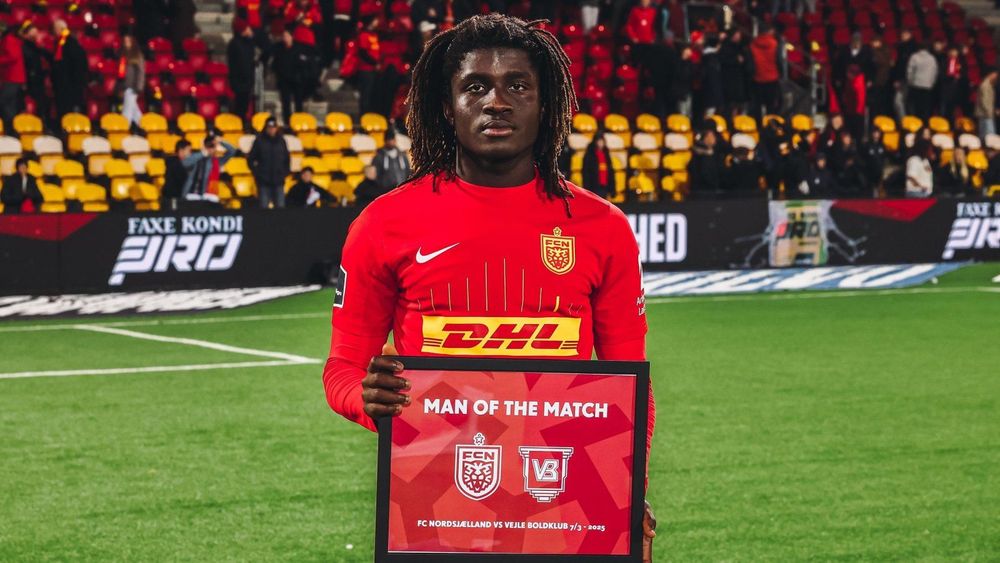
Before he was bending games at a World Cup, Caleb Yirenkyi was building robots. In 2019, aged 13, the boy from Bechem — a cocoa-farming town in Ghana's Ahafo Region — won the National RiSE Robotics Championship in Accra.
Seven years later, in the 95th minute against Panama, he redirected a stoppage-time cross past the goalkeeper to give Ghana their first win of the 2026 World Cup and become the Black Stars' youngest-ever tournament scorer. Ghana's run would eventually end against Colombia in the round of 16, but by then Yirenkyi's name was known well beyond Denmark.
It very nearly wasn't obvious he'd get there. Thomas Kristensen, FC Nordsjaelland's transition coach and the man who brought Yirenkyi to Denmark from the Right to Dream academy in 2024, doesn't dress up how he arrived.
"He's very humble and hardworking," Kristensen said. "Maybe not the biggest talent we ever brought through — he wasn't someone we expected to take us and the Superliga by storm. But he has a fantastic mindset and is a fantastic guy, both on and off the pitch."
That work ethic showed itself in small ways before it showed up in results. FCN's training facilities close over Christmas, and in his first winter in Denmark, Yirenkyi didn't want to stop.
"We got him set up in an apartment, and I had to drive him back and forth a bit, because he basically just wanted to get up to the club so he could train," Kristensen said.
Rather than leave him alone over the holiday, Kristensen and 25 family members invited him to Christmas Eve dinner — his grandmother among them, and she has followed Yirenkyi's career closely ever since.
His breakthrough came fast once it came. Team-mate Peter Ankersen, watching him train through the second half of 2024, saw it building before most outsiders noticed.
"He's impressed everyone," Ankersen said in spring 2025. "I'd heard beforehand that he was a big talent, and I could see it early in training too, but since he's got senior experience now, it's basically only gone one way for him. He's a player we should enjoy while he's in the Superliga, because I think he'll be a sought-after asset by summer."
Fellow midfielder Benjamin Nygren was just as effusive.
"I think he's really, really good. He has a really high international level. He wins a lot of duels, he's really strong and he's also good with the ball, so he's someone I think will go far," Nygren said.
"There are a lot of people who haven't known about him, but I've trained with him for almost a year, and I've thought for a long time that once he started playing, it would be really good. He's just a joy to watch. He's taken the Superliga by storm."
Head coach Jens Fønsskov Olsen has watched that arc from the closest possible seat, and his praise has only sharpened with time. In May 2026, after a goalless draw with Midtjylland, he called Yirenkyi "an insane player" and "one of the biggest names in the Superliga all season — too good to be in the Superliga."
Pressed on whether he was ready for a bigger league, Fønsskov Olsen didn't hedge: "I see a player who isn't just technically and mentally ready, but physically ready for a bigger challenge than the Superliga."
After the World Cup winner against Panama, he went further still.
"He's damn good," the coach said. "I had a conversation with him the other day and told him that if I could freely choose from the whole Superliga and build my own team, he'd be the first player I'd pick — and I think others feel the same."
None of that has made letting go any easier. As Ghana's tournament ended, Fønsskov Olsen was blunt about what comes next.
"You have this small hope — 'can you just stay another six months?' But he's made himself ready, and he's going to be fiercely wanted," he said, adding: "We're proud he's represented his country and got a lot of minutes, and now he should be allowed a bit of a holiday."
Weeks later, with a return imminent, he was still holding out hope of a delay.
"I'd obviously like to keep him, and overall he's been the best player in the Superliga across all positions," he told Viaplay. "I've knocked on the door and said we don't need to send him off straight away. Let's say no a few times."
The admiration extends beyond Farum. Ghana head coach Carlos Queiroz, fresh off watching Yirenkyi score his first senior international goal against Wales, praised both the player and his temperament, in comments carried by Danish outlet TV2.
"He's a fantastic player. He has a big future ahead of him," Queiroz said. "He's still young and has a lot to learn — at this level everything happens so fast. Young players need both talent and experience. I think that with more experience, he can become one of the best players on the national team."
Right to Dream's imprint on all of it is hard to miss. The academy that also produced Mohammed Kudus, Kamaldeen Sulemana and Ernest Nuamah builds its programme around the idea that football and education can't be separated — a philosophy that suited a boy who was winning robotics titles before he was a first-team regular.
Whatever comes next for Yirenkyi, in Denmark or beyond, the people who have coached him seem to agree on one thing: the calm that let him build a robot under pressure at 13 is the same quality that let him finish a World Cup winner in the 95th minute at 20.