
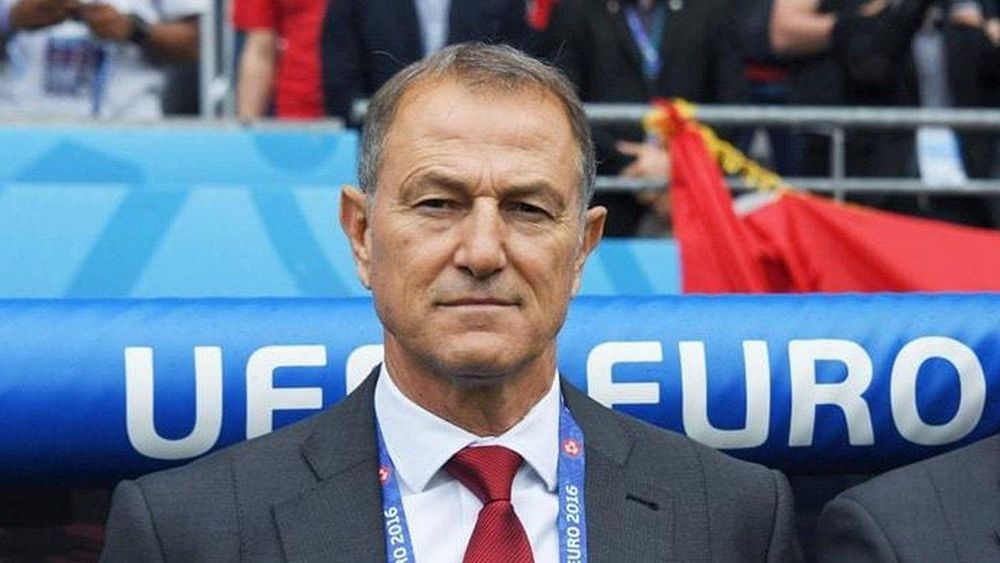
He came through the Italian game, worked his way into Serie A, experienced promotion battles and difficult rebuilds, moved abroad and eventually became the coach who took Albania to the European Championship for the first time.
There have been successes, disappointments, departures and opportunities that only became clear with hindsight. For De Biasi, however, the common thread has always been the need to learn from every experience.
“There have been several moments that were formative for my career,” De Biasi told Football Presse. “Clearly, each of us has to gain experience through our own experiences, but I believe my time at SPAL, Modena, and Brescia, where I had the opportunity to coach a champion like Roberto Baggio, was certainly very important.”
His career has also given him the opportunity to work in very different football cultures, from Italy to Spain, Albania and Azerbaijan. Rather than identifying one particular environment as the defining influence, De Biasi believes every experience has contributed something.
“In every experience, both positive and negative, there are situations that help you grow, especially if you are able to look at them with the critical spirit needed to analyse why things happened.”
That willingness to analyse his own career has also shaped his view of the changing role of the coach. The football De Biasi entered several decades ago is very different from the modern game, with tactical approaches and expectations around possession having evolved considerably.
“Football itself has changed considerably over these years,” he said. “We have moved from a more defensive style, traditionally associated with Italian football, towards a more possession-oriented and sophisticated game. We have understood that if you don't try to control the game, your opponents will put you in difficulty.”
The demands placed on coaches have changed, but De Biasi believes the fundamental challenge remains the same: managing people while trying to deliver results.
“The challenges in a coach's life are daily. They involve managing the group, dealing with situations on the pitch, communication and trying to achieve the objectives established with the club.”
That relationship between coach and club is, in his view, one of the most important elements in determining whether a project succeeds.
“Very often, however, the coach and the club speak different languages. This is one of the problems that is frequently at the root of unsuccessful experiences.”
De Biasi has also learned that professional decisions are not always as clear at the moment they have to be made as they appear later. Even after a career containing some remarkable achievements, he would not pretend every decision was perfect.
“Yes, I would change more than one,” he admitted when asked whether he would do anything differently. “You only understand certain things afterwards. Often, you have to make decisions in a very short period of time and don't have enough time to consider and evaluate the situation as a whole. That, too, is part of gaining experience.”
That mixture of reflection and pragmatism has followed him through his international career. Working outside Italy gave De Biasi the chance to encounter different footballing cultures and different expectations, while also testing the methods he had developed over decades in the Italian system.
His time at Levante, despite the difficulties, remains particularly fondly remembered.
“The experience at Levante was, despite everything, a very positive one,” he said. “Even today, when I return to Valencia, there are many people there who still have great respect for me.”
His subsequent experience with Alavés provided a different lesson, one he is willing to acknowledge as his own.
“With Alavés, things were different. Probably, I made a mistake at the beginning by not making certain things clear enough.”
De Biasi's career has also taken him into international management, where the nature of the job changes considerably. Instead of working with players every day, a national-team coach has limited time to build an identity and must make the most of the resources available.
That was particularly evident in Azerbaijan, where De Biasi was tasked with developing a competitive national side in an environment with a relatively small pool of players competing at the highest level.
His experience there reinforced his belief that patience can produce results even when the starting point appears modest.
“That with patience, ability and competence, you can achieve something worthwhile even in smaller footballing environments.”
The limitations facing emerging football nations are obvious, he believes, but they do not make progress impossible.
“The difficulties are connected to the lack of a significant number of high-level players. But if you have time to work and you do it effectively, you can achieve results that seem unimaginable.”
That philosophy is closely connected to his wider view of coaching. Whether working at a club or with a national team, De Biasi believes success depends on creating the right conditions rather than simply assembling talented individuals.
It is also why he remains interested in the development of young Italian players. He sees a curious contradiction between the success of Italy's youth national teams and the limited opportunities many of those players subsequently receive at senior club level.
“If we are talking about the youth national teams, there is certainly good work being done by the various coaches and by my friend Maurizio Viscidi,” he said.
“What I don't understand is why these young players, who win European Championships and other tournaments, so rarely find space in their first teams. And when they do, it is often very limited.”
The issue reflects a wider question about Italian football and its ability to produce and retain elite talent. De Biasi believes Serie A remains an important competition, but its position within the European landscape has changed.
“Serie A is certainly still a great championship. It is unpredictable and has some beautiful stories, such as Como, which is one of the things that makes football special.”
But he does not believe Italian football currently possesses the same technical depth as it did in the past.
“We have less technical quality because our league is no longer the best championship in the world.”
The financial strength of other major European leagues has changed the competitive landscape, with England, Germany and Spain now able to attract and retain enormous amounts of talent. Yet De Biasi believes Italian clubs continue to compensate through organisation and tactical competitiveness.
“Today, unfortunately, there is the Premier League, the Bundesliga and La Liga, the dominant leagues. However, Italy often manages to achieve excellent results in Europe despite having fewer financial resources.”
That resilience is one of the characteristics he still associates with Italian football.
“Overall, I believe Italian clubs in European competitions often manage to go beyond expectations and beyond what you might expect from the quality of their squads.”
It is an observation that fits De Biasi's own career. Few of his most memorable achievements came from having the biggest resources available. Instead, they emerged from projects that required patience, adaptation and an ability to find solutions.
From his early development at SPAL to Serie A, from Spain to Azerbaijan, and from club football to the unique pressures of international management, his career has been shaped by the ability to operate in different circumstances.
The greatest recognition remains his work with Albania, where he became permanently connected with a landmark moment in the country's sporting history. But even that achievement sits within a much broader career.
For De Biasi, football has always been about the process as much as the destination: understanding what went right, recognising what went wrong and carrying those lessons into the next challenge.
“Each of us has to gain experience through our own experiences,” he said.
That may be the simplest description of a coaching career that has taken him from the Italian lower divisions to Serie A, from Spain to the international stage, and ultimately into the history of Albanian football.