
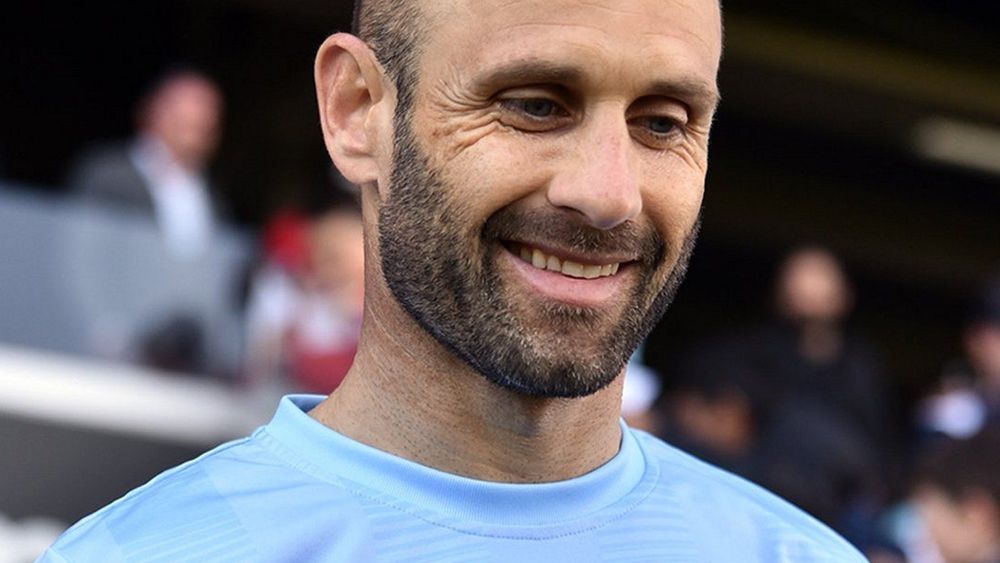
He would spend the next 21 years playing in Italy, experiencing its football across multiple divisions, learning a different tactical culture and building a career that gave him a perspective on how the game in the country has evolved.
His journey began in Lyon's academy, where his own development took an unexpected direction before he ever became a professional midfielder.
“I joined the academy when I was 14 years old and I was not a midfielder at the start, I was a centre-back, but when I came with the first team they decided to move me into midfield because I was too small for centre-back,” Genevier told Football Presse.
The change helped shape Genevier's career, but he also remembers the training environment in Lyon as an important part of his development. The emphasis when he was young was on repetition and the refinement of technical ability, something he believes differs from how the game is approached today.
“But when I was in the academy, the way we trained was different with today because when I was young we did a lot of repetition in order to improve our technical skills, and today is more often focused on using technique to apply tactical movement and ideas, you know, is different.”
That technical foundation would become particularly important when he moved to Italy, where he discovered that understanding the tactical demands of the game was a different challenge.
“And that's why when I arrived in Italy, I was very strong with technical skills, but I was very bad with tactical movement, you know. And I improved a lot during my first season.”
Genevier had just signed his first professional contract with Lyon, but the club's strength at the time made the prospect of regular football difficult. Lyon were competing in the Champions League and winning championships, with a squad featuring players he remembers as particularly impressive.
“Lyon was playing in Champions League every year, they won the championship for many times, so there was a lot of very, very strong players, very nice players like Juninho, Essien, Edmilson, Sonny Andersson. So the team was very strong.”
He knew he needed an opportunity to play, and Perugia offered a route into senior football. After a trial involving a couple of training sessions and a friendly, the Italian club decided to sign him.
“I know it won't be easy for me to play, so I wanted to play more. And so I had the opportunity to go to Perugia for a trial, just for a couple of training and a friendly game. But at the end of the game, the sports manager told me he wanted to sign me. So they signed an agreement with Lyon for the transfer and I signed for four years.”
The move was an important decision, but adapting to a new country was not straightforward. Despite France and Italy being geographically close, Genevier found the mentality different, and the language barrier made his first season difficult.
“To be honest, at the beginning it was not easy because even if Italy is very close to France, the mentality is different. Italy is very passionate.”
He was also adjusting to life away from home with his wife, while trying to find his place in a dressing room where English was commonly spoken among foreign players.
“And it was not easy for me to choose Italy because I was just with my wife and moving in another country is not easy at the beginning. I didn't speak English, the first season was very hard because there were a lot of foreigners in the dressing room. So we used to speak English and not to speak Italian, and it was a very bad decision because, you know, when you arrive in another country, it's much better to try to speak the language of the country.”
Despite those difficulties, playing in Serie A gave Genevier an experience he would never forget. He remembers his first match against Parma, a team he considered particularly strong, and the presence of Brazilian striker Adriano.
“Playing in Serie A was a great experience for me, and I remember very well the first match was against Parma. At this time, Parma was a very strong team. Adriano was playing there, so I have probably a picture with him on the field in this game.”
The match also left him with a tangible souvenir. Genevier still has the shirt he exchanged with a player during that game, another reminder of the significance of his first steps in Italy's top division.
“And I still have the shirt of—I changed with one player during the game, at the end of the game.”
For Genevier, the stature of Serie A at that point was part of what made the experience so special. He remembers a competition whose standing in European football was comparable to that of the Premier League today.
“And yeah, you know, playing for Serie A at this time, Serie A was probably like the Premier League right now, or maybe very close. So it was very emotional.”
Having spent 21 years in Italy, Genevier has seen the country's football evolve across different levels and generations. His reflection on the present is that Serie A remains a good championship, but the established clubs are no longer necessarily defining the entire story.
“Serie A is not like 25 years ago when I arrived in Italy, as I told you before. And the Serie A is still a good championship, but you can see now even Juventus has problems. Milan didn't reach the Champions League. So it's a special moment for Serie A. I think something is happening in Serie A.”
He sees the growth of clubs outside the traditional giants as an encouraging element of the current landscape, with the progress of Como and Cagliari offering a different dynamic to the competition.
“But it's good because Como is doing great, Cagliari is doing good. Some small teams are growing and it is nice too. Not just only Juventus, Milan, Inter, always the same teams.”
Genevier believes that shift could make Italian football particularly interesting, even as the difficulties extend beyond the club game to the national team.
“And it could be a very interesting moment for Italian football, even if it's not easy even for the first national team because it's not reaching the World Cup. And it's not a good moment for Italy.”
From his positional change at Lyon to the challenges of moving countries, the excitement of his Serie A debut against Parma and the 21 years he spent playing throughout Italy, Genevier's perspective is rooted in lived experience.
He remembers a league that once stood alongside the Premier League in stature, but sees today's Italian football as a competition in transition, with new clubs growing and the traditional order facing fresh challenges.