Twentyman was just a child when he discovered that the European Cup had somehow found its way into his family's lounge.
It was not there as a piece of Liverpool memorabilia, however. His father, who worked as a talent scout for the club, had been asked by manager Bob Paisley to take the trophy to an amateur football club and show it to local players.
For Twentyman, that extraordinary memory has come to represent something about Liverpool that he has carried with him throughout his life.
"I always look back. It's in the book when I was a child and played Subbuteo on the floor, that little flick the players around," Twentyman told Football Presse.
"And I used to commentate as I flicked them. And my mum said when I was on the radio later in life, you were always destined to do that because you did it when you were a child.
"But I have been fortunate. Very fortunate."
His father's work meant Liverpool's success was not something Twentyman simply watched on television.
He grew up around people who had helped create it.
"The story in the book about when I came in from school and in the lounge there was something covered by green velvet cloth in a bag, about 2.5 feet high and 2 feet wide," he said.
"And I said to Dad, who'd gone into the kitchen with Mum, what's in the lounge? What is it?
"And he said, well, go and have a look, take the velvet bag off it.
"And I did, and there it was. It was the Champions League trophy, the European Cup, which Liverpool had won."
There was no grand ceremony surrounding it.
"Dad was going to an amateur football club that night to do a talk, and Bob Paisley, the manager of Liverpool at the time, had said to Dad, well, take the cup and show them.
"That's how Liverpool was as a football club, and probably still is. Very, very understated.
"And they shared that success with the local amateur footballers.
"And that night, the Champions League trophy was in the boot of my dad's car in the garage."
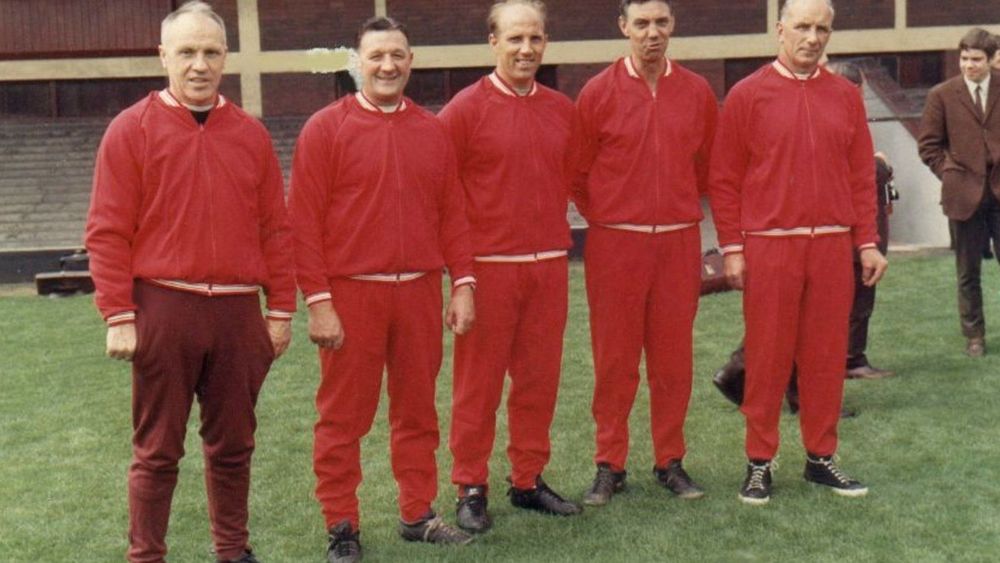
For Twentyman, that story says something about the Liverpool of the Shankly and Paisley eras, when the famous Boot Room Boys formed a collective that helped establish the club as one of English football's dominant forces.
"I speak from personal experience, Jacob, and it is for me in terms of my dad's heritage with the football club and how they remember him and the Boot Room Boys," he said.
"I mean, people know the Boot Room Boys under Shankly and Paisley, great people like Ronnie Moran, Joe Fagan, Tom Saunders, Reuben Bennett, John Bennison, amazing people who collectively made Liverpool such a powerful, dominant football club."
Twentyman's father was one of those figures whose influence was not necessarily measured in trophies lifted or goals scored.
His expertise was finding footballers.
And years later, Twentyman discovered that Liverpool had chosen to commemorate that contribution at Anfield.
"In one of the corporate lounges, got these amazing artworks to each of the Boot Room Boys," he explained.
"And my dad's is like a pair of spectacles, and it's got something about like an eye for talent, an eye for the right personality, which was Dad's forte as a talent scout."
Twentyman saw photographs of the artwork and decided he wanted something similar for his own home.
"I wrote a letter to the then chief executive of the football club, handwritten letter with no expectation really," he said.
"And I asked him if I could pay for the production and transport of a smaller version for my place.
"And about three weeks later, I got a phone call from a guy called Keith Watson.
"And he said, is that Geoff? I said, yeah, who's asking? He said, oh, my name's Keith Watson from Liverpool Football Club.
"The chief executive has just put your letter on my desk and said, make this happen."
That response meant more because it was not simply a replica of something hanging at Anfield.
The smaller artwork contained details of the players Twentyman's father had helped find.
"So I've now got this amazing smaller version of what's at Anfield," Twentyman said.
"And it's a bit more detailed, actually, as to the players Dad was responsible for finding and scouting.
"And it's absolutely beautiful."
When the family travelled to Anfield for the presentation, the man chosen to hand it over made the occasion even more personal.
"Alan Kennedy actually presented it to us," Twentyman said.
"And Alan Kennedy is a player my dad scouted, so that was a beautiful moment."
For Twentyman, Liverpool's treatment of the Boot Room Boys did not end there.
The club later unveiled a plaque to the group on the Main Stand, with members of the respective families invited to attend and Roy Evans involved in the ceremony.
Again, it was the manner of the tribute that struck Twentyman.
"And it's just little things, you know, it's little personal things which makes me think it's a really classy football club," he said.
"Because, you know, in the corporate world in which we live, things like that could easily get forgotten.
"But their attention to detail and to people is, in my opinion, fantastic."
It is that attention to people that ultimately defines Liverpool for Twentyman.
He has seen the European Cup sitting in his childhood home, knew the men behind the Boot Room culture through his father and has watched the club continue to honour their contribution long after their work was done.
"That's why I say that, you know, classy football club," he said.
"And this amazing plaque of the Boot Room Boys, and they invited me up to watch, and other members of the respective families to watch the unveiling of it, which Roy Evans did, who's the only surviving member of the Boot Room Boys."
For someone whose career eventually took him into professional football and then three decades of broadcasting, Twentyman has spent much of his life around famous clubs, players and managers.
Yet Liverpool occupies a different place.
"Well, I speak from personal experience," he said.
"And it is for me in terms of my dad's heritage with the football club and how they remember him and the Boot Room Boys."
That distinction matters.
Twentyman is not describing Liverpool simply through the achievements of its greatest teams. He is talking about a club's relationship with the people who helped build those teams, including those whose work was carried out far from the attention enjoyed by the players and managers.
For him, that is where Liverpool's special character can still be found.
"Little things," he said again.
"Things like that could easily get forgotten.
"But their attention to detail and to people is, in my opinion, fantastic."
And perhaps that is the most enduring part of the story. The European Cup was once carried to an amateur football club in the boot of a car; decades later, the people who helped Liverpool win it are still being remembered at Anfield.
For Twentyman, that is what makes the club special.
Geoff Twentyman is author of "Top Man: The Geoff Twentyman Story" from Pitch Publishing - which is available here.