
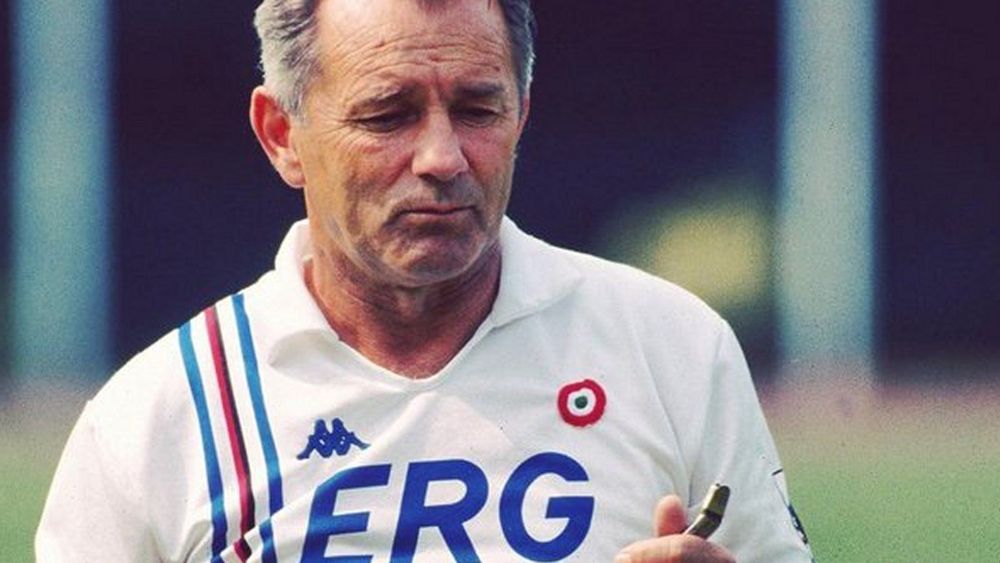
The legendary manager wanted him to remain with the first team, giving a young defender an opportunity that would change his career. Lanna remembers the coach he considers a father figure, the faith he placed in him and the debt he will always feel he owes him.
As a young defender approaching the end of his time in Sampdoria's youth system, Lanna was expected to leave Genoa and continue his development elsewhere. Foggia, then coached by Zdeněk Zeman and competing in Serie C1, was supposed to provide his next opportunity.
Instead, Boškov wanted him to stay.
It was an intervention that Lanna has never forgotten. The manager not only gave him the chance to remain at the club he supported as a boy, but also brought him into the senior environment at a time when his future at Sampdoria was far from certain.
Asked about the experience of working under Boškov, Lanna's response is immediate and deeply personal.
Lanna told Football Presse, “For me, he was a sort of father, because a great deal of where I got to, I owe to him.
“When I was in the Primavera, in my final year of youth football, I was approaching the point where I had to make that step up. That year, I was supposed to go and play at Foggia, the Foggia coached by Zdeněk Zeman, which was in Serie C1.
“Instead, Boškov wanted me to remain with the first team and train with them.”
It was a significant decision for a young footballer. Rather than sending Lanna away to gain experience in another environment, Boškov believed he would benefit from remaining close to the established Sampdoria players and learning within the senior squad.
There was no immediate reward. Lanna would have to be patient.
“I spent that year training with the first team, really just training. I only made a few appearances on the bench.
“Then, towards the end of the season, I made my debut against Napoli in 1988, in the final league match.
“From that point onwards, he gave me so much. He gave me enormous confidence because he started giving me games, even though I was only around 20 and just beginning to break into the first team.
“He had tremendous faith in me.”
The opportunity that changed everything
Lanna's debut came on 15 May 1988, when Sampdoria travelled to Napoli for their final Serie A fixture of the season. He was named in the starting line-up as the visitors secured a 2-1 victory.
For the young defender, it was the beginning of a first-team career at the club he had supported throughout his childhood.
The significance of Boškov's decision becomes clearer when considering what followed. The coach had taken charge of Sampdoria in 1986 and was building a side that would eventually collect five major honours during his six-year spell.
Lanna was given the opportunity to develop alongside an established group while gradually earning a more regular role. He would go on to make 193 appearances for Sampdoria across his two spells, winning the Scudetto, two Coppa Italia trophies, the European Cup Winners' Cup and the Italian Super Cup.
But it is the decision to keep him at the club in the first place that remains at the centre of his gratitude.
Lanna is also careful not to suggest that his entire professional future depended on that one intervention. He recognises that he might have enjoyed a successful career had he moved to Foggia or another club.
What Boškov gave him, however, was something that could not necessarily have been replicated elsewhere.
“I owe him an enormous amount, because perhaps I would have had a career anyway if I had gone to Foggia or somewhere else.
“But for me, he gave me the dream of being able to play in that team at that particular moment.”
That distinction says much about Lanna's relationship with Sampdoria. He was not simply looking for a route into professional football. He wanted to play for the club he supported, in the city where he had grown up, and alongside the players who would make its history.
Boškov gave him that opportunity.
A father figure beyond football
There is another reason Lanna speaks about Boškov with such affection. His appreciation extends beyond the manager's decision-making or the opportunities he provided on the pitch.
He remembers someone who helped him develop as a person, too.
“I owe him almost everything. For me, he was a great teacher, both of football and of life.
“I can only thank him for what he did for me.”
It is a remarkably personal tribute to a coach whose achievements at Sampdoria are already firmly established in the club's history.
Boškov guided the Blucerchiati through their transformation into Italian champions, winning the 1990-91 Serie A title and establishing them among Europe's leading sides. But for Lanna, the manager's legacy is also measured in the individual opportunities he gave to younger players.
One of them was a teenage defender who might otherwise have been sent away to continue his development.
Lanna never forgets that his route into the Sampdoria first team was not guaranteed. He had been expected to move, spent a season largely training and waiting, and needed the manager's confidence before he could establish himself.
The faith Boškov placed in him allowed him to become part of a generation that would bring extraordinary success to the club.
For the player, that meant far more than simply finding a place in professional football. It meant being able to represent his boyhood club and play his part in the most successful period of its history.
When Lanna describes Boškov as a father figure and a teacher of both football and life, it is clear that his gratitude has endured long after their time working together.
The manager gave him an opportunity when another path seemed to be opening up. More than three decades later, Lanna remains convinced of what that decision meant.
He might still have become a professional footballer had he gone to Foggia. But he would never have experienced that particular Sampdoria team in quite the same way.
For Marco Lanna, that was the dream Boškov gave him, and the debt he will always remember.