
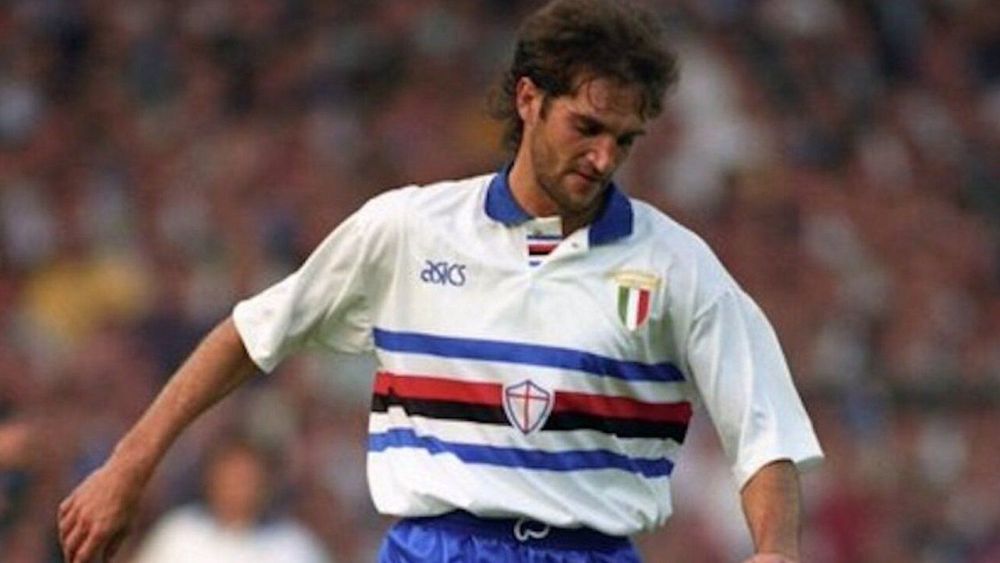
After growing up in Genoa, joining the club's youth system and experiencing its greatest successes, moving to AS Roma meant stepping into an entirely different world.
He was no longer the young defender developing within familiar surroundings. He was leaving his family, his city and the environment in which he had spent almost his entire life.
Looking back, Lanna describes his time in the Italian capital as an important period of personal development, as well as an opportunity to learn a different side of football under Carlo Mazzone.
“Roma was a good experience, particularly in terms of life, because for me it was my first experience away from home," Lanna tells Football Presse. "When I was at Sampdoria, I lived with my parents. I was at home, and my life hadn't really changed even though I had become a professional footballer. I continued living with my parents.
“So leaving was initially difficult, because there is a big difference between Genoa and Rome, not just in terms of the city but the whole environment. We are talking about a capital compared with a city that perhaps has a fifth of the population, or even less.
“I was suddenly confronted with a completely different reality, with completely different expectations.”
It was an adjustment that extended beyond finding a new home. Roma were a club with ambitions of challenging for the biggest prizes, and the expectations surrounding the team reflected that.
President Franco Sensi was investing heavily in the project, with the ambition of building a side capable of winning the Scudetto. But Lanna understood that assembling a successful team was not something that could necessarily happen immediately.
“Roma was a team where the objective was to win. President Sensi spent a lot of money because the ambition was to eventually win the championship.
“Initially, the team wasn't particularly competitive, but it was something that was being built over time. Sometimes projects cannot start as winning projects immediately. Sometimes they need time to create the right group and establish the right conditions to win.
“That is what happened there.”
It was an interesting lesson for a player who had experienced the opposite at Sampdoria, where an established group had developed over several years into Italian champions. At Roma, he was experiencing another ambitious project at a different stage of its development.
Carlo Mazzone and a different football education
One of the most interesting aspects of Lanna's Roma experience was the opportunity to work under Mazzone.
By the time he arrived in the capital, Lanna had already experienced different tactical approaches during his career. At Sampdoria, he had worked under Vujadin Boškov, whose defensive organisation relied on man-marking. Eriksson subsequently introduced him to zonal defending, before Mazzone offered another tactical education.
For a defender, understanding those differences was an important part of his development.
“With Mazzone, I believe it was another very important experience, particularly because I had arrived from an experience with Boškov where we played man-to-man marking.
“Then I had Eriksson in Genoa during my final year, when I played with a zonal back four. With Mazzone, I played with a zonal back three.
“Being able to play and understand different systems, knowing how to adapt and understanding what you have to do in different situations, was another experience that helped me develop.
“It allowed me to grow as a footballer.”
Lanna is particularly keen to challenge one aspect of Mazzone's reputation. The former Roma coach has often been associated with a defensive approach, but the defender insists that description does not reflect the football they played.
“Mazzone has always been described somewhat as a defensive coach, but I can assure you that we played in a team that had absolutely nothing defensive about it.
“We had a defence, of course, because we had to defend, but Aldair was another fantastic player. I believe he was one of the strongest defenders I played alongside.
“Objectively, even though we didn't win anything, we enjoyed ourselves and gave people something to enjoy watching. We had some satisfaction from those years.”
It is an important distinction. Lanna's recollection is not simply about learning to defend in another formation. It is about understanding how a team can organise itself differently while still playing attractive football.
For someone who had already experienced the demands of playing in a championship-winning Sampdoria side, the opportunity to work under another respected Italian coach added another dimension to his football education.
Discovering the intensity of Rome
The football was only part of the experience. Away from the training ground, Lanna was learning to live in a city whose relationship with its football club was very different from what he had known in Genoa.
At Sampdoria, he had grown up with the supporters and understood the atmosphere surrounding the club. In Rome, he encountered a more intense relationship between the team and its followers.
“The memory of my experience in Rome is absolutely positive because I met fantastic people, I had a good time and I grew as a person.
“Living alone in a city like Rome was important, particularly because of the way the supporters relate to the team. Roma supporters are very attached to their club, and I wasn't used to that level of intensity.
“In Genoa, the supporters are attached as well, but there is a certain calmness about it. You can live your life, go for a walk and perhaps a supporter will ask for an autograph or a photograph, but generally it happens in a very relaxed way.
“In Rome, they live football in a much more passionate way. You have to learn how to manage those situations.”
For Lanna, that adjustment was part of becoming more independent. He had moved away from the city where he had grown up, encountered a different football culture and learned to manage the expectations that came with playing for another major Italian club.
He looks back on the experience with considerable affection.
“I was happy there, I enjoyed myself and it was a beautiful experience. It was an important period in my life as well as in my football career.”
His time at Roma did not bring the championship success he had experienced with Sampdoria, but it gave him something different. He learned to adapt to another tactical system, experienced the demands of playing in the capital and discovered the challenges of building a life away from his family.
For a footballer who had spent so much of his formative years in Genoa, that experience was significant.
Lanna's career would take him through different clubs and football environments, but his memories of Rome remain positive. The opportunity to work with Mazzone, learn new defensive approaches and experience a different side of Italian football helped shape the player he became.
Sometimes a move away from home is measured by what a footballer wins. For Lanna, the value of Roma was also found in what he learned, both on the pitch and beyond it.