
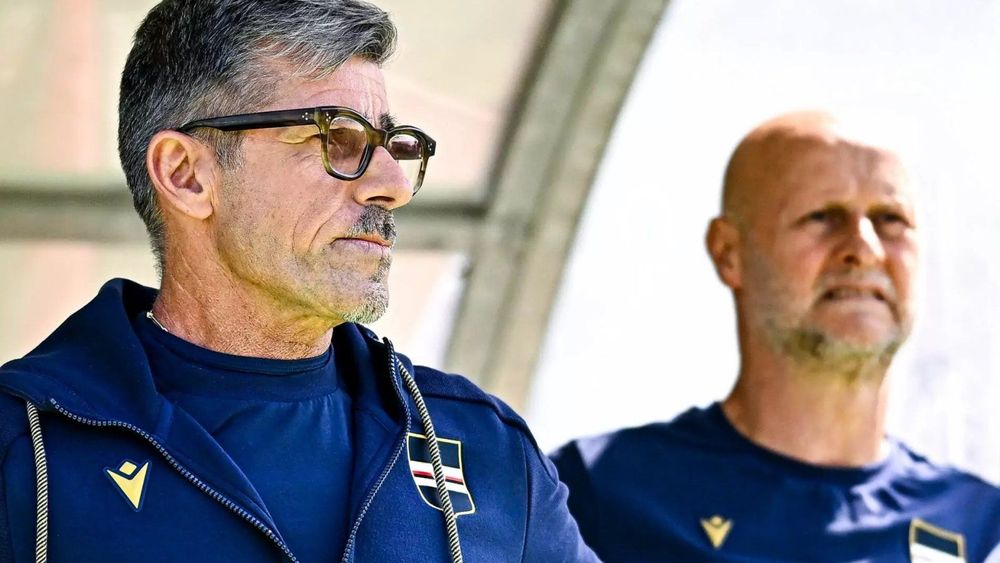
He spent four important years at the club as a player, becoming part of an environment that left a lasting impression on him, before returning decades later to take charge of a team fighting to avoid relegation.
The former Italy international has never forgotten the affection he received in Genoa, nor the influence of the late Paolo Mantovani, the president who helped establish Sampdoria among Italy's leading clubs.
For Evani, the connection went beyond football. It was an experience that made his return as manager particularly meaningful, even if the circumstances could hardly have been more difficult.
“Both Milan and Sampdoria were important to me," Evani told Football Presse. "Milan was the club that brought me up, almost like a family, my second family. I arrived when I was 14 and left when I was 30. I had an important journey there, learned a great deal and was fortunate enough to win a lot.
“Sampdoria, however, was a great discovery and a surprise. There was a president like Mantovani, who had an enormous passion for the team. All the Sampdoria supporters still remember him.
“I had a wonderful time there. They have a fantastic public, a beautiful stadium, an English-style stadium, and I spent four important years there.”
Those memories were reinforced by what Evani achieved on the pitch. His first season at Sampdoria brought another significant honour, with the club winning the Coppa Italia, a trophy he had not yet managed to win during his time at Milan.
It was another reason why the club retained such a special place in his footballing life. When the opportunity eventually came to return, he did not need much persuading.
Why Evani accepted Sampdoria's rescue mission
After leaving the Italian federation, Evani did not follow Roberto Mancini to Saudi Arabia. Instead, he was offered the opportunity to return to Sampdoria and attempt to rescue a club experiencing one of the most difficult periods in its history.
The circumstances were far from ideal. Evani was being appointed as the fourth head coach of the season, with only six matches remaining. He inherited a team that he described as being in pieces, struggling for confidence and morale.
It was an assignment that carried considerable risks, particularly given his personal association with the club. But that same connection was ultimately what persuaded him to accept.
“I left the federation and I didn't follow Mister Mancini to Saudi Arabia. Then I was given the opportunity last year to try to save Sampdoria again.
“It was a very complicated, very difficult situation, because arriving as the fourth coach of the season with six matches remaining, with a team that was really in pieces, down in confidence, there were more risks than advantages.
“But I accepted that challenge precisely because I had already been at Sampdoria. I know the environment, I know the prestige of that club, I know the affection and the passion that the supporters put into it, so I tried to give everything I could.”
Evani's task was to restore belief as much as improve results. The club's position meant there was little time to implement changes, but the connection between the manager and the supporters provided an additional motivation.
Sampdoria eventually secured their survival through the play-outs against Salernitana, giving Evani an achievement he continues to regard with considerable affection.
“We managed to save ourselves in the play-outs against Salernitana, and that is another satisfaction I carry in my heart.”
However, the successful conclusion to the rescue mission did not lead to the continuation Evani had hoped for. Having returned to a club he knew so well and helped it through a difficult period, he wanted the opportunity to build on the work he had started.
“It was a shame that there wasn't a possibility to continue, because it would have been important for me, wonderful for my coaching career. But it ended there.
“I hope now to find another occasion, another opportunity, because it is what I like doing and I would like to continue doing it.”
Evani cannot understand Sampdoria's decline
His affection for Sampdoria makes the club's continued difficulties particularly painful. Asked about the situation and the problems that had affected the organisation over several years, Evani struggled to understand why a club with such a strong footballing identity had been unable to achieve more.
Beyond his disappointment, he pointed to the ingredients that should allow Sampdoria to compete at a considerably higher level.
“Alongside the sadness, I also don't understand why, because Sampdoria have everything there to do much better.
“They have a public that very few clubs have, an important stadium and a prestigious club. They have had management difficulties in recent years and even risked bankruptcy.
“Now they are gradually starting again, but I think even this year they could have done better.”
Evani's comments are particularly significant because they come from someone who knows the club from the inside, both as a player and as a manager. He is not simply looking at Sampdoria's historic reputation. He believes the club still possesses tangible advantages that should translate into stronger performances on the pitch.
The supporters are central to that argument. During his playing career, he experienced the atmosphere at the Luigi Ferraris and the affection of the Sampdoria faithful. Returning as manager only reinforced his appreciation of what the club represents to its people.
He also believes the recruitment work had provided a platform from which the team could achieve more.
“Considering the two transfer campaigns, the one in July and especially the one in January, where they brought in some good players, I think they perhaps could at least have reached the play-offs.”
It was an assessment based on the quality he believed had been assembled, rather than simply the club's name or its history. Evani felt Sampdoria had sufficient resources within the squad to pursue a more ambitious objective.
For a club that had spent recent years dealing with instability and the threat of financial collapse, reaching the play-offs would have represented a meaningful step forward.
A relationship that goes beyond one season
Evani's comparison between saving Sampdoria and winning the European Championship with Italy also reveals how much the rescue mission meant to him.
He was asked which achievement had been more difficult, but refused to separate the two.
“They were two great achievements. I wouldn't say which was more difficult. They were both difficult, although eventually things became easier.”
For Evani, the satisfaction came from overcoming the circumstances surrounding each challenge, whether it was bringing together an international squad or attempting to restore a struggling club's confidence in the final weeks of a season.
His Sampdoria experience was particularly personal. He had returned to a place where he had enjoyed four important years as a player, where he had experienced the affection of the supporters and where his memories of Mantovani remained strong.
The fact that he was unable to continue after securing survival remains a disappointment, but it has not diminished his affection for the club.
Evani's message is ultimately one of belief in what Sampdoria can still become. The supporters, the stadium and the prestige remain, in his view, the foundations of a club capable of achieving considerably more.
What is needed is for those advantages to be translated into better decisions and greater consistency.
For someone who has experienced the club's golden years and subsequently returned during its most difficult period, the contrast is striking. But Evani has not lost faith in Sampdoria's potential.
As he sees it, the ingredients are still there. The challenge is making them count.