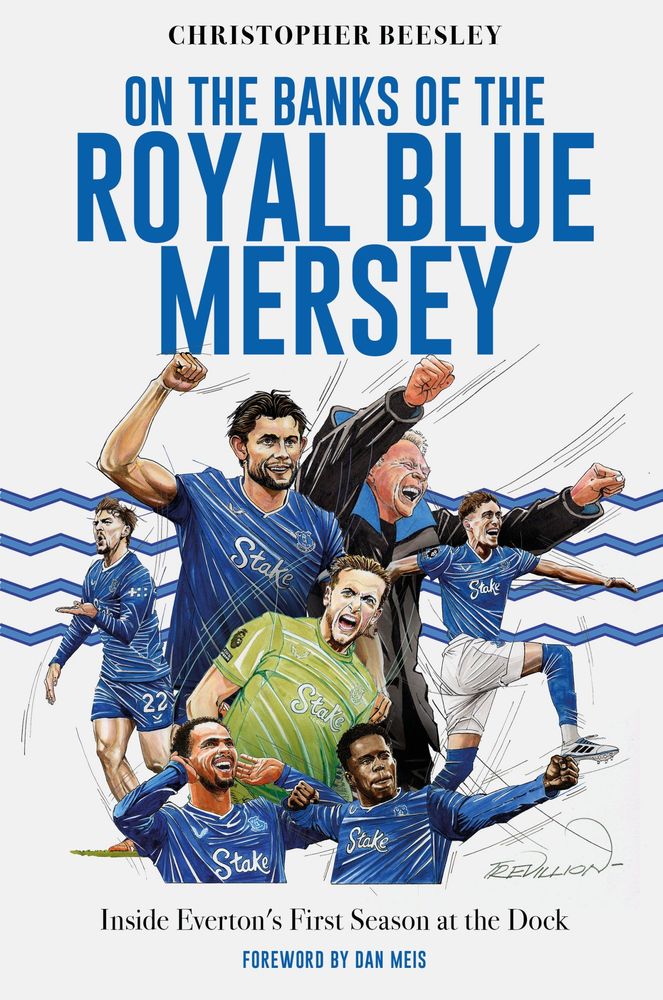
The Liverpool Echo journalist’s new book, "On the Banks of the Royal Blue Mersey", chronicles Everton’s first season at Hill Dickinson Stadium, but its concluding chapters also examine the uncertainty surrounding the club’s ownership.
When the announcement came, Beesley was surprised by the timing rather than the underlying decision. Having followed the situation and spoken to contacts in the United States, he believed the possibility of Friedkin moving on had been there for some time.
“I've got contacts over there in the US, and people in Houston, where The Friedkin Group are based," Beesley told Football Presse. "It says in the book that there are serious question marks over whether these people are going to be there long term and whether they have the appetite for it.
“So you heard it first in the pages of 'On the Banks of the Royal Blue Mersey'. We were kind of looking towards that, and we were all surprised that it happened last Friday, with a three-week international break and everyone getting ready to go back into action.
“It wasn't great timing, 48 hours before the game, but it was always on the cards that it was going to happen.”
For Beesley, the announcement was the culmination of concerns about an ownership that had brought financial stability to Everton without establishing a particularly visible presence around the club.
The distinction is important. Everton were in a perilous position when Friedkin arrived, following years of financial problems under Farhad Moshiri and the collapse of the proposed takeover by 777 Partners. The Friedkin Group's intervention helped secure the club's immediate future, but Beesley questions whether the owners ever intended to make Everton a long-term priority.
From the threat of 777 Partners to financial stability
Everton's previous ownership crisis was not simply a question of disappointing results or an unsuccessful transfer policy. The club faced significant financial difficulties, twice breached the Premier League's profitability and sustainability rules under Moshiri, and endured points deductions while the proposed sale to 777 Partners remained unresolved.
Beesley believes the consequences of that period could have been considerably worse had the American investment group completed its takeover.
“Things were chaotic under Moshiri, on and off the pitch. It was the most turbulent period in the club's entire history, unfortunately. There must have been few teams in football history who spent as much to become as bad as Everton did under Farhad Moshiri.
“They sorted all that out, and things seem to be a lot smoother now. To be honest, looking at the way the club is run, not a lot seems to have changed. It's been very light-touch with The Friedkin Group, other than paying the bills.
“They've not done a lot in terms of the club. It still seems to be very similar in the way things are done. They haven't left a big footprint or fingerprint on the club since they've been here, other than actually sorting things out, which is obviously a huge thing.”
That last qualification is significant. Beesley is not dismissing the importance of what Friedkin has done. Stabilising Everton after the Moshiri years was essential, and the alternative ownership scenario was potentially disastrous.
As he explained during the interview, Everton might have faced relegation and a much longer recovery had 777 Partners taken control. The stadium project was already well advanced, but the club's wider future could have been thrown into doubt.
The problem, in Beesley's view, is what comes next. Financial security is a necessary foundation, but it is not the same as an owner who wants to build something at Everton.
“They've got the deep pockets, but they just don't seem to have an interest. They just don't seem to have an appetite for it, which is a shame because, as I've outlined, it's an exciting project for somebody who does have a vision.”
The contrast with Roma
The clearest illustration of Beesley's concerns is the difference between Friedkin's apparent involvement with Everton and his relationship with Roma, the Italian club also owned by The Friedkin Group.
During the interview, Beesley pointed to Friedkin's presence at a European football clubs conference in Copenhagen and the pictures of him at AS Roma's training ground, meeting the coach and players. Those images offered a striking contrast with his absence from Everton.
“It's almost like they were hoping it would be a Cinderella story, but it's Cinderella in that she's getting ignored while the other sibling is getting all the attention. It's a different type of Cinderella story.
“You see Dan Friedkin. He was actually at Copenhagen the other week, wasn't he, doing the European Football Clubs Conference? He's on the executive committee there. Things were going well at Roma, they were top of Serie A before the weekend, and they'd just had the go-ahead for their new stadium as well.
“He's been pictured at the training ground there, shaking hands with the coach and the players. And he's never even been to an Everton game.”
Beesley returned to that point several times because he believes it says something fundamental about the relationship between an owner and a football club.
“Never since he bought the club. Didn't go to the last game at Goodison, didn't go to the first game at Hill Dickinson Stadium. He's never been. He's never watched Everton play. And now he decides he's going to sell. He just doesn't have the appetite.”
The comparison with Roma also raises questions about the practicalities of running two clubs with overlapping ambitions. Beesley explained that the Friedkins had reportedly hoped to find a way around the difficulties that could arise if both teams qualified for European competition.
The two clubs occupy broadly comparable positions in the football landscape and could find themselves competing for similar players. Roma had moved further ahead in that respect, but Everton's new stadium and supporter base give them the potential to become a more attractive proposition.
Beesley said the owners had been unable to make the proposed European workaround work, providing another reason for their decision to explore a sale.
It remains unclear how quickly a transaction could happen. At the time of the interview, no prospective buyer had publicly emerged, and the announcement itself had placed questions over the club's longer-term direction.
A relationship with Moyes that never began
Perhaps the most remarkable detail to emerge from Beesley's assessment concerns David Moyes.
Moyes returned to Everton during the club's difficult period and has helped restore a degree of stability on the pitch. Yet, according to Beesley, the relationship between the manager and the owner had barely existed at all.
After the summer transfer window closed, Moyes had indicated that he had never actually spoken to Friedkin. That meant the owner had not only failed to attend an Everton match but had also never had a conversation with the manager responsible for leading the team.
“That's a huge call now because David Moyes is the most successful manager for Everton in the Premier League era. He's led them to nine top-eight finishes. Before he arrived, they'd only ever finished once in the top half of the Premier League in the first decade.
“The highest position they'd achieved was fourth. He's in the final year of his contract now, so somebody has to make a decision over what happens to that. And the guy who owns the club has never even spoken to him, never mind watched his football team play.
“So yeah, that's not great either.”
The situation leaves an obvious question about who will determine Everton's direction if a sale takes time to complete. Moyes's contract requires a decision, while the club must continue planning its recruitment and development around the new stadium.
For Beesley, the absence of contact between the owner and manager is more than a symbolic complaint. It illustrates the difficulty of building a coherent football project when the person ultimately responsible for the club has so little direct involvement in its sporting operation.
An owner does not need to select the team or interfere in every footballing decision. But there has to be a relationship between ownership and the people charged with delivering results.
The middle ground Everton need
Beesley is equally clear that the answer is not a return to the Moshiri model, in which heavy spending failed to produce sustained success.
He recalled a comparison made between Moshiri's transfer policy and a football supporter with a Panini sticker album, simply pointing at players and deciding he wanted them. The problem was not a lack of money but the absence of an effective strategy for using it.
“Farhad Moshiri spent lots of money, but he just didn't know what he was doing. I heard somebody compare him to a fan with a Panini sticker album, pointing and saying, 'I'll have him and him and him.'
“So there's a happy medium between Moshiri meddling in the team and Dan Friedkin never even going to a game. There's got to be somebody who's in between all of that who could actually do a good job with the club.”
That is the ownership model Beesley wants Everton to find: someone with the financial resources to support the club, a clear idea of how to develop it and enough personal commitment to understand the institution they have acquired.
The timing matters because Everton are now in a different position from the one they occupied when Friedkin arrived. Hill Dickinson Stadium offers opportunities to grow matchday income, host other major sporting events and attract new commercial revenue. Its role as a venue for international rugby and football has already demonstrated that its value can extend beyond Everton's home fixtures.
Beesley sees a compelling proposition for the right investor.
“I actually think, and it's not just because I am an Everton fan, that it's an exciting project for somebody if somebody does have a vision in terms of a huge supporter base.
“You've got that huge supporter base, probably more than the club deserve in many ways in terms of what they've achieved or not achieved in recent times. You combine that with the new stadium, and it's actually an exciting project if somebody does have a vision.”
The question is whether a prospective buyer will see Everton as a club with potential to unlock or simply another asset to add to a portfolio.
Friedkin's tenure has prevented the financial crisis inherited from Moshiri from continuing unchecked. But Beesley believes Everton need more than an owner who can pay the bills and keep the operation running.
Asked directly whether he was happy that the Friedkins were selling, his answer returned to the same central point.
“It has to be, in that you can't go on with an owner who's like that. He's stabilised the club and, like you said, it could have been disastrous. You could have had 777 Partners, Everton could have got relegated, and it could have been a long way back.”
The Friedkins' departure would not automatically guarantee a better future. Everton must find an investor capable of sustaining the financial progress already made while giving the football operation a coherent direction.
For Beesley, though, the new stadium, the size of the club's following and its potential for growth provide reasons to believe the right ownership could make a substantial difference.
The foundations are there. What Everton need now is an owner who wants to build on them.
Christopher Beesley is author of "On the Banks of the Royal Blue Mersey: The Inside Story of Everton's First Season at Bramley Moore Dock" from Pitch Publishing - which is available here.