
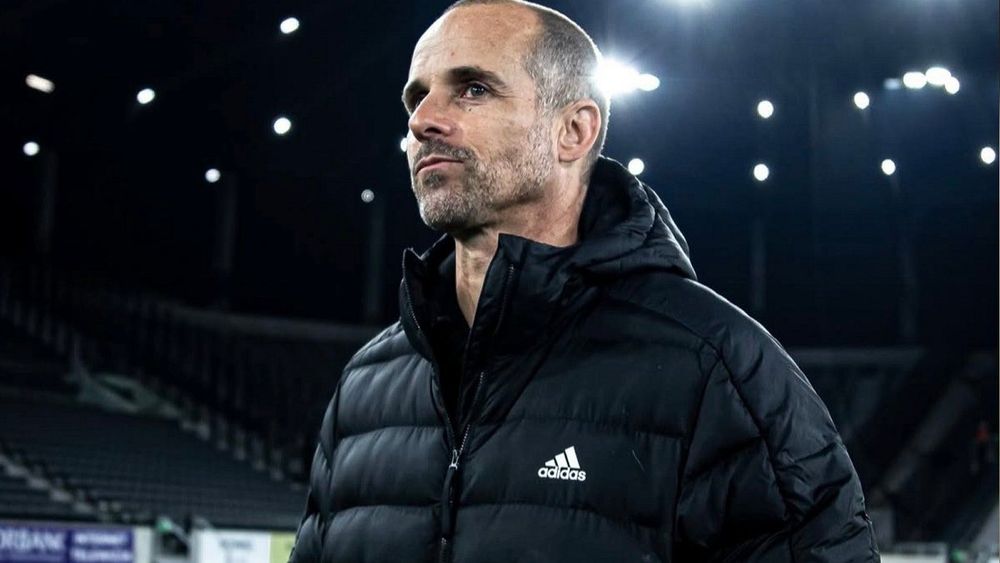
The Portuguese coach had been attracted to the vision presented by Kylian Mbappé and his staff, seeing an opportunity to help rebuild a historic French club and eventually return it to the top flight.
Instead, his tenure lasted just seven matches.
More than a year later, Caen have suffered the relegation that followed their disastrous campaign, while Baltazar has experienced the very different challenge of returning to Poland and helping Radomiak Radom secure their top-flight survival.
Yet his assessment of Caen remains remarkably measured.
“The way Kylian Mbappé and all his staff, they proposed me the project for the future and they showed me the project, really impressed me,” Baltazar told Football Presse.
“It really attracted me to move to France.”
That project was built around Mbappé's investment in Caen.
His investment vehicle acquired an 80 per cent stake in the club in 2024, with the ambition of restoring Caen to Ligue 1. Baltazar was appointed head coach on December 29, 2024, replacing club favourite Nicolas Seube.
The timing was difficult from the outset.
Caen were already struggling near the bottom of Ligue 2 and Seube's dismissal had provoked anger among supporters, with protests directed at the new ownership.
Baltazar knew immediately that he was inheriting a club where expectations were high and patience was already running thin.
“The fans are the heart of the club,” he said after his appointment, promising to bring victories back to Caen and restore pride to the supporters.
He also spoke about the scale of the challenge awaiting him, saying he wanted to “honour the status” of Mbappé while expressing ambitions that ultimately stretched towards European football.
There was an important distinction, however.
Baltazar had not spoken directly to Mbappé before being appointed.
The project had been presented to him by Mbappé's staff, and it was that vision which convinced him to take the job.
“I was really impressed with the club, with the city, with the fans, even with the people working at the club,” Baltazar told Football Presse.
“So it's a really, really special club.”
The new coach was walking into a situation where the immediate results mattered just as much as the long-term ambition.
And those results never came.
Baltazar lost all seven of his matches in charge.
Caen scored only once during that run and conceded 11 goals, with his final match ending in a 2-0 defeat at Laval. He was dismissed on February 18, 2025, and replaced by Michel Der Zakarian.
The Portuguese coach does not attempt to disguise the disappointment.
“Unfortunately, when I arrived to the club, the situation was tough,” he said.
“I went there with my staff to try to change the situation, and unfortunately, I wasn't able to do it.”
He describes the experience in two very different terms.
“It's mixed feelings of the pride of having the opportunity working this big club in France and frustration for not being able to change the difficult situation.”
Then comes the bluntest admission.
“Coach, I depend on results.”
“Unfortunately, for the first time in my career, I wasn't able to achieve the objective proposed.”
There is no attempt to blame the ownership, the players or the circumstances.
Instead, Baltazar repeatedly returns to one of the fundamental realities of management.
“There are no easy jobs,” he said.
“Especially in the coach job that you need to have results and to bring a team and a group of players around you and the fans and the board.”
“Every time it's challenging and difficult.”
The subsequent history of Caen makes his words even more revealing.
The club were relegated from Ligue 2 in April 2025 after a 3-0 home defeat by Martigues, ending a campaign in which they finished bottom of the table. It was their first relegation to France's third tier since the early 1980s.
The ambitious project had therefore become a fight for survival almost immediately.
Baltazar's departure did not solve Caen's problems.
But nor did he pretend that his own spell had been successful.
“I wasn't able to change the difficult situation,” he said.
“It was sad for me and frustrating, but it's football life.”
That final phrase perhaps explains Baltazar's attitude to a career that has taken him through Portugal, Cyprus, Qatar, England, the United States, Poland and France.
He sees each difficult experience as part of his education.
“Each time I go to a new club or to a new country, obviously we need to adapt to the new reality,” he said.
“Each club is different, and of course different countries have made even more difficult.”
The adaptation goes well beyond tactics.
“We need to adapt also to the culture, to the language, to all the values from one country that are different from mine.”
Baltazar believes those experiences have made him stronger.
“I grew up a lot as a coach,” he said.
“I grew up a lot as a man, as an individual.”
That perspective has since been tested again.
In March 2026, Radomiak Radom turned to Baltazar for a second time, appointing him with eight Ekstraklasa matches remaining and the club still needing points to secure its position in Poland's top flight.
This time, the story had a happier ending.
Baltazar recorded three victories, two draws and three defeats from those eight matches, helping Radomiak finish 10th before leaving the club at the end of the season.
It was a reminder that a difficult managerial spell does not necessarily define the next one.
Baltazar had left Caen after seven consecutive defeats.
He returned to Poland and helped save another club from trouble.
“All the clubs, I take good things,” he said.
“I bring special people, I bring new experiences, and all these experiences make me a better man, a better coach, and more prepared for the future challenges.”
There is also an important postscript to the Caen story concerning Mbappé's own involvement.
Caen recruitment director Reda Hammache later said that Mbappé was kept informed about major sporting decisions and supported the appointments of Baltazar and subsequently Der Zakarian. Hammache described the club's majority shareholder as involved in the major decisions without being an intrusive presence in the day-to-day football operation.
That makes Baltazar's recollection particularly relevant.
He was not simply joining a club owned by a global football superstar.
He believed in the football project being presented to him.
“The way Kylian Mbappé and all his staff, they proposed me the project for the future really impressed me,” he said.
“And it really attracted me to move to France.”
What ultimately failed was not Baltazar's belief that Caen had potential.
It was the ability to turn that potential into immediate results.
“In the world of football, we know how it is,” he said.
“We have ideas, we have the good people around you, you have... But sometimes things are not possible to do in an immediate way and needs more time to elaborate the plan.”
Caen did not have that time.
Baltazar's seven matches became a footnote in a much bigger story of ownership, expectation, supporter unrest and relegation.
But his account provides something that the results alone cannot.
He saw the project from inside.
He understood why it attracted coaches.
And he experienced just how quickly the demands of professional football can overwhelm even the most ambitious long-term plan.
“Caen is a really special club,” Baltazar said.
“I wish them all the best, and I hope that they can come back to the elite of the French football in the near future.”
The project that attracted him to Normandy did not unfold as planned.
But the lessons from it have followed him.
And for Baltazar, that is the reality of football management: the next challenge is always waiting, and the last one can only make you better if you are willing to learn from it.