
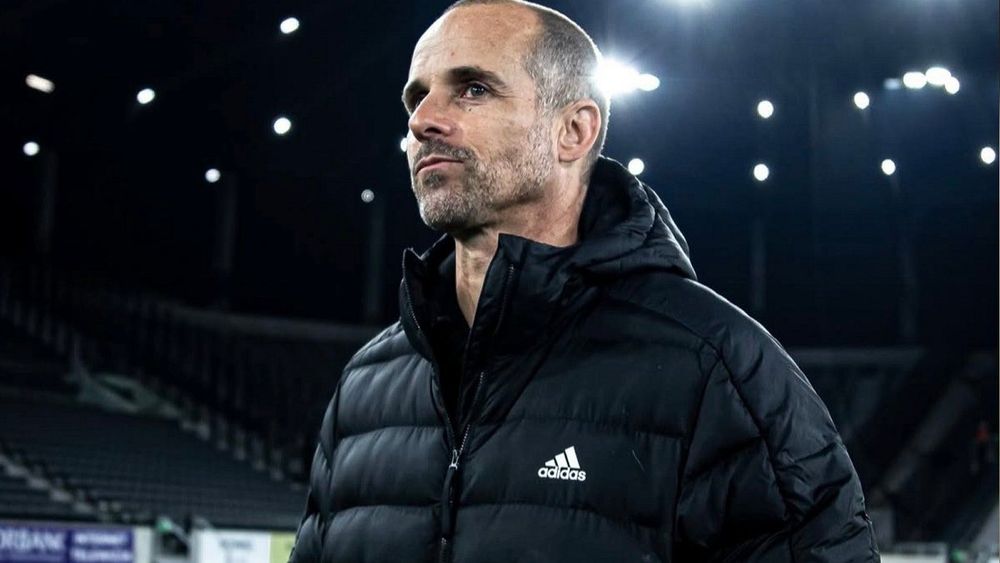
The Portuguese coach did not see Rochester New York FC simply as another job. He saw it as a way into a football market he believed was developing rapidly — and potentially a route towards the Major League Soccer dugout.
“I was really impressed with the quality that I found in MLS NEXT Pro,” Baltazar told Football Presse. “One career target I have is to work one day in MLS. I don't hide this.”
Baltazar's American adventure came in 2022, when he was appointed head coach of Rochester New York FC for the inaugural MLS NEXT Pro season.
Rochester was an unusual project.
The club, formerly the Rochester Rhinos, had returned after a period without professional football and was the only independent team in a league largely made up of MLS-affiliated sides. Jamie Vardy was part of the ownership group, and the club was attempting to build a new identity around developing players and reconnecting with a city that had a long football tradition.
For Baltazar, that was precisely the attraction.
“When I was at Nottingham Forest, I had offers from other leagues in Eastern Europe, even financially attractive ones, but it wasn't the type of challenge I wanted,” he said.
“Those doors were still open if I wanted to try, but I wanted a different challenge.”
Vardy's involvement helped convince him.
“When I knew Jamie Vardy was involved with the project, and when he invited me here, I was very excited.”
His ambition was bigger than Rochester.
“One of my targets is to get to MLS someday,” Baltazar said. “I am ambitious, but I'm taking it step by step, just like my playing career.”
The first step was difficult.
Baltazar did not even arrive in Rochester until shortly before the season began because of visa problems. He reached the United States only days before the club's opening match, leaving him with almost no preparation time with a completely new squad.
“I arrived in early March, so I was still in shock,” he said at the time. “Freezing cold, snow on the ground — it was tough in the beginning.”
The football, however, surprised him.
“I was really impressed with the quality of the players, especially the young players,” he says. “I wasn't expecting so much quality.”
That became one of the defining features of his American experience.
Rochester was not simply trying to win matches. Baltazar and his staff were building a squad almost from scratch, looking for players who could develop and potentially move further up the American football pyramid.
“We were really worried, in a good sense,” Baltazar said. “We didn't want just the technical and tactical part of the players. We also wanted a good person, a good mentality and mindset.”
The recruitment process was consequently about personality as much as ability.
“It was a tough few months going through the signing process and trying to find the best mixture of players. We did reject a few great talents because of the information we were given about their personalities.
“We wanted to create a good atmosphere here because it is the only way you can create a team.”
That philosophy produced results.
Rochester started slowly, partly because of the disrupted preparation, but eventually surged into the Eastern Conference play-off positions. Baltazar was named MLS NEXT Pro Coach of the Month for May after leading the team through a five-match unbeaten run, including four consecutive wins.
The experience reinforced his belief that the United States had more football quality than outsiders often assumed.
“I was really impressed with the quality that I found in MLS NEXT Pro,” he said. “The football is growing really fast in a really, really positive way in America.”
He was particularly struck by the young players.
“I saw many young players with very good quality.”
And he saw a development system that could eventually feed the senior league.
“Many of them are playing in MLS on a regular basis.”
For Baltazar, that mixture of youth and experience was the key.
“All this blend of experience, quality and young players is turning MLS into a more attractive league.”
He also believed the arrival of global stars was accelerating the process. The presence of players such as Lionel Messi and Luis Suárez, he argued, was about more than publicity.
“It's important that these big names come to these kinds of leagues,” he said.
“They attract attention, they bring other players in, they attract coaches, players, investors and money.
“It's like a snowball.”
The league, he believed, could use established stars to raise its profile while continuing to develop younger players underneath them.
“I think it's a good mixture.”
Baltazar's prediction about the direction of American football now looks particularly interesting.
At the time of his Rochester experience, MLS was still building towards the next stage of its development. Since then, the league has continued to expand its international profile, while MLS NEXT Pro has grown substantially as a development competition.
The league is now preparing for a major calendar change, moving towards a summer-to-spring schedule designed to align MLS more closely with the global football calendar. MLS commissioner Don Garber described the next phase as “MLS 3.0”, with greater emphasis on competing internationally and improving player development.
The incoming commissioner, Larry Berg, has also identified MLS academies and MLS NEXT Pro as priorities, specifically wanting them to become more productive pathways into first-team football.
That is strikingly close to the philosophy Baltazar was describing in Rochester.
The irony is that Rochester itself did not survive.
After qualifying for the playoffs in its first MLS NEXT Pro season, Rochester New York FC ceased operations and withdrew from the competition before the 2023 season. The club cited the need for substantially greater investment and the failure of a prospective ownership deal.
Baltazar therefore experienced both sides of American football's development.
He saw the potential. He saw the players. He saw the growing appetite. And he also saw how difficult it could be to build a sustainable professional club outside the established MLS structure.
But the ambition he took to Rochester has never disappeared.
“One of my targets is to get to MLS someday.”
The American experience did not ultimately take him into MLS. Instead, it gave him something else: a different perspective on where the game was heading.
“I was really impressed with the quality,” he said. “And they are growing up really fast.
“I still follow the league, and I pay attention to the league because in the future we never know.
“We need to be ready.”