
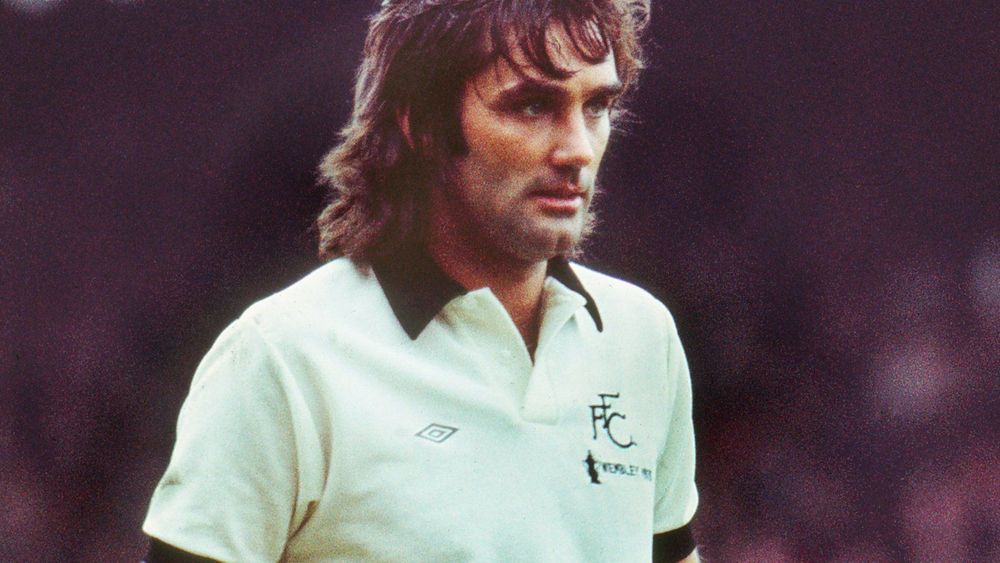
For the young defender, it was an extraordinary education, but Gale remembers Best for more than the brilliance that made him one of football's most celebrated players.
"George Best was special. He was special," Gale recalls to Football Presse.
"He'd do things in games which I think if you saw now, people would be purring over it every two seconds. You'd be replaying it, slow motions, freeze frames."
Gale played alongside Best at Fulham towards the end of the Northern Irishman's career, when the problems that would eventually define much of the public perception of him were already becoming impossible to ignore.
But those who shared a dressing room with Best saw something else.
"He was a kind of loner," Gale says. "Obviously he had his problems at the time when he was at Fulham, the drink and things like that. But he was just a special talent, just a special talent."
The football itself left Gale almost struggling to describe what he had witnessed.
"His movements, he could kick with right foot, left foot. He was a good header of the ball for a small man, very brave in the tackle, very brave at riding tackles as well when he was in possession.
"And more importantly, running with the ball, just beating people."
Best's ability to manipulate defenders was extraordinary.
"Left, right, left, right, feint to cross it, cut back in, go the other way. And all the tricks that you see today, he's probably done before.
"One of those, you know, when they say, 'Oh, this trick and that trick.' I remember seeing him when he finished playing football and I was commentating and he was working on TV as well, and he went, 'I've done that one. I remember doing that one.'"
Yet Gale believes the player Best became never fully realised the potential of the teenager who had conquered Europe with Manchester United.
"Did he fulfil his potential? No, no way, because of the problems he had."
There is an interesting comparison in Gale's mind between Best and the modern game's greatest stars.
"I think great players like that though, there's very seldom great players like Messi who's had such a clean-living life, is there? And Ronaldo, really. They're kind of not one-offs, two-offs, because they just look after themselves impeccably, don't they?"
For Gale, Best and Paul Gascoigne belonged to another category of extraordinary British talent whose lives became tangled with problems away from football.
"You tend to see the British talent, say someone like Best, Gascoigne, it was fuelled with problems. Why? I don't know, but maybe it's the environment that we created around it that maybe drove them to what they did."
But Gale is careful not to allow Best's difficulties to overwhelm his memories of the man.
Because, as a young player, he experienced something very different.
"George Best was good to us as kids. So it's always in life, you speak as you find. And as I found him, I found him really good, good to us as kids."
The age difference was significant. Gale was around 17, while Best was approaching 30, and the older players naturally had their own circles.
"Obviously we were 17, he was 28 or 30 or something like that. So there was the age difference that, you know, his company would be George, Rodney Marsh and Bobby Moore and some of the senior players.
"But never ever left us out of anything. He was really, really good to us lads."
That generosity was part of what made Gale so fortunate to have come through football at that particular time.
He describes Best, Moore and Marsh as mentors, although they never sat down and formally took on that role.
"They were mentors without knowing it. That's how life was then, you know. It wasn't, 'Oh look, study this, study that' with them. You just had to be in their company to learn.
"Look and learn."
It was an extraordinary group for a young defender to observe. And although Best's career was winding down, Gale would encounter him again years later, when the circumstances were much darker.
"I remember seeing him when he finished playing football and I was commentating and he was working on TV as well."
Best was by then suffering badly, but Gale remembers the reaction when they recognised each other.
"He was in particularly dark times. When he saw you, he'd say 'Tony', and his face lit up."
The reason was simple.
"He just loved talking football. Loved talking football."
That, perhaps, is the part of Best that Gale wants people to remember most.
Not the headlines. Not the photographs. Not even the drinking.
The footballer.
Because for a teenager lucky enough to share a dressing room with him, there was never any doubt about what he was watching.
"George Best was special."