
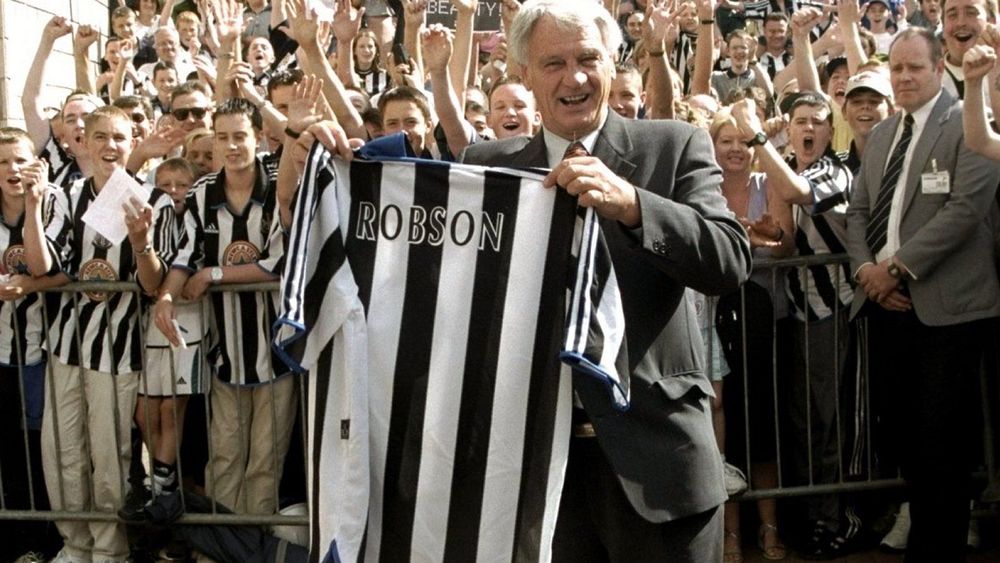
It was also a personal experience that brought together his childhood connection with Ipswich Town and his admiration for a man whose influence would extend well beyond his playing career.
Bramble grew up in Ipswich, where Robson had established himself as a managerial legend during a remarkable spell between 1969 and 1982. Having taken the club from the Second Division to the top of English football, Robson guided Ipswich to the FA Cup in 1978 and UEFA Cup in 1981 before moving on to become England manager.
By the time Bramble arrived at Newcastle United in 2002, Robson had already enjoyed an extraordinary managerial journey, including taking England to the 1990 World Cup semi-finals and working with some of Europe's biggest clubs.
For the young defender, however, the connection went back much further.
“My family are big Ipswich Town fans, so when he was at Ipswich, they would support Ipswich when he was there," Bramble tells Football Presse.
“So to have the opportunity to work with him every day was fantastic, and I loved every moment of it. I learned so much from him, and so much of how I coach now I've taken from Sir Bobby.”
It was a particularly meaningful appointment for Bramble, who had come through Ipswich's academy and established himself in the first team before Robson brought him to St James' Park.
The defender completed his move to Newcastle in July 2002, with Robson personally welcoming a player he believed had considerable potential.
Learning from a managerial giant
Robson's Newcastle side was entering an exciting period. The club had returned to the Champions League and were competing against Europe's leading teams, with the manager combining experienced internationals with younger players developing their careers.
Bramble experienced those European nights first-hand, but his recollections of Newcastle also reveal a player conscious of his own development and the inconsistencies that accompanied his early career.
“As an experience, it was amazing, a great experience. I mean, playing Champions League nights in front of 52,000 passionate fans was incredible.
“But my time was very inconsistent, performance-wise. I'd have periods where I play well and periods when I play not so well. But obviously at the time I was a young kid, so that's normal for young kids to be inconsistent and have good weeks and bad weeks.”
Robson's ability to work with young players was an important part of his reputation, and Bramble's comments suggest that the education he received went beyond the immediate demands of playing Premier League football.
There was also the opportunity to share a dressing room with some outstanding footballers, including Alan Shearer, whose influence on the team was unmistakable.
“His goal scoring speaks for itself really. He's a phenomenal striker, phenomenal goal scorer, and he was a really, really good captain.
“So it was, again, it was an honour to play beside such a legend.”
Bramble also experienced the managerial transition that followed Robson's departure in 2004, with Graeme Souness taking charge at Newcastle.
His assessment of that period was characteristically honest.
“He came in to replace Bobby, so again, a bit like my whole career, it was very inconsistent. Even when Graeme came in, it was inconsistent.
“I had some good games and some bad games.”
A legacy that continued after Newcastle
Robson's Newcastle reign ended in August 2004, but his influence on the people who worked with him remained an important part of his legacy.
For Bramble, that influence has become particularly relevant since moving into coaching.
After retiring from professional football around 2013–14, the former defender initially considered whether to pursue a career in the media or move into coaching. He eventually chose the latter, returning to Ipswich to work with the club's younger age groups.
His coaching experience included the under-11s, under-12s, under-14s and under-16s, alongside work with the under-18s and under-23s.
It was an opportunity to give something back to the club where his own football journey had begun.
“I wasn't really sure what I wanted to do. I wasn't sure if I wanted to go into the media or wasn't sure if I wanted to go into coaching.
“So I decided to start coaching, and I've really enjoyed coaching.
“I started coaching with Ipswich Town. I've done the under-11s and the 12s and the 14s and the 16s. I've done some work with the under-18s and under-23s, so it was great to give something back to the club that I love.”
The connection with Ipswich has therefore continued into another chapter of Bramble's football life. His subsequent move to Abu Dhabi provided a different environment in which to continue working in the game, but the foundations of his coaching education had already been established.
Bramble's coaching journey has since taken him well beyond the academy environment at Ipswich. After gaining experience in the United Arab Emirates, he has now moved into international football, taking up the position of assistant coach of Pakistan's national team in September.
The appointment brought another Newcastle connection into his coaching career. Pakistan are managed by former Magpies midfielder Nolberto Solano, with whom Bramble shared the pitch 83 times between 2002 and 2007.
The pair have reunited more than two decades after their playing careers first brought them together at St James' Park, this time working on the touchline as Pakistan look to develop their national team.
Bramble joined the coaching staff as Pakistan prepared for the inaugural FIFA ASEAN Cup, following the lifting of the Pakistan Football Federation's FIFA suspension in March 2025.
It represents a significant new stage in his coaching career, moving from youth development at his hometown club to the demands of international football.
Yet the connection to Robson remains central to understanding the coach Bramble has become. The lessons he absorbed while playing under the former Newcastle manager have travelled with him through his subsequent coaching experiences and into his latest international appointment.
For a young defender who grew up in an Ipswich-supporting family, the opportunity to work with Robson was something special. That he continues to draw on the experience today gives his recollections an added significance.
Robson died in July 2009, but his achievements at club and international level remain part of English football history. For Bramble, however, his legacy is also personal: the knowledge gained from working alongside him continues to inform the way he approaches coaching and developing young players.
His reflection offers a fitting reminder that a manager's influence is not measured exclusively by trophies, league positions or memorable European nights. Sometimes it is found in the careers and decisions of the players who carry those lessons forward.