
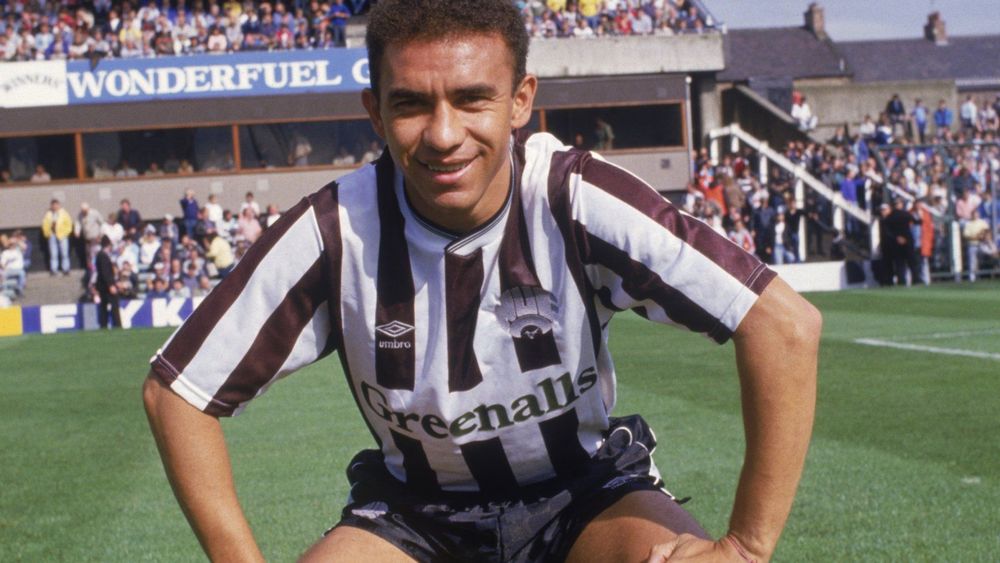
Speaking to Football Presse, his former Newcastle United teammate Liam O'Brien and Newcastle historian Gary Sherrard revisit the Brazilian's pioneering adventure, the dressing-room frustrations, the spectacular near misses and why he still holds a special place in the hearts of supporters.
A Brazilian on Tyneside: an entirely new experience
When Newcastle United signed Mirandinha from Palmeiras in August 1987 for £575,000, they were doing something that would seem entirely ordinary in modern football. Bringing a Brazilian international to English football, however, was anything but ordinary at the time.
Francisco Ernandi Lima da Silva, better known as Mirandinha, became the first Brazilian to play in the Football League. He arrived with a reputation for pace, direct running and an attacking style that offered Newcastle supporters something they had rarely witnessed before.
For Gary Sherrard, Newcastle historian, writer and lifelong supporter, the arrival was about much more than another signing. It was an event that captured the imagination of a fanbase at a difficult time for the club.
"Yeah, I do. That would be after I'd left home, so I wouldn't have been a matchday regular, but there was a great buzz, an absolute great buzz. You've got a Brazilian there, the fact that he smiled a lot and didn't really speak English except for the swearing that Paul Gascoigne had taught him. It was a very endearing kind of naivety that goes with that, but it was definitely a buzz. I remember having a yellow T-shirt with a Mirandinha in black and white stripe on it and Brazil shirts. It's the kind of thing that happened properly 10 years later, but at that stage it was very new, very fresh, a bit odd."
The excitement was understandable. Newcastle had lost Chris Waddle to Tottenham in 1985 and Peter Beardsley to Liverpool in 1987, while Paul Gascoigne would also depart for Tottenham in 1988. Mirandinha represented something different at a time when the club was undergoing considerable change.
Sherrard believes the Brazilian's contribution needs to be considered within those circumstances, rather than simply judged by the consistency of his performances.
"And he had some real standout moments for Newcastle. It just wasn't consistent enough and didn't happen often enough or long enough. But it wasn't a great team that he was in either. Things were changing around him in the team and in the club as well. But yeah, we attempted to start the foreign invasion before there was really one in Premier League football."
From facing Brazil to sharing a dressing room
For Liam O'Brien, Mirandinha was not simply an unfamiliar international signing. The Irish midfielder had actually encountered him before they became Newcastle teammates.
O'Brien had represented the Republic of Ireland against Brazil in Dublin in 1987, when the Irish secured a memorable victory over the South Americans. Mirandinha was in the Brazilian side that day, giving O'Brien a rather unusual introduction to the player he would subsequently share a dressing room with.
"Yes, he was indeed. Mirandinha. I played against him, would you believe, for Ireland against Brazil in 1987 when we were lucky enough to beat them in Lansdowne Road here in Dublin. And he played that day. So I either played against him and then I played with him at Newcastle."
Having previously played for Shamrock Rovers and Manchester United, O'Brien arrived at Newcastle with his own experience of different footballing environments. He quickly discovered that his Brazilian teammate had a distinctive approach to the game.
"And Mirandinha was obviously a flair player, Brazilian, but he could be very frustrating at times. He kind of, he wanted the ball all to himself sometimes. He wasn't passing as much, so he got a few bollockings off some of the players around him."
It was a fascinating contrast. Mirandinha had arrived with the reputation of a technically gifted Brazilian forward, but English football demanded a different kind of discipline, particularly in a Newcastle side that was not always able to provide him with the platform he needed.
O'Brien, however, makes clear that the language barrier did not prevent Mirandinha from becoming part of the group.
"Yeah, yeah, he was fine. I mean, he had an interpreter with him, interpreter trying to help him to speak English and stuff. You know, he was fine. He was one of the lads. He had a bit of fun. He wasn't standing in the corner on his own. He joined in with the lads and tried to have a bit of fun."
The Manchester United debut and the shot that nearly changed everything
O'Brien's arrival at Newcastle created another connection with Mirandinha that would produce one of the more memorable recollections from the interview.
Having left Manchester United to join Newcastle, O'Brien made his debut for the Magpies against his former club at St James' Park on November 27, 1988. The game finished goalless, but Mirandinha almost provided an extraordinary moment to mark the occasion.
O'Brien remembers the Brazilian striking the post from approximately 30 yards, an effort that demonstrated both his ability and his willingness to attempt the spectacular.
"Yes, I do indeed, yeah, yeah, it was a kind of windy day, I remember that as well, yeah, he had a good strike on the ball, he was a good striker of the ball, to be fair to him, typical Brazilian, you know. That was the only problem. He thought he could score from 40 or 50 yards out every time, you know, instead of laying the ball off. So he just turned and run and shoot, and people are running into the box and not getting the pass off him. But that was him. Sometimes they go in, sometimes they go into the stand."
It was precisely the sort of moment that made Mirandinha such an intriguing player. He possessed the confidence to attempt things that others might not even consider, but that same instinct could occasionally frustrate teammates who were waiting for a pass.
For O'Brien, the memory of that particular afternoon also brings together two important moments in his own footballing career: leaving Manchester United and beginning his Newcastle adventure against the club he had just departed.
The missed opportunity that could have changed his Newcastle story
Sherrard also remembers that near miss - which could have altered the way Mirandinha's time on Tyneside was remembered.
"He had a couple of sort of, 'Oh, if that shot had gone in, that might have changed things for Mirandinha'. It was a shot that hit the post, and you think that might have changed things, because that might have made three goals in four games, and he could have gone on from there.
"Obviously it would have been a big confidence lift for the player."
Asked whether Mirandinha had been judged fairly given the circumstances at Newcastle and the demands of English football, Sherrard reflected on the limited footage supporters had seen of the Brazilian before his arrival.
"Yeah, I think you just— at that stage, we hadn't seen much of him. I think the clip that was always shown was the game at Wembley where he played for Brazil against England, and there was one clip, and he was quick and he was direct."
But Sherrard is particularly sympathetic towards Mirandinha's attempts to adapt. He believes the forward deserves considerable credit for making the effort to fit into an unfamiliar environment.
"I'd give him top marks for trying to fit in there.
That recollection is particularly revealing when considered alongside O'Brien's memory of the Manchester United game. The Brazilian was capable of producing the sort of strikes that could change a match, but the margins between a spectacular goal and another near miss were sometimes very small.
There was also the famous Liverpool encounter on February 4, 1989, when Mirandinha scored in Newcastle's 2-2 draw before striking the inside of the post with an audacious 40-yard half-volley. It was another demonstration of the extraordinary shooting ability O'Brien remembers.
A fish out of water, without the support modern players enjoy
Perhaps the most important part of Sherrard's assessment is his belief that Mirandinha arrived at a club that was not particularly well equipped to help him settle.
Newcastle were going through a difficult period, with an ageing stadium, limited investment and considerable uncertainty surrounding the team. Mirandinha was not simply adapting to a new league; he was attempting to build a life in a country where almost everything was unfamiliar.
"And he was very much a fish out of water when he came in. If you can imagine coming into Newcastle at that stage, into a stadium that had three sides on it, and a team that didn't have huge investment in it. So it would have been really tough, and he lived in a hotel for— I don't know if he lived in a hotel the whole time he was there, he lived in a hotel for a long while he's there."
Sherrard draws an interesting comparison with the Brazilian players Newcastle have welcomed in more recent years, particularly Joelinton and Bruno Guimarães.
The difference, he suggests, is that those players arrived in a much more established environment, with fellow Brazilians already at the club and able to offer support.
"You've seen since then, when Joelinton came in and then Bruno came in, he had somebody to look at and somebody to talk to. Mirandinha was very much on his own, and Paul Gascoigne became his mentor. That's the last thing you need, but it endeared him to the place."
It is a wonderful observation, particularly given Gascoigne's own personality and the stories surrounding his influence on the Brazilian's early attempts to learn English.
For all the difficulties, Mirandinha clearly made an impression on those around him. His smile, his willingness to join in and his attempts to adapt to a completely different culture helped establish a connection with supporters that went beyond the goals he scored.
A pioneer who deserved more time
Mirandinha's Newcastle career lasted two seasons. He returned to Palmeiras in 1989 following the club's relegation, having become an important part of the club's history as the first Brazilian to play in English league football.
His record included 20 league goals, with further appearances and goals in cup competitions. But his significance cannot be measured simply by statistics.
For Sherrard, the affection that remains among Newcastle supporters is rooted in the fact that Mirandinha took a chance on something entirely new, arriving in an unfamiliar country and attempting to make his mark at a club that was struggling to find its direction.
"I think there's a warm place in the hearts of the fans for him for being brave enough to do it. And nothing wrong with the spell he had, just didn't last long enough really."
O'Brien's recollections offer the other side of that story. He remembers the talented but sometimes frustrating teammate, the Brazilian who could strike a ball with extraordinary power, and the personality who made an effort to become part of the dressing room despite the language difficulties.
Sherrard remembers the excitement of seeing a Brazilian in black and white, the shirts, the buzz and the feeling that Newcastle had brought something completely different to Tyneside.
Together, their memories paint a picture of a player who arrived ahead of his time. Mirandinha was not afforded the support structures or the familiarity that later generations of Brazilian footballers would enjoy, but he helped establish a connection between Newcastle and South American football that would continue decades later.
Perhaps his greatest achievement was simply daring to be first.
For a club that has always treasured its characters as much as its footballers, Mirandinha remains a rather special part of its history.