
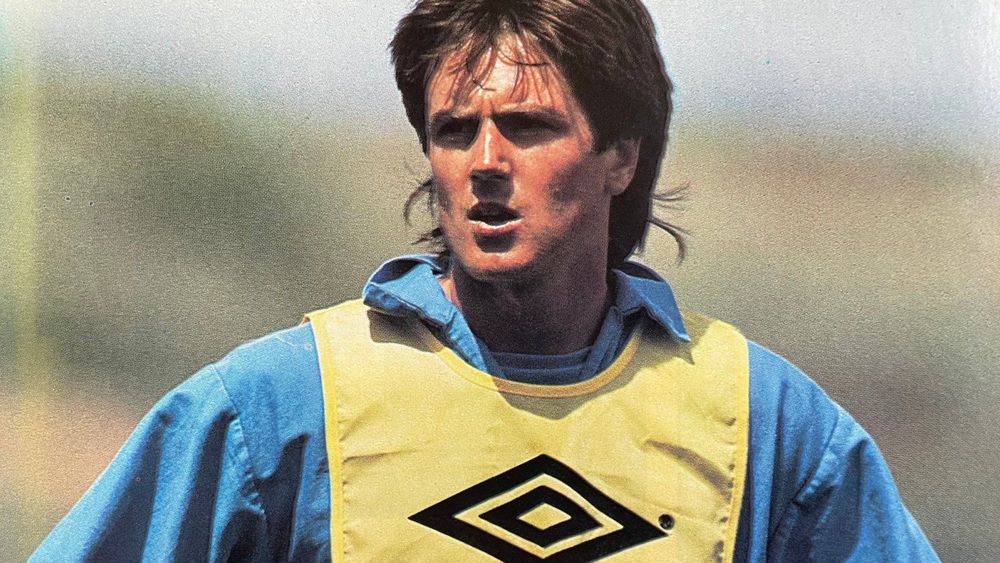
He wanted to stay. But his relationship with manager Jim Smith had deteriorated, and, as he would eventually come to believe, his time at Loftus Road was coming to an end.
What happened next was almost too extraordinary to make up. On the same day, Arsenal manager George Graham and Tottenham's soon to be appointed Terry Venables both pursued his signature.
Fenwick had known both men for years. He had to choose between them, and the decision would remain one of the great what-ifs of his career.
The breakdown with Smith
The relationship with Smith had become increasingly uncomfortable. Fenwick believed his influence at QPR, particularly his insistence on defensive organisation, had become a problem for the manager.
He remembered the responsibility he carried on the pitch and the way supporters recognised his role.
“Everybody knew, and this was the Queens Park Rangers crowd, because at times in the game they would just be listening to Terry Fenwick. Hard up, hard, drop off, squeeze up, get closer to him. I was always the voice," Fenwick told Football Presse.
“But Jim Smith, because I wasn't one of his players and I kept on questioning why defensively we weren't doing what we should have been doing, I think Jim wanted me out.”
He had also been disappointed with Smith's handling of the League Cup final against Oxford United. QPR had beaten Liverpool over two legs in the semi-final, but Fenwick felt the manager's decision to change his position had compromised the team.
“From playing me centre-back, looking after the defensive, this and the other, he pushed me into midfield and we just, we've lost it. My God, imagine we conceded three, four goals.”
Fenwick's interpretation of the situation became clearer with hindsight. He believed he had become too influential at the club, not simply among the players but throughout the organisation.
“I realised Jim wanted me out. I was too big an influence. Not just in the dressing room but in the club, because people would listen because they'd see all the success that we'd had, whether it would be with Terry Venables, whoever.”
His assessment of the difference between the managers was equally revealing.
“Jim Smith, [Alan] Mullery, they weren't even close to Terry Venables' tactics, organisation, structure of the team. And because I'd been through Crystal Palace with Terry and Malcolm [Allison], QPR, I was the one still making sure we stuck to the game plan. We defensively were tight, we'd do this, we'd do that, and Jim didn't like that. Because it wasn't his coaching that was bringing that to the table.”
Despite the friction, Fenwick had no particular desire to leave.
“I had two or three meetings. I was out of contract at the end of the season. I wanted to stay at QPR. That was my club. That's all the success and things that we've done, England caps, all of that.”
He had, however, reached a point where he suspected the club was not going to offer him the future he wanted.
Eleven o'clock, the Target Roundabout and 150 QPR fans
The approach from Arsenal came through Smith, who informed Fenwick before training that Graham wanted to meet him.
The two men already knew each other from Crystal Palace. Venables had brought Graham into the club as a player, and the pair were close friends. Graham had subsequently worked in youth development at QPR, so Fenwick was familiar with him well before he became Arsenal manager.
The meeting was arranged for 11 o'clock at the Target Roundabout pub, on the Western Avenue leaving London.
Fenwick arrived to find a venue that was already being prepared for the meeting, although he had little idea of the reaction it would provoke.
“Got there, there was about half a dozen staff just setting everything up in the bar, but it was a big Queens Park Rangers pub.”
Graham arrived on time.
“Met George there, 11 o'clock on the button. By 20 past, at past 11, there was 150 QPR fans outside and inside the pub.
“What the hell's going on? He's Terry Fenwick, our captain, with George Graham, the Arsenal manager. But what's — it was like, whoa.”
It was an extraordinary scene. The QPR captain was sitting with the manager of one of their biggest London rivals, and the supporters had quickly discovered what was happening.
But Graham was not there for a social visit. He wanted Fenwick at Arsenal and was prepared to discuss what the club could offer.
The conversation was friendly because of their previous relationship, but there was a serious proposition on the table.
“As I'm sat there discussing with George across the table — now we were friends, so it was a friendly, but business — want you to come to Arsenal, see what we can do financially, what potentially we could do.”
Then came the moment that turned an already remarkable meeting into something even more unusual.
Fenwick had one of the old mobile phones, "the type that resembled a brick", complete with a large aerial. As the two men discussed Arsenal, it rang.
“So I pick the phone up and then I stare quickly at George and George mouths at me, who's that? Is that Terry?”
It was indeed Terry Venables.
He was returning from Barcelona to take charge of Tottenham and wanted to speak to Fenwick about joining him at White Hart Lane.
“Venables was coming back to Tottenham from Barcelona. So I've nodded my head at George. Yes, it is Terry. But I didn't tell Terry who I was with.”
The situation was almost unbelievable. Graham was sitting opposite him, trying to persuade him to join Arsenal, while Venables was making his own move from the other side of north London.
Fenwick could hardly believe what was happening.
“Crazy. This is unbelievable. So in the same day, I've got Tottenham and Arsenal want to sign me. Both of their managers are friends of mine, people I knew, you know, passionately.”
Venables arranged to see him at six o'clock that evening. He had just returned to London and, importantly, Fenwick was to be his first signing.
“Terry arranged to see me at six o'clock that evening. He had just got back into London from Barcelona, Spain, all of that, and he wanted — I was his first signing.”
Fenwick was careful about how he handled the situation. He had no intention of misleading Graham, particularly given their friendship and the seriousness of the Arsenal offer.
“I promised George, I'll go and see Terry tonight at six but I won't do anything. I'll not be signing any contract until I ring you back, George. So I keep everything above board, everything proper. So George, thank you very much.”
Graham understood the relationship between the two men.
“But George knew how tight I was with Terry.”
The Tottenham project
The meeting with Venables would prove decisive. Fenwick already knew his methods, understood his football and had experienced the manager's ability to build a team around a clear tactical plan.
There was also the attraction of what was happening at Tottenham under chairman Irving Scholar. Fenwick remembered Scholar positively, describing him as someone who wanted the club to achieve success in the right way.
“He was a good guy. He wanted success doing the right things.”
Venables made Fenwick his first signing and began assembling a team that would attract considerable attention.
“Now when you look at Terry Venables' early stage at Tottenham Hotspur, I was his first signing, then he brought in Gary Lineker from Barcelona, Paul Gascoigne, Paul Walsh.
“He brought in these players that were going to take Tottenham Hotspur to success.”
Fenwick could see the direction the club was heading. He was particularly impressed that the new arrivals were not simply big names being collected for their own sake. They fitted into the manager's ideas.
“Everybody in that first division was looking at Tottenham. They're on their way, they're coming. He's buying all and putting all these top players together. And not just that, when he buys these top players, they all fit into his game plan, the structure of the team, the organisation, everything that I'd done as a youth coming through.
“They all knew success was on the way.”
Fenwick also understood his own importance within that environment. He had been accustomed to organising teammates and communicating Venables' instructions, and he continued doing so at Tottenham.
“I got on great with Gary Lineker at Tottenham. Gazza. Tottenham, because I was still the same voice on the field, and because what I'd gone through with Terry. I knew the game plan, I knew what was expected, what we meant to be, and passing that information on to others was easy for me.”
It was a natural fit. He had followed a manager he trusted into a new environment, and was helping establish the standards and organisation that Venables wanted from his team.
But the decision would look different when Fenwick considered what Graham was building at Arsenal.
The Arsenal career that might have been
Fenwick did not pretend that the choice had been easy. He had been torn between the club he loved at QPR, the friendship he had with Venables and the opportunity Graham was offering at Arsenal.
With the benefit of hindsight, however, the Arsenal possibility became increasingly difficult to dismiss.
Graham was developing a formidable defensive side, with Tony Adams central to his plans. Fenwick could picture himself alongside Adams, becoming part of the back four that would define the manager's Arsenal team.
When the subject returned to his decision, his words were striking.
“When I look back on it, my God, George Graham coming to me and Tony Adams, me, and the back four that he would have had already put together, that could have been me at an absolute different level altogether.”
He was not simply regretting a move to another club. He was imagining the career he might have had within a specific team, under a manager who had personally wanted him.
And he knew exactly why he had gone the other way.
“But I allowed — this was my fault — I allowed my emotions with my friendship-partnership with Terry Venables to overtake the two actual clubs, Tottenham and Arsenal.”
There was no attempt to blame the circumstances or the people involved. Fenwick accepted that his friendship with Venables had been the decisive factor.
Asked whether he regretted it, his answer was immediate.
“Absolutely. I wanted my career to be very successful and all that. I had no idea.”
It is a remarkable admission from a player who had enjoyed a long career and experienced some of the biggest stages in English football.
That day at the Target Roundabout had given him an extraordinary choice. Arsenal had come calling through George Graham, Tottenham had arrived through Terry Venables, and the two managers had both been people he knew and respected.
Fenwick chose his friend. He never questioned the relationship, but he could not help wondering what might have happened had he chosen the other club.
In his own words, the opportunity to play alongside Tony Adams in Graham's Arsenal defence could have taken his career to an entirely different level.