
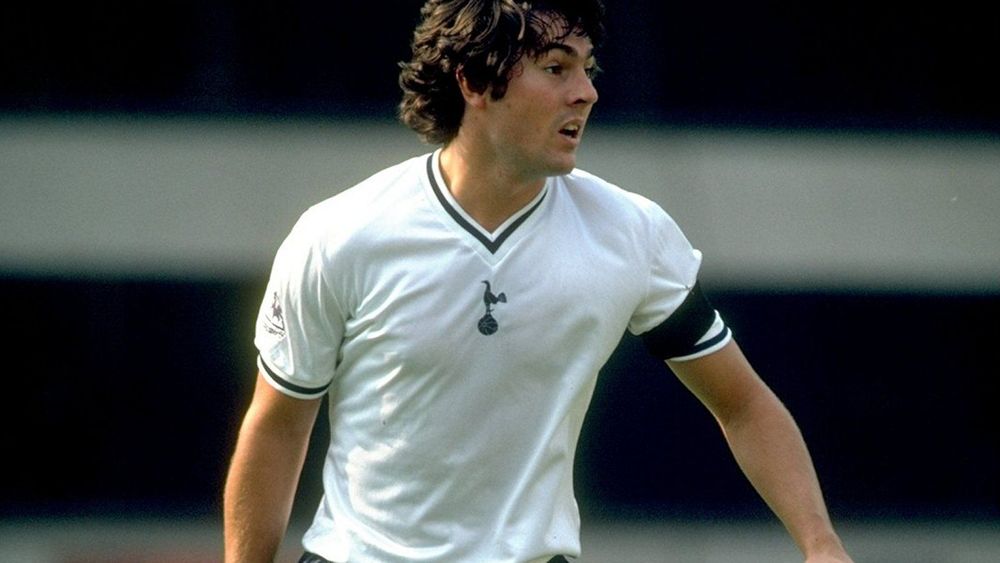
Long before he became a Tottenham defender, won two FA Cups and a UEFA Cup, played alongside Glenn Hoddle and Ossie Ardiles and established himself in one of the most successful English teams of his generation, Miller had already developed the mentality that would define his career.
“I've never not been confident of anything,” he tells Football Presse. “I was born at 12. I was born ready. So for me, it was never going to be if and what, it was just I will be.”
That confidence had been forged in a very different London to the one footballers know today.
Miller grew up in the East End, where money was scarce and boxing was the dominant sporting culture. He chose football, but the environment around him was formative.
“It was a good place to grow up,” he says. “It was very close, it was tough, it was difficult. We had no money, but we made the best of it. And there was only one way, which was up.”
Football became an escape and, eventually, a route out.
“The East End of London produced many fine footballers over the years since then,” Miller says. “Absolutely hadn't done before my time. Before that, it'd only been famous boxers, obviously famous criminals. But I was one of the first to actually become a footballer from the East End of London.”
His route into professional football was also very different from the modern academy system. As a youngster, Miller could train with several clubs simultaneously, something that is almost impossible to imagine in today's game.
In the space of one week, he could be at West Ham, Arsenal, Tottenham and Chelsea, with clubs supplying him with boots, tracksuits and training equipment in an effort to persuade him to sign.
Eventually, Tottenham won him over.
The decision was influenced by Bobby Moore, who advised Miller to choose either Spurs or Arsenal. He chose Tottenham and never regretted it.
“I signed for Spurs and never had no regrets for that,” he says.
Miller's development was not confined to club football. Before leaving school, there were no youth teams operating in quite the same way as today's academies, so he played for his school, district, county and London Boys before entering Tottenham's youth structure.
That background helped create the player he became: competitive, vocal and comfortable taking responsibility.
By the time Keith Burkinshaw handed him his Tottenham debut, Miller did not see himself as a teenager stepping into a man's world.
“I was a leader on the pitch as well,” he says. “I was very verbal, very loud. And so, you know, it didn't matter. Forget my age. I was old. I was born at 12. I was never young. I've never been a young man.”
It was a personality Burkinshaw understood. Miller had already spent months around the first team without getting on the pitch, repeatedly making himself available and waiting for his opportunity.
When that opportunity finally came, it came in one of English football's biggest fixtures: Arsenal against Tottenham.
Burkinshaw's message was characteristically direct. Miller had spent six months driving his manager mad, and now he had his chance.
Tottenham lost 1-0, but Miller played well enough to stay in the team.
There was no sense of surprise that he had succeeded. For Miller, it was simply the next stage of what he already believed was going to happen.
That mentality was particularly valuable in a Tottenham side containing players of extraordinary technical ability. Hoddle and Ardiles could transform matches, but Miller understood exactly what his own role was.
He describes the distinction using an old football metaphor.
“There's piano players and piano pushers, but unless someone pushes the piano onto the stage, the piano players can't play it,” he says. “You've got to know your position early in life. I know I was a piano pusher, I know that, I accepted that.”
Miller was perfectly comfortable with it.
“I pushed the piano onto the stage so the piano players could then play.”
That self-awareness was one of the reasons he fitted so naturally into Tottenham's dressing room. The club had a remarkable collection of homegrown players, with Miller coming through alongside Hoddle, Chris Hughton, Mickey Hazard and others, while players such as Tony Galvin and Graham Roberts became part of the same close-knit group after arriving from non-league football.
Burkinshaw, Miller believes, deserves considerable credit for creating that environment.
“We had seven or eight homegrowns in the side,” he says. “So we had a lot of people who'd been there a long while, grown up into the club, brought in. And Burkinshaw did a wonderful job, to be fair. So did his scouting system.”
The competitiveness of that group remains part of Miller's memories of the era.
“Very, very tough. Not easy. Fights every day. Lots of arguing. Healthy. Healthy. Proper.”
The friendships have lasted. Miller still sees many of those former teammates regularly at Tottenham, decades after they first met as teenagers.
“These are my oldest friends,” he says. “I've known them since I was 12.”
And although Miller's job was to protect the more creative players, he also understood how privileged he was to watch them work every day.
Asked about Hoddle, his answer is immediate. But there is another name he refuses to leave out.
“Him and Ozzy,” he says, placing Hoddle and Ardiles together. “I would say they were both as good as each other, different in different ways.”
Of Hoddle, he adds: “Glenn had a set of golf clubs on both feet. Glenn was unique.”
Ardiles, meanwhile, brought something different, and Miller believes the two complemented each other perfectly.
“Ozzy, different type of player, they suited each other. They played off each other. Glenn helped make Ozzy, vice versa.”
The arrival of Ardiles and Ricardo Villa also represented something much bigger than two outstanding footballers joining Tottenham. They were World Cup winners arriving from Argentina at a time when the idea of signing foreign players was still radically unusual in English football.
Miller was in Norway when Tottenham completed the deal, but he remembers the impact vividly. The news was everywhere, including in Norway.
It was another sign that Tottenham were becoming something different.
Miller's own Norwegian adventure had helped accelerate his development. Frustrated at his lack of first-team opportunities, he was encouraged by captain Steve Perryman to consider Norway rather than spending the summer in America. He joined Skeid, helped the newly promoted club finish fourth, qualified for Europe and was voted the league's best foreign player.
The experience gave him confidence, responsibility and regular football before he returned to Tottenham and established himself.
Then came the trophies.
Tottenham's football was attacking, flamboyant and unmistakable. Miller remembers a team that went into matches looking to win rather than merely avoid defeat.
“We were very flamboyant, we were very attack-minded,” he says. “We didn't go anywhere to draw, we were going everywhere to win.”
That approach brought two FA Cups and the UEFA Cup, while Tottenham became one of the major forces in European football.
Miller's memories of that period are coloured by the physicality of the game. He believes the English teams of the era were exceptionally strong, and that playing against the best domestic strikers could be every bit as demanding as facing Europe's biggest names.
For a defender, it was a different footballing education.
“It was tough going,” he says. “It was not for the faint-hearted.”
Yet there was also enormous affection for the era and the people who shared it with him. Miller talks about former opponents as friends now, players with whom he once fought for every inch of the pitch.
“When we played, it was World War III,” he says. “But we're all great friends now, by the way. We always see each other, we hug and kiss and cuddle because we know we played in great times.”
That may be the clearest way to understand Paul Miller's football life.
He was not the player expected to provide the magic. He was the player who made the magic possible.
He was the defender who came from a difficult East End upbringing, entered Tottenham believing he belonged, accepted his role without ever diminishing its importance and shared a dressing room with some of the most gifted players in the club's history.
The piano players got the applause.
Miller was happy to push the piano onto the stage.
And he was convinced from the beginning that he was ready to do it.