
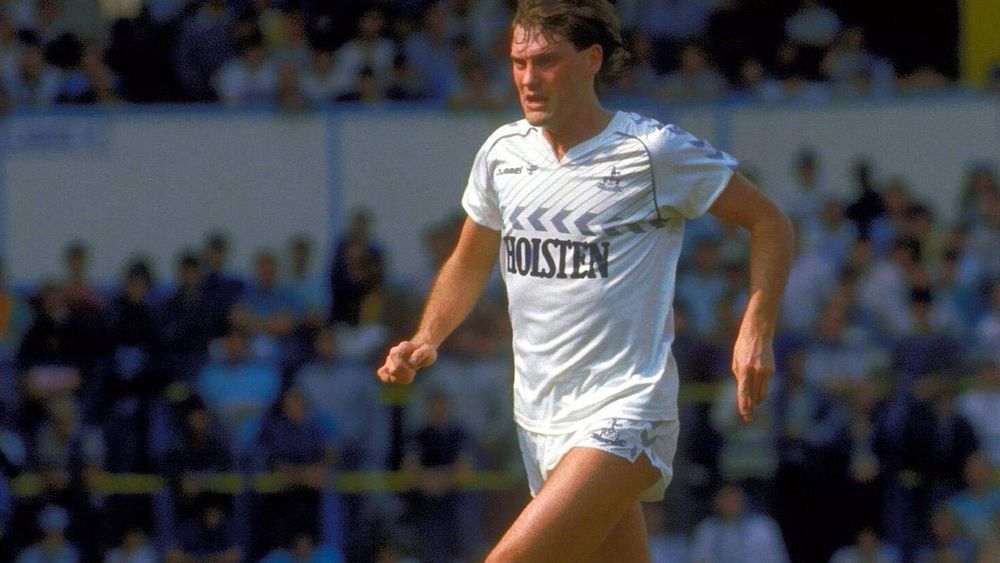
Miller came through at Spurs with a generation of homegrown players who would eventually form the core of Keith Burkinshaw's trophy-winning side.
“Yes, we came through together," Miller tells Football Presse. "Chris Hughton, Mickey Hazard and Mark Falco were around that group as well. Kerry Dixon was younger than us, but he left and went to Chelsea, after going to Reading first.
“In the end, we had seven or eight homegrown players in the side. Steve Perryman was a homegrown member, and Graham Roberts and Tony Galvin joined us as very young men from non-league. They were teenagers when they came in, so we adopted them into the group.
“We had a lot of people who had been there a long while, grown up into the club and come through together. Burkinshaw did a wonderful job, to be fair, and so did his scouting system.
“It was a very, very tough group. It wasn't easy. There were fights every day, lots of arguing. But it was healthy. It was proper.”
Those relationships have lasted long beyond their playing careers.
“We still see each other today. We see each other at Spurs every week, seven or eight of us. These are my oldest friends. I've known them since I was 12.”
One of the most gifted players in that group was Hoddle, and Miller places him alongside Ossie Ardiles when asked about the best players he played with.
“Him and Ossie. I'd say they were both as good as each other, just different in different ways.
“Ossie was a World Cup winner and one of my close friends. The two of them were magnificent.
“Glenn had a set of golf clubs on both feet. Glenn was unique.”
Miller believes the relationship between Hoddle and Ardiles was important to both players.
“Ossie was a different type of player and they suited each other. They played off each other. Glenn helped make Ossie, and vice versa.
“But, yeah, Glenn was undoubtedly brilliant. But you have to put Ossie in the same category, in my opinion.”
Miller's own role was to provide the platform for those players to express themselves.
“You had two geniuses in front of me called Hoddle and Ardiles, so you had to just give them the ball, really. Give them the ball and let them make it happen from there.”
But Miller stresses that even the most gifted players had responsibilities within the team.
“I don't think you can really be over-nice to someone. It's a team game. Remember, for every Ossie and Glenn, you needed me and Steve Perryman and Graham Roberts.
“They didn't tackle, they didn't do our dirty work.”
Miller uses an old football expression to explain the relationship between the players.
“There's an old-fashioned saying in England: there are piano players and piano pushers. Unless someone pushes the piano onto the stage, the piano players can't play it.
“What you've got to know in life is your position. I knew I was a piano pusher. I accepted that.
“I pushed the piano onto the stage so the piano players could then play, and that was Hoddle and, I think, Crooks, Archibald, whoever.
“You learn that quite quickly when you're younger. Piano players and piano pushers. It's a very old-fashioned saying.”
Miller's memories of Hoddle also include one of the biggest occasions of their careers: the FA Cup final.
The first final against Manchester City ended 1-1, before Tottenham won the replay 3-2. For Miller, the experience of playing at Wembley was something he had dreamed about since childhood.
“I roomed with Glenn because we used to have room partners in those days.
“We got up in the morning and watched the FA Cup preview, which started at eight o'clock in the morning then. I don't know if you remember that.
“They had cameras outside the hotel and Glenn, as he opened the curtains, was on television. He had his underpants on and he was on the telly.
“It was so funny, actually.”
The humour of the moment was set against the enormity of the occasion.
“The whole day, the Cup Final was the biggest game in the world then. It was magic.
“You couldn't only dream about going there. The reason we all wanted to become young footballers was because after a Cup Final was on when you were little, from eight o'clock in the morning until six o'clock at night, you then went out in the street trying to emulate the people you'd just seen on the telly.
“Remember, in those days there were only two live games on the telly: England v Scotland and the FA Cup Final.
“So, as young kids, that's all we saw. You went out and played the Cup Final. Then, all of a sudden, when you wake up on Cup Final morning, you realise millions of people are going to watch you.
“And certainly when we had the Argentinians, it was the first time South America was going to watch you.
“So, you know, two billion people were going to watch our game. You think, well, wow, okay.
“Then you meet the Queen Mum. It's everything that goes with it. It's a wonderful day, the Cup Final. I know it's changed a lot now, but it used to be the best.”
For Miller, the excitement surrounding Hoddle was not confined to the Cup Final. He saw the midfielder's ability every day at Tottenham.
The contrast between the two was obvious, but so too was the mutual understanding.
“I was a leader on the pitch. I was very verbal, very loud. So it didn't matter who was playing against me.
“I'd been fighting all my life, so it didn't matter to me. Those days were very physical games as well, so I enjoyed that.
“And when you play for Spurs, you have to be out-passed and do other things. But we had two geniuses in front of me called Hoddle and Ardiles, so you had to give them the ball.”
That Tottenham side was built to attack.
“We were very flamboyant, we were very attack-minded. The manager would attack. He wouldn't dream of going out and getting a 0-0 draw.
“I can't remember playing a 0-0 draw, by the way. I'm sure I did, but I don't remember them. They were few and far between.
“We didn't go anywhere to draw. We were going everywhere to win, which is how we were with the players we had in the side.”
Miller also believes Hoddle's international career failed to reflect his ability.
Asked whether Steve Perryman should have won more England caps, he immediately brings Hoddle into the discussion.
“Of course he should have done. But you had two managers then called (Ron) Greenwood and (Sir Bobby) Robson who hated Tottenham Hotspur from their club days. They did all their best not to give Spurs players caps.
“Glenn should have had 150 caps. He ended up getting 51, and 30 of those were substitutes because Robson and Greenwood both didn't like him because of Spurs.
“That's a fact.”
For Miller, that is ultimately the frustration of having watched Hoddle so closely for so many years.
He wasn't simply a player he admired from the stands. He was the player standing a few yards away in training, the teammate receiving the ball from him, the roommate opening the curtains at a Cup Final hotel and accidentally appearing on television in his underwear.
Miller saw the genius up close.
And he still has the simplest way of describing it.
“Glenn had a set of golf clubs on both feet.
“Glenn was unique.”