
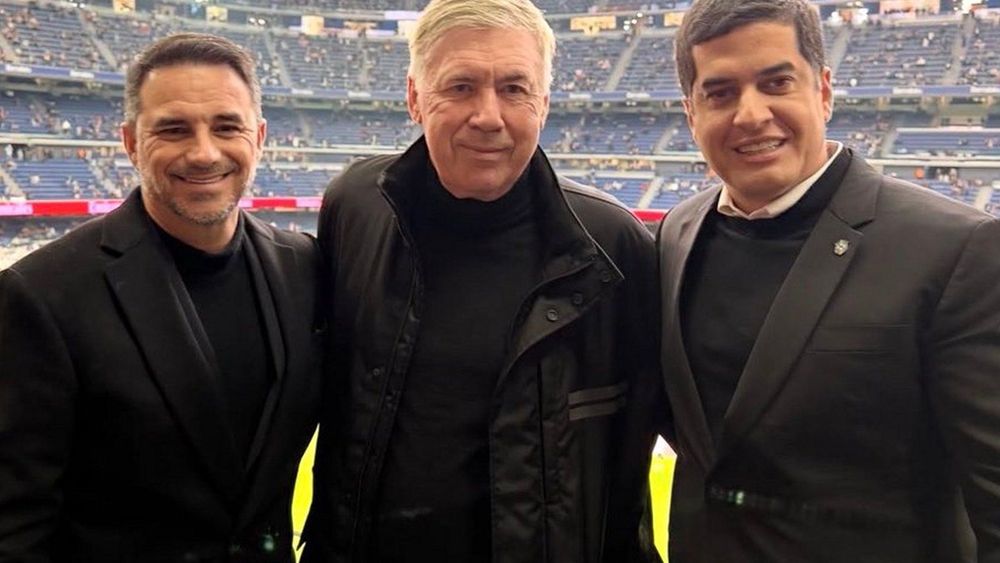
They first came together at Chelsea in 2009, then reunited at Paris Saint-Germain before moving on to Real Madrid and Bayern Munich. Across those years, Clement watched Ancelotti manage some of the biggest clubs, biggest personalities and biggest pressures in football.
And he learned.
“I saw the way he operated with the players. He was the boss, but he was close to them,” Clement tells Football Presse.
That balance became one of the defining features of Ancelotti's management — authority without distance, discipline without fear.
“He likes to communicate with the players and that's what I'm like as well.”
Clement's introduction to Ancelotti almost did not happen. Initially working in Chelsea's academy, he spent two weeks with the new first-team manager before suggesting he return to the reserves.
Ancelotti had other ideas.
“He said to me, ‘No, no. The best experience for you would be to come and work with me. We’ll be successful. You’ll enjoy it.’”
Clement stayed.
The partnership would eventually produce league titles, domestic cups and Champions League success, but some of the lessons had little to do with tactics.
“He’s never ruled with the iron fist. He’s a very humble man, Carlo.
“He’s always been very good at managing the dressing room because he’s a good communicator and he insists on respect.”
For Clement, the order of importance was simple.
“First, there’s a person, and then second, there’s a player.”
That philosophy was tested constantly at Real Madrid, where Clement found himself working with Cristiano Ronaldo, Sergio Ramos, Luka Modrić, Karim Benzema, Gareth Bale and a dressing room packed with elite personalities.
“The stars are under an incredible amount of pressure — especially at this club — and what Carlo does well is understand the pressure they are under.
“His calm temperament is a help to that, especially during the week in training — the way he manages them individually.”
Clement remembers one particularly revealing example from their Chelsea days. The night before the 2010 FA Cup final, Ancelotti asked his players a question.
“This is the last game of the season. We know what we're able to do and we know the opposition. What do you think the tactics should be?”
The room initially fell silent. Then the players began offering their ideas. Clement stood beside Ancelotti with a marker pen, writing them down.
“The tactics were decided; the team talk was done and the next day the players went on and delivered.”
Chelsea beat Portsmouth 1-0 to complete the Premier League and FA Cup double. For Clement, the lesson went beyond that particular final.
“When a game goes on, how much can a coach influence what’s happening, in a full stadium where the noise is deafening and you can’t get information across to the players?
“They need to be able to make those decisions in split-second moments. The more responsibility the players take, the better.”
Ancelotti's ability to remain calm was another lesson Clement carried into his own management career.
“I never saw him get too high, and never too low.”
He remembers sitting in dressing rooms at half-time, sometimes expecting Ancelotti to react far more aggressively than he actually did.
“He’d be at the back of the room gathering his thoughts, then tapping on the tactics board: ‘This is what I want to see second half.’ Clear. Simple. Boom. Go out and do it.
“So calm.
“And it usually worked.”
Clement also learned from Ancelotti's willingness to evolve. When the Italian arrived at Chelsea, he adapted his coaching methods to a different football culture. Later came France, Spain, Germany and further experience in Italy and England.
“He’s not an old-school coach that is a bit stuck in his ways.
“His strength has been that he’s adapted. He’s been amazing at evolving over his career.”
That adaptability, Clement believes, explains much of Ancelotti's extraordinary longevity.
“He’s developing language skills, different styles of football. “He’s evolved incredibly.”
And Clement was evolving too. At Real Madrid, he was exposed to the pressure of arguably the world's biggest club.
“Real Madrid — monster of a club. Huge, the biggest, big from the outside. When you get inside, it’s massive as well.
“The history, the tradition, the trophies, the players that have played there — an immense club.”
He saw the same pressures Ancelotti had to absorb.
“Both [Florentino Pérez and Roman Abramovich] were winners, both very demanding, both pushing their clubs, their teams, their people to be the best that they can be.”
But Ancelotti's response was rarely to add more pressure. Instead, Clement saw a manager who could absorb it himself and allow his players to concentrate on performing.
That became something Clement repeatedly returned to when he eventually stepped into management himself.
“I often went back to those times. I recalled different situations and the ways in which Carlo managed them.
“What would Carlo do?”
The answer was often patience, clarity and trust. After years alongside Ancelotti, Clement has no hesitation when asked to assess the influence.
“I was able to see first-hand how Carlo operated, from how he worked with the players, dealt with the politics, how he spoke to the media, and it was all invaluable.”
And perhaps the simplest assessment remains the most revealing.
“If I were a player, I would love to play for a coach like him.”
For Clement, that influence has stretched far beyond four clubs and a collection of trophies.
“He’s by far the greatest influence on my career.”