
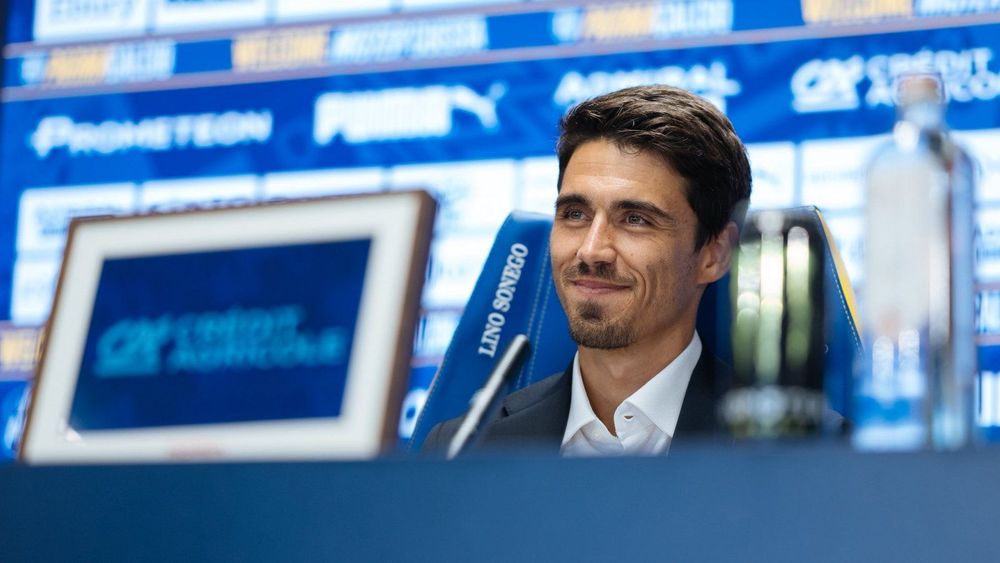
It was a composed debut campaign for the 30-year-old Spaniard who spent five years as Mikel Arteta's assistant at Arsenal before making the step into management on his own terms.
At 30, he is the youngest head coach in Europe's top five leagues and has already accumulated more varied coaching experience than most managers twice his age, having worked with youth sides at Atletico Madrid and Juventus before joining Arsenal's first-team staff in 2019.
His route into coaching began after a playing career ended at 18. Rather than wait for opportunities to arrive, he manufactured them — including sending direct messages to members of staff at Real Madrid and Atlético on social media, which eventually led to a voluntary role with Atlético's academy.
"I was very lucky. During the journey I found incredible people that were super willing to help me to grow, that were super available, opening the doors of their knowledge. I learnt a lot. I had great inspirations."
The influence of Arteta is visible in the way Cuesta speaks about the game, though he is careful to separate his former mentor's achievements from his own involvement.
"I'm extremely happy for them. They deserve everything," he told BBC Sport.
"Every person from this organisation, and especially Mikel. A lot of people can see how incredible he is, and the only thing I can say is that he's even better than what people see. When you know him day to day, only then can you understand that he's even better. He's an incredible human being, leader and coach."
At Parma, Cuesta spent the early months of the season experimenting between a back four and a back five before committing more decisively to a 5-3-2 by February — a shape he described in specific tactical terms.
"That gives you more cover inside. Sometimes on the switch, if you don't handle the rhythms of shifting across you can suffer a little, but it gives you density in central areas and you can be a threat on the counter, in relation to how you play with your strikers. If they do more blind-side movements, if they start to play a little bit more on the shoulder, it's good."
His broader philosophy rejects the idea that structure and creativity are in opposition.
"The references, the principles, the macro guidelines allow you to have more creativity because if you don't have clear references and signals to recognise during the game, it becomes total chaos. We try to have people close to each other that are complementary. One way of getting players to interact better is to have them get to know the players close to them — on the pitch and socially."
He also pushed back on the idea that tactics are purely about positioning.
"Tactics are not just about space occupation. It's 'how do I take advantage of this space?' It's about timing. It's about habits. People think that all the pieces of the tactics board are the same but in practice, they all have different characteristics."
On what his ideal version of Parma looks like, Cuesta was expansive.
"A team that is complete, very dominant on the ball, able to attack open spaces with speed and attack small spaces when the opponent is deep. At the same time, it is a team that is relentless without the ball, able to regain it high but when needed, able to protect the goal deep."
He describes his coaching philosophy through the metaphor of colour.
"In football, I think that you need to choose black or white. It doesn't mean that if you choose black, for your whole life you will do black. But it does mean that in this context maybe black is the better choice. At the same time, this black needs to have different tones. If someone looks at it, they know what colour it is, but there is room for it to look slightly different depending on what you need."
Parma won 11 of their 38 Serie A matches this season. The club's ambition is to rebuild toward the form of their late-1990s golden era — when Lilian Thuram, Gianluigi Buffon, Fabio Cannavaro and Gianfranco Zola were among those to have represented them.