
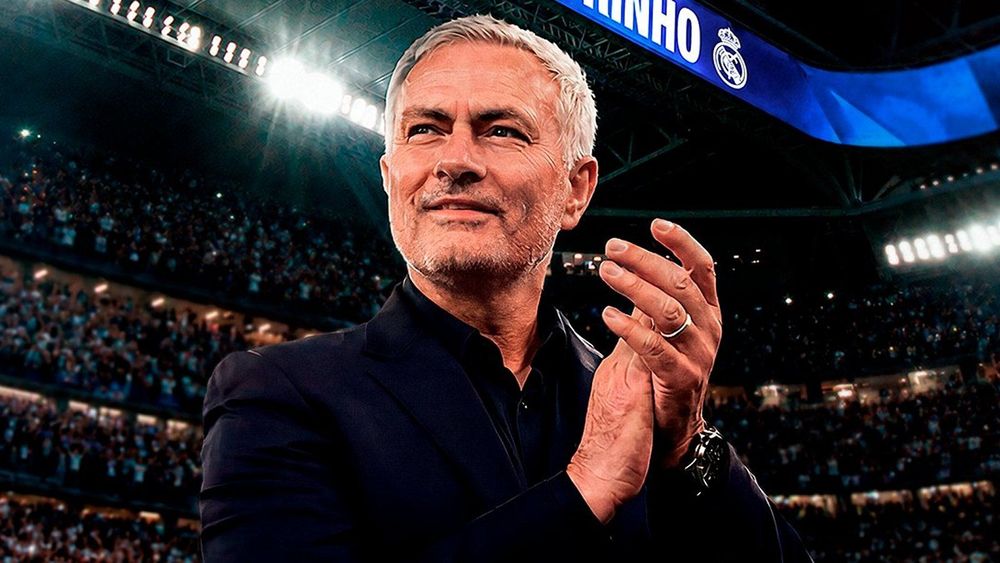
The appointment was confirmed on June 11. Mourinho joins on July 13, the day preseason begins, on a three-year contract until 2029. He replaces Álvaro Arbeloa after two consecutive trophyless seasons that culminated in Barcelona's 2-0 Clásico title clincher — the first time the league had been settled between the two clubs in 94 years.
The Mourinho who arrives in 2026 is different in register from the one who announced himself to the world as The Special One in 2004. The arrogance remains, but it is quieter.
"I don't want to say I was the chosen one," he told Vanity Fair. "I was one of them."
The most divisive manager in European football is making an effort to present himself as part of a lineage rather than above it.
On the institution he is rejoining, the language is sentimental.
"The history of Real Madrid cannot be compared with anyone," he said, adding that the white shirt has something magical. His relationship with Kylian Mbappé will attract as much scrutiny as anything else about his return.
Mourinho's handling of elite forwards has been a recurring theme — friction with Samuel Eto'o, complexity with Cristiano Ronaldo — and Kylian Mbappé carries noise alongside his goals. The response is deliberate restraint.
"It's not the moment to talk, it's the moment to listen," he said. "Mbappé is a phenomenal player and I'm going to try to help him be even better."
Those Clásico years sit at the centre of his professional identity. Guardiola on one side, himself on the other, Lionel Messi and Cristiano on the grass.
"The world stopped for those games," he said. He compares that period to the Nadal-Federer-Djokovic era in tennis: a convergence of greatness that will not be repeated.
He has no resentment toward Barcelona, where he worked under Bobby Robson alongside a young Pep Guardiola and Luis Enrique, and where his children were born.
"I enjoy playing against the best," he said, "because the best force you to be better."
The charge of defensive, results-only football still finds him unyielding.
"There is an absurd theory: that you can be great without winning."
His exhibit A: the 2011-12 Madrid that accumulated 100 points and scored 121 goals. He also revisits the Inter semifinal against Barcelona — not the ten-man stand at the Camp Nou, but the 3-1 win in Milan the week before. That rearguard was not anti-football. It was craft and competitive intelligence at the highest level.
He knows what he did to the image of the manager. Before him, the camera pointed at players. With him, the dugout became a stage. He is careful now.
"I never wanted to be more important than my players," he said. Charisma, he insists, is not a performance. "Charisma is not something you buy at the supermarket." It is earned through the work.
Mourinho returns to a club that has gone two years without a trophy. He has never lasted more than three seasons anywhere. Whatever follows, this looks like his last great act.