
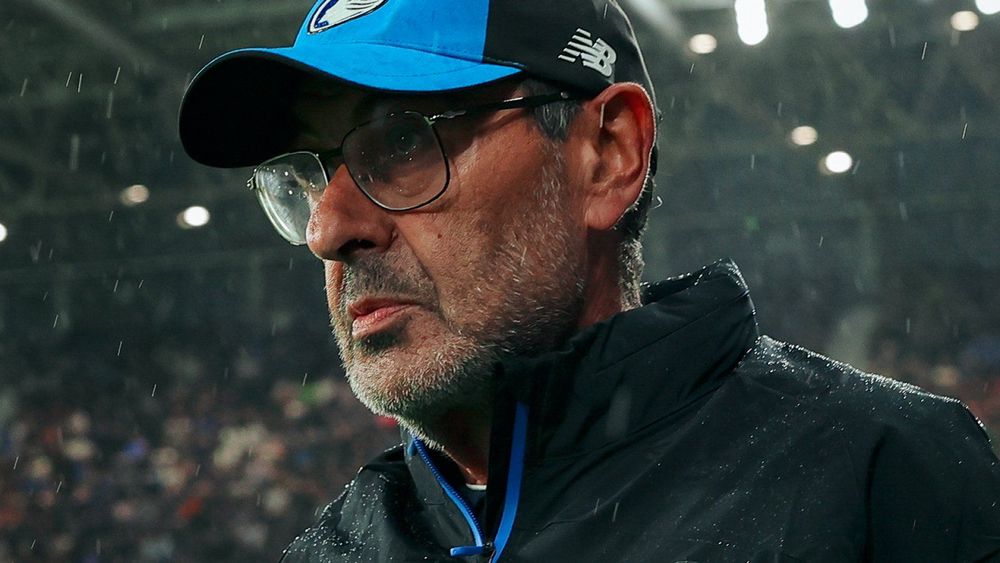
Atalanta were forced to settle for a point at the New Balance Arena after Nikola Krstović equalised late, cancelling out Gual's opening goal for Kairat. The result extended the club's difficult run, with Sarri acknowledging that the performance could not be expected to provide an immediate cure for their problems.
The manager pointed to the scale of the injury crisis, explaining that he had been forced to select a team while several players were unavailable and others were fit enough only for limited involvement.
"It was difficult to think we could recover tonight, with a team put together amid a huge number of problems. If you start with nine or ten injured players and four or five more whose assessments suggest they should only be used for a short spell, the situation becomes complicated," Sarri said.
He nevertheless felt his side could have done better, particularly in possession.
"As always lately, we gave the opposition a goal. In the build-up, I think we need to be much quicker: quicker physically, moving the ball, and quicker mentally, taking a touch out of our play. When we come up against a team that is well organised, our difficulties increase."
Sarri also praised young defender Idele, who completed his first 90 minutes for the senior side. He noted that Atalanta had finished the match with four defenders who had all come through the club's academy.
The coach insisted that qualification remained possible, either directly or through the play-offs, but stressed that improvement would depend on recovering injured players and addressing several shortcomings.
Asked to identify the biggest problems facing the team, Sarri described Atalanta as emotionally fragile, while defending the players' effort against Kairat.
"On a mental level, it's clear that we are an emotionally vulnerable team. In terms of desire, you can't say much to them tonight, because they kept looking for the result until the 95th minute."
He also explained how injuries had made it difficult to establish tactical consistency, particularly when players were returning to the team without having completed enough training sessions together.
"The tactical problems have multiplied and made a job that was already very difficult even harder. A lot of players get injured, a lot don't train with us, the positional training sessions take place without them and then they have to play."
Sarri said it was too early to decide which players were best suited to the team's evolving style, arguing that a proper assessment would only be possible at the end of the campaign.
He was also asked about Gianluca Scamacca, who had started despite having only recently returned from injury. Sarri explained that Krstović had been among five players whose physical assessments indicated an increased risk of injury, making Scamacca's selection necessary.
"He's a boy coming back from an injury who had only trained with the team yesterday. It's clear that he can't be at the top of his condition at the moment. I expected him to have a difficult match and he did, but he has every possible mitigating circumstance."
The manager revealed that Sead Kolašinac and Franck Kessié were close to returning to full training, although neither had yet rejoined the group. Their availability would be assessed over the following days.
One of the manager's strongest comments concerned the lack of time available to work on tactics between matches.
"From a technical-tactical point of view, it does us no good, because when you play every three days you practically never train. Tomorrow morning they'll do recovery work, the day after we'll be one day away from the match, so they'll have a 45-minute training session."
He added: "If you play every three days, players don't train, so tactically you do nothing. Unfortunately, that's the situation."
Sarri said the team had instead been concentrating on building relationships and finding collective objectives, believing that time spent together away from the pitch could strengthen their willingness to work for one another.
He also acknowledged the frustration of the supporters, who had backed the team throughout the match before booing at the final whistle.
"We are in debt to the supporters. Even tonight they cheered for 90 minutes, then there's disappointment with the result and they boo you as you leave. But I think all of us are in debt to the public, and if the whole group thinks like me, we have to make a commitment, sooner or later, to repay them in a significant way."
Finally, Sarri suggested Krstović could develop into an important leader, not necessarily through speeches but through the intensity he brings to the team.
"Krstović can become a leader, not because of his ability to motivate others through words or anything like that, but because his competitive spirit can become contagious. He has that characteristic."