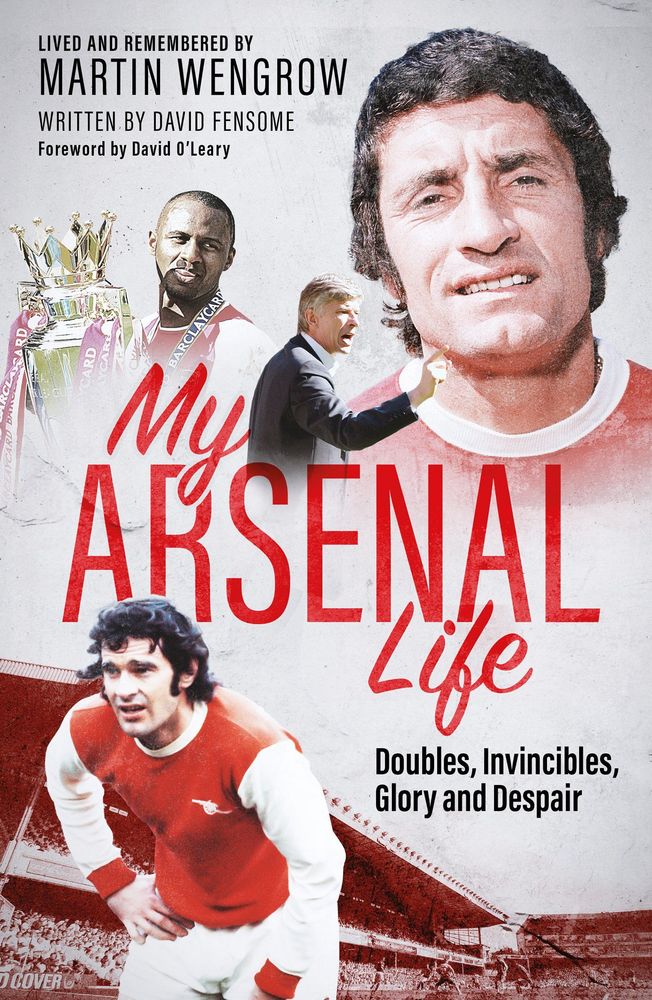
He didn't simply watch some of the greatest players in the club's history. He became friends with them. He travelled with them, stayed in hotels with them and celebrated major victories with them.
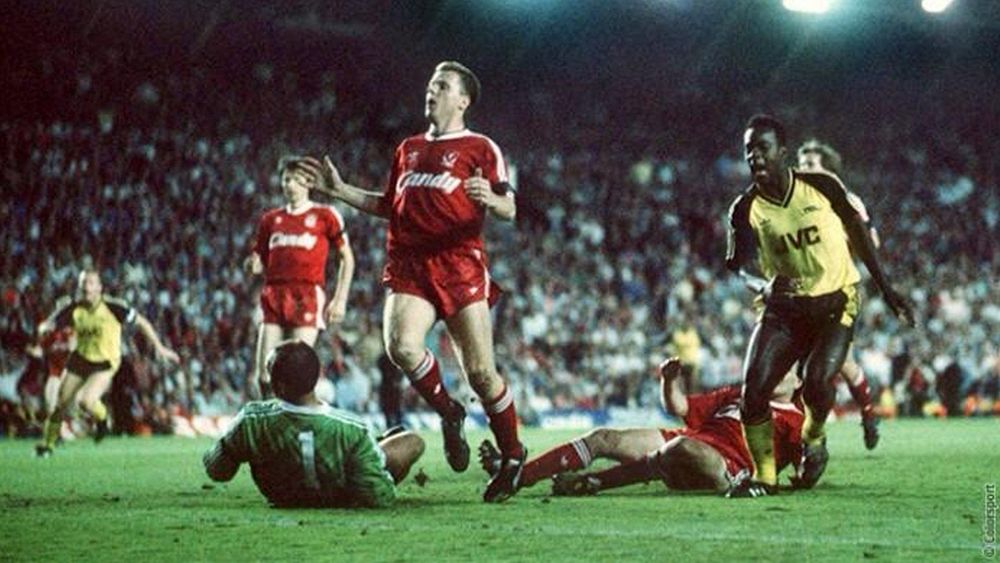
He was in the dressing room after Arsenal clinched the 1971 title at Tottenham and again at Wembley when they completed the Double. He was around the team before the extraordinary night at Anfield in 1989.
And he has somehow maintained friendships with many of those players for more than half a century.
"I was five years of age when I started supporting Arsenal, so next season will be my 75th season as an Arsenal fan," Martin tells Football Presse.
His story begins in a very different Arsenal world.
"As a kid and as a young man, I never ever thought I'd see Arsenal play at Wembley."
Arsenal had won the league in 1953 and the FA Cup in 1950, but for the young Wengrow, the club spent years frustratingly distant from the major occasions. The transformation came as the friendships he had formed with Arsenal players began to overlap with one of the greatest periods in the club's history.
"When they won the first leg of the Double at Tottenham I was in the changing room with the players who were my friends as well as my heroes.
"Then on the following weekend Arsenal played Liverpool at Wembley to win the Cup and the Double, and I was able to be in the changing rooms again with them, celebrating and drinking with the Cup.
"No one has ever done that before, no one will do it again."
That access came partly through a remarkable series of friendships. John Radford was one of the earliest.
"We were all a similar age, so we sort of grew up together."
Through Radford, Wengrow's circle expanded to include players who would become Arsenal legends. Frank McLintock. Peter Storey. George Graham. Liam Brady. David O'Leary.
And while modern football has created an enormous distance between supporters and players, Wengrow remembers a time when the barriers barely existed.
"Today, you can't get anywhere near your icons unless you're part of some kind of in-crowd. But in those days they mostly lived in north London. You could go and meet them in a pub."
That intimacy became extraordinary once his friends became successful.
"In those early years of friendships, they weren't successful at all at Arsenal.
"But in the late 60s the group that I was intimately friendly with became very successful. They became legendary players.
"As they became successful I shared in those successes. I still have close personal friendships with them now, and their families."
There was another side to Wengrow's unusual relationship with football, too. For several years he became an expert at what he calls "jibbing" — getting into sporting and entertainment events without a ticket.
He was young, rebellious and simply couldn't afford to attend many of the events he wanted to see.
"I didn't really have the resources to buy tickets, not even for Wembley games really at that time. So that's what was behind it. But as I sort of developed this reputation, I had to face challenges."
His secret was confidence.
"I learned that you needed to be very confident. I learned all about Wembley. So I knew where the press rooms were located, and where the press interview was located.
"I made it my business on occasion to spend time walking around the inner sanctums of Wembley."
He became so accomplished that the opportunities went far beyond Arsenal.
"I was a big boxing fan, so I was boxing matches at Wembley Arena. It was concerts, Frank Sinatra concerts, anything, variety shows, premieres and after-premieres."
And the reputation never really disappeared.
"I got a phone call two years ago from somebody in America to discuss my jibbing from all those years previous. It's been 60 years."
He still takes pride in it.
"I'm happy today to still carry that reputation and I'm quite proud of what I did then."
It was that same extraordinary access that put him inside the orbit of England's greatest football occasion.
Wengrow attended the 1966 World Cup final at Wembley.
And, naturally, he had a story about how he got there.
"I jibbed into that game at Wembley."
But this time he was also an invited guest of the Football Association, arriving in a large limousine arranged through the family of Billy Wright.
"It was a very big black limousine which was laid on by the FA and the Beverley Sisters."
He watched England win the World Cup and later joined the celebrations in London.
There was another reason the day remains particularly important.
"It was the day that I took my wife out for the first time as well, coincidentally, that evening."
They have now been married for 56 years.
And Wengrow is candid about the role his wife played in allowing his Arsenal obsession to consume so much of his life.
"I had to be at every Arsenal game, even when my kids were babies. I was very unfair. I wasn't a good father, I wasn't a good husband.
"But to be fair, I did tell her before we got married, this is who I am, this is what I do, this is what I love, and if you're going to marry me, you have to accept part of my life.
"She's done it with gratitude, so I've been a very lucky fellow in that respect."
His memories stretch across virtually every significant Arsenal era. The 1970 European triumph remains particularly important because it represented something new.
"The most important, memorable football match for me was when Arsenal won the Inter-Cities Fairs Cup in 1970.
"They hadn't won anything for 17 years."
Arsenal overturned a 3-1 first-leg deficit against Anderlecht by winning 3-0 at Highbury.
"That was probably the greatest night for me."
But even after witnessing the Double, Wengrow would eventually experience something even more dramatic.
Anfield, 1989.
The night before the match, he was at David O'Leary's house.
"I was actually in the team hotel for most of the day when they played."
Except it wasn't really a conventional team hotel routine.
"The night before the game I was over at David O'Leary's house. The team travelled up at 10 o'clock the next morning."
It sounds almost impossible now.
"It can never happen today."
Arsenal had been 16-1 outsiders at the start of the season. Then came the final game against Liverpool, with the title hanging on Arsenal winning by two clear goals.
"Nobody thought Arsenal could do it."
And yet they did.
"Who wins 2-0 at Anfield, especially in a game of that magnitude? It just doesn't happen.
"But it did."
That, perhaps, is why Wengrow's memories are so valuable.
He isn't simply remembering results. He remembers the world around them — the players, the friendships, the dressing rooms, the strange journeys and the atmosphere.
And despite all those friendships, he insists that his ultimate loyalty has always been to Arsenal rather than to any individual.
"I've had some major issues, not all of them. But most of them I'm still in touch with."
The passage of time has inevitably changed that. Some former players are suffering from serious illness. Others have died.
Peter Simpson, a member of the 1971 Double-winning side, died after spending years in residential care.
"It does make it difficult, to be truthful with you.
"It's very hard to have a conversation with them, really."
For Wengrow, that is one of the less comfortable consequences of having lived so deeply inside Arsenal's history. He has watched generations of players come and go.
He has seen Arsenal win trophies and lose finals. He has watched managers become heroes and then fall out of favour.
And, remarkably, he has remained there throughout.
Even now, his strongest opinions aren't necessarily reserved for the obvious heroes.
His favourite Arsenal player is Nigel Winterburn.
"There's a big difference between favourite and best. I love Nigel Winterburn.
"He wasn't world class, I'm not suggesting Nigel Winterburn was world class, but his level of consistency — he was like seven, seven-and-a-half, eight out of 10 out of nearly every one of his 500 games for Arsenal."
For the greatest player, however, there is no hesitation.
"For me it's absolutely no competition. Thierry Henry, hands down."
And that says something about Wengrow's Arsenal life.
He has seen the club before the trophies, during the trophies and through the years when they became expected.
He has watched Arsenal's football change beyond recognition.
He has lost friends, made lifelong ones and somehow remained the same supporter who first fell in love with the club as a five-year-old.
"I've been able to enjoy every single Arsenal success over these last 60, 70 years. And I've been present to witness them."
That is what makes Martin Wengrow's story so unusual.
He didn't just watch Arsenal history.
For much of it, he was standing inside the room when it happened.
Martin Wengrove's book "My Arsenal Life: Doubles, Invincibles, Glory and Despair" is from Pitch Publishing - which is available here.