

The reports were written when Messi was 13 and measured around 142 centimetres. Two evaluators recommended signing the Argentine, while a third believed his physical development made the move too risky.
The documents offer a remarkable snapshot of the debate surrounding a youngster whose technical qualities were already apparent, but whose stature raised questions about whether he could compete against older and physically stronger opponents.
The first assessment: Too small to make the grade?
One evaluator recognised Messi’s exceptional technique but believed his physical limitations would make it difficult for him to compete in his current age group and progress into the next category.
The report, written in Catalan, read:
“I consider him a player with unquestionable technical quality, but his physical limitation (142 cm and a slight build) is too great for him to be able to compete with boys in his category, and next year even more so.
“He might grow a lot in one year, perhaps reaching 150 cm, but with that height, combined with the physical build he has, I think it would be very difficult for him to play in the Cadet Preferent category.”
The evaluator’s conclusion was underlined by an emphatic handwritten verdict: “I think he should not be signed.”
The recommendation continued:
“At most, we can follow his physical development and try him again in a couple of years.”
The report was not dismissing Messi’s ability. Rather, it questioned whether his physical development would allow him to translate that talent into success against increasingly powerful opponents.
It was a significant reservation about a player whose future would eventually demonstrate just how misleading physical measurements could be when assessing footballing potential.
The second assessment: A young Maradona
Another evaluator reached the opposite conclusion, drawing a striking comparison with one of the greatest players in football history.
The handwritten assessment read:
“Allowing for the differences, he is a Maradona (young in age).
“I would sign him. He has to go to a new [the final phrase is unclear in the handwriting].
“We will see his development.”
The comparison with Diego Maradona was extraordinary, even with the evaluator’s qualification that the differences had to be taken into account.
The recommendation was nevertheless clear: Messi was worth signing, and his development should be monitored.
Where the first report focused on the physical obstacles facing the teenager, this assessment looked beyond his size and identified a player whose qualities justified taking the risk.
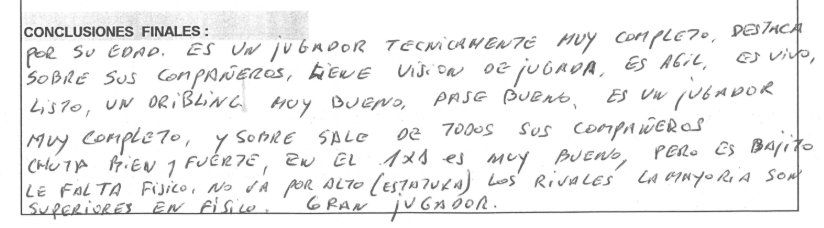
The third assessment: Technically complete
A third evaluator also supported Messi, providing a more detailed description of his strengths and weaknesses.
The report praised his technique, vision, agility, intelligence and ability on the ball, while acknowledging that his opponents frequently enjoyed a physical advantage.
It read:
“For his age, he is a very complete player technically. He stands out among his teammates, has vision of the game, is agile and sharp, and has very good dribbling and passing.
“He is a very complete player and stands out above all his teammates. He shoots well and powerfully. In one-against-one situations, he is very good, but he is small.
“He lacks physical strength and height is a disadvantage in the air. Most of his opponents are physically superior.
“A great player.”
The assessment was an emphatic endorsement of Messi’s technical ability. It identified the characteristics that would later become central to his game: close control, dribbling, vision and the ability to beat opponents individually.
At the same time, the evaluator did not ignore the physical disadvantage Messi faced. His size was a concern, but it did not prevent the report from concluding that he was a great player.
Three reports, two recommendations
Taken together, the three assessments reveal a divided verdict on a 13-year-old Messi.
One evaluator believed his height and slight build made it too difficult to justify signing him immediately, recommending that Barcelona follow his physical development and reconsider him in a couple of years.
The other two assessments supported bringing him into the club. One compared him with Maradona, while the other highlighted his technical completeness and ability to stand out among his peers.
Barcelona ultimately chose to trust the positive evaluations and bring Messi into La Masia after he arrived from Rosario, Argentina, at the age of 13.
He went on to become Barcelona’s record goalscorer and one of the defining players of his generation.
The reports provide a fascinating reminder that even within a club renowned for its youth development, the assessment of exceptional talent can involve competing judgements about what matters most: physical readiness or footballing ability.