
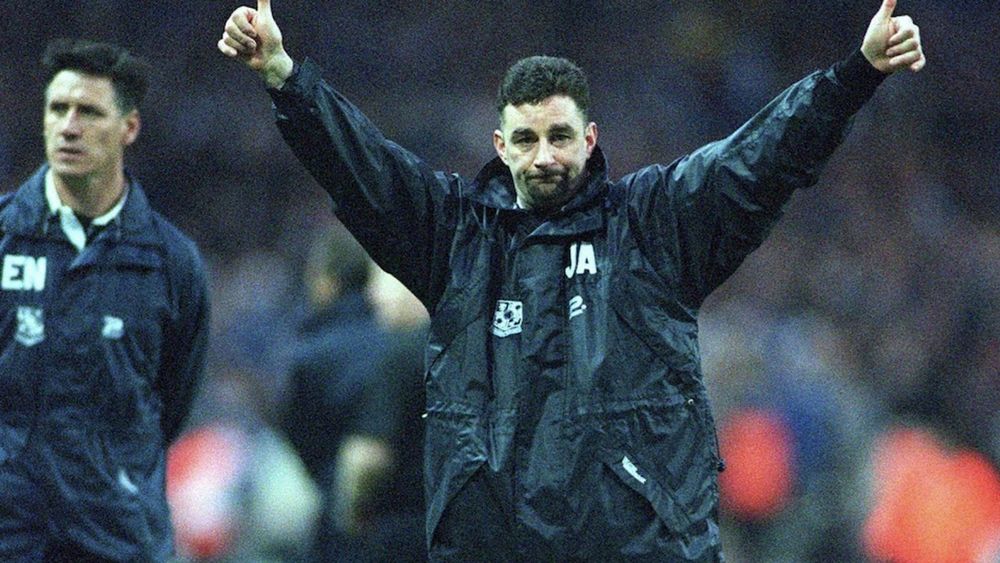
John Aldridge was there. So were Pat Nevin, Gary Stevens and Shaun Teale. Later came Paul Cook, while Liam O'Brien brought international experience from the Republic of Ireland and a career that had already taken him from Shamrock Rovers to Manchester United and Newcastle United.
It was a team capable of playing football that O'Brien still remembers with enormous affection.
It was also a team that came agonisingly close to the Premier League — and never quite made it.
“We were very unlucky,” O'Brien recalled to Football Presse. “We got into three play-off semi-finals to get into the Premier League. We couldn't get beaten in the three of them, but we just didn't have the luck.”
Tranmere reached the play-off semi-finals in three successive seasons, although O'Brien was not there for the first campaign and was involved in the final two. His memories of those years give a first-hand account of a team that repeatedly came within touching distance of the top flight.
And the players around him made it a remarkable dressing room.
“We had Pat Nevin, who played for Scotland. We had Gary Stevens, who played for England. We had John Aldridge, obviously, and myself.
“We had some other great players as well. Ged Brannan was a good player. John Morrissey played on the right. We had Kenny Irons and Paul Cook came eventually. Shaun Teale came from Villa.
“So, you know, we had some really good players.”
There was also something distinctive about Tranmere itself.
The club had developed a reputation for producing young players, and O'Brien remembers an environment in which established professionals and emerging talent were brought together.
“It was a great conveyor belt. They had a good youth system there, so it was a good conveyor belt of bringing youth players through over the years.
“And that's what Tranmere was then. It's unfortunate where they are now. But back in the day, in the 90s, it was very good. It was a good club to go to. I enjoyed my time down there.”
The frustration was that the team had enough quality to believe it belonged in the fight for promotion.
What it lacked, O'Brien believes, was the ability to finish off opponents when the opportunity presented itself.
“As I said to you, we just didn't have it. We played really well in the games, we just couldn't kill teams.”
The most painful example came against Leicester City.
Tranmere had home advantage in the first leg at Prenton Park and, according to O'Brien, dominated the contest. Yet when the final whistle came, the score was still 0-0.
“In the first game against Leicester, if you ever watch it, if you get a chance to ever see it, we hammered them at Prenton and we finished nil-all in the first leg.”
It was the kind of match that can define a season.
Tranmere had created the chances, played well and established themselves as the better side on the night. But they had not scored.
The return at Leicester's old Filbert Street ground became another painful lesson in the fine margins of the play-offs.
“We went to Filbert Street, where they were playing at the time, and they beat us 2-1. We got back to 1-0. And they got a goal in injury time.”
For O'Brien, the memory has never really faded.
“And the first game, that goalkeeper made save after save. I'll never forget it. It was just unbelievable that day.
“We just couldn't score.”
That was the story of that Tranmere side: good enough to compete, good enough to dominate matches, good enough to make people believe, but never quite able to take the final step.
O'Brien remembers the football as much as the disappointment.
“It was a great team to play in. I really enjoyed it because it was a good footballing team.”
There was a sense around the club that something special was possible. Tranmere were not simply trying to survive in the second tier. They had ambitions of joining the elite.
But the economics of football eventually caught up with them.
O'Brien believes the club's inability to retain its best players was a major reason why the team could not sustain its challenge.
“I think it was financial problems,” he says.
“Any good player that came through the system, they had to sell them. So I don't think that helped.”
That makes the story of O'Brien's Tranmere years more than a nostalgic recollection of a good team from the 1990s.
It is a story about how close a club outside the Premier League could come to breaking through — and how difficult it was to maintain that momentum without the financial power to keep a successful side together.
O'Brien had already experienced the transformation of Manchester United under Sir Alex Ferguson and the extraordinary rise of Newcastle United under Kevin Keegan. At Tranmere, he encountered something different: a club that could assemble a side good enough to dream, but not necessarily one capable of holding on to it.
And yet, decades later, he does not sound bitter.
He remembers the players, the football and the feeling around Prenton Park.
“We had really good players,” he says.
“It was a great team to play in.”
For Tranmere, the Premier League remained just out of reach.
For O'Brien, though, those years remain part of a career that gave him something rather more difficult to measure: the memory of being part of a team that, for a time, genuinely looked capable of getting there.